How Is Hydrogen Produced
How Is Hydrogen Produced
Hydrogen is the most abundant element in the universe, yet it rarely exists in its pure gaseous form on Earth. As the global industrial sector shifts toward decarbonization, understanding how is hydrogen produced has become a priority for process engineers, plant managers, and energy stakeholders. Hydrogen serves as a critical feedstock for ammonia production, petroleum refining, and increasingly, as a clean energy carrier.
In industrial settings, the production of hydrogen involves complex chemical and thermal processes that require precise monitoring of temperature, pressure, and fluid levels. This guide explores the primary methods of hydrogen generation and the essential role of level measurement instrumentation in ensuring process safety and efficiency.
Primary Methods of Hydrogen Production
To understand how is hydrogen produced, one must look at the various energy sources and chemical pathways used to extract it from compounds like water and hydrocarbons. Currently, the majority of global hydrogen is derived from fossil fuels, though water electrolysis is rapidly gaining market share due to its potential for zero-emission "green" hydrogen.
1. Steam Methane Reforming (SMR)
Steam Methane Reforming is the most common method for industrial-scale hydrogen production. It accounts for nearly 95% of the hydrogen produced in the United States. The process involves reacting methane ($CH_4$) with high-temperature steam (700°C to 1,000°C / 1,292°F to 1,832°F) under a pressure of 0.3–2.5 MPa (43–362 PSI) in the presence of a catalyst.
The Process Steps:
* Reforming: Methane and steam react to produce carbon monoxide and hydrogen.
* Water-Gas Shift Reaction: The carbon monoxide is reacted with more steam to produce additional hydrogen and carbon dioxide.
* Purification: Pressure Swing Adsorption (PSA) is typically used to remove $CO_2$ and other impurities, leaving pure hydrogen gas.
2. Water Electrolysis
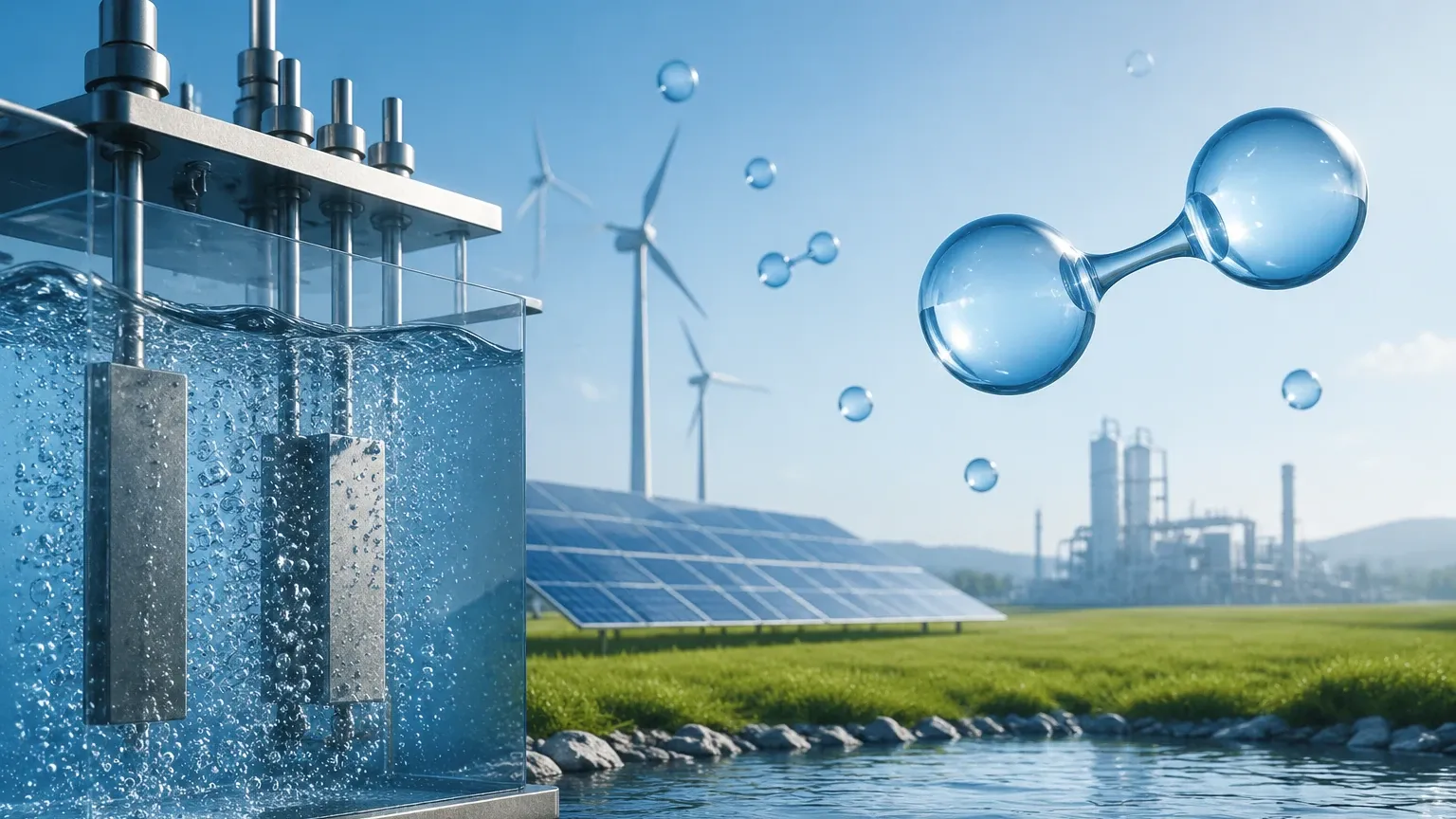
Electrolysis is the process of using electricity to split water ($H_2O$) into hydrogen and oxygen. If the electricity comes from renewable sources like wind or solar, the resulting hydrogen is classified as "green."
* Alkaline Electrolysis: Uses a liquid alkaline solution (typically potassium hydroxide, KOH) as the electrolyte. This is a mature technology used for large-scale production.
* Proton Exchange Membrane (PEM) Electrolysis: Uses a solid polymer electrolyte. PEM electrolyzers are more compact and can respond quickly to the fluctuations of renewable energy inputs.
3. Coal Gasification
In coal gasification, coal is reacted with oxygen and steam under high pressure and temperature to form syngas (a mixture of hydrogen, carbon monoxide, and carbon dioxide). Like SMR, the carbon monoxide then undergoes a shift reaction to produce more hydrogen.
4. Partial Oxidation
This method involves reacting a fuel (such as heavy fuel oil or natural gas) with a limited amount of oxygen that is not sufficient to completely oxidize the fuel to carbon dioxide and water. This produces a hydrogen-rich syngas.
Comparison of Hydrogen Production Technologies
| Method | Feedstock | Primary Energy Source | Maturity | Environmental Impact |
| :— | :— | :— | :— | :— |
| SMR | Natural Gas | Thermal (Gas) | High | High $CO_2$ (unless CCS used) |
| Electrolysis | Water | Electricity | Moderate/High | Low (if renewable) |
| Gasification | Coal/Biomass | Thermal | High | Very High $CO_2$ |
| Partial Oxidation | Hydrocarbons | Thermal | High | High $CO_2$ |
The Role of Level Measurement in Hydrogen Production
Regardless of how is hydrogen produced, liquid management is a fundamental requirement. Whether it is managing the water supply for an electrolyzer or separating condensates in a reforming plant, accurate level measurement is vital for automation and safety.
Measurement Principles and Technologies
Before selecting an instrument, it is essential to understand the physics behind the measurement. In hydrogen production environments, instruments must often handle high pressures, cryogenic temperatures (for storage), or corrosive electrolytes.
Radar Level Measurement
Radar level meters operate on the Time-of-Flight (ToF) principle. The device emits a high-frequency electromagnetic wave (usually in the GHz range) that travels to the liquid surface and reflects back to the sensor.
* Non-Contact Radar: Ideal for corrosive fluids like the KOH used in alkaline electrolysis because the sensor does not touch the liquid. It is highly accurate and unaffected by pressure or vacuum.
* Guided Wave Radar (GWR): Uses a physical probe to guide the signal. This is particularly effective in high-pressure separators where steam or turbulence might interfere with a non-contact signal.
Ultrasonic Level Measurement
Ultrasonic sensors emit sound waves that reflect off the liquid surface. While cost-effective for atmospheric water tanks, they are generally not used in high-pressure hydrogen reactors because the speed of sound changes significantly with gas density and composition.
Hydrostatic Pressure Measurement
This principle measures the pressure exerted by a liquid column ($P = \rho gh$). In hydrogen production, hydrostatic transmitters are often used in feed-water tanks. However, they require accurate knowledge of the liquid's density, which can change with temperature.
Magnetic Level Gauges (MLG)
MLGs use a float containing a magnet that moves with the liquid level inside a bypass chamber. Outside the chamber, magnetic flags or a transmitter track the float's position. This provides a clear visual indication and a remote signal, making it a favorite for high-pressure vessels where a direct sight glass would be a safety risk.
Instrumentation Selection for Hydrogen Production
Choosing the right level meter depends on the specific stage of the production cycle. For a comprehensive overview of available technologies, engineers often consult the Main Page of specialized manufacturers to compare technical specifications.
| Application | Recommended Technology | Why? |
| :— | :— | :— |
| Electrolyzer Water Tank | Ultrasonic or Radar | Non-contact, handles high-purity water without contamination. |
| SMR Condensate Separator | Guided Wave Radar | Handles high temperature and pressure with high reliability. |
| KOH Storage (Alkaline) | Non-contact Radar | Resists corrosion from the strong alkaline solution. |
| Buffer Tanks | Hydrostatic Transmitter | Simple, reliable for constant-density liquids. |
| High-Pressure Storage | Magnetic Level Gauge | Provides mechanical redundancy and high-pressure safety. |
Installation and Safety Considerations
Hydrogen production involves unique hazards that dictate strict installation guidelines for level instrumentation:
1. Hazardous Area Ratings: Hydrogen is highly flammable (Group IIC). All electronic instruments must have ATEX, IECEx, or equivalent explosion-proof or intrinsically safe certifications.
2. Hydrogen Embrittlement: Hydrogen atoms can diffuse into metal lattices, making them brittle. Wetted parts (probes, diaphragms) should be made from compatible materials like 316L Stainless Steel or specialized alloys like Hastelloy C276.
3. Sealing and Permeation: Hydrogen is the smallest molecule and can permeate through many materials. Dual-seal designs are often required to prevent gas from migrating through the instrument housing into the electronics or the atmosphere.
4. Dielectric Constant: Hydrogen gas has a very low dielectric constant ($\epsilon_r \approx 1.0$). While radar can measure the *liquid* level in a tank, the gas phase's composition can affect the signal's travel time in high-pressure applications, requiring compensation techniques.
Limitations and Challenges
While modern instrumentation is highly advanced, there are inherent limitations to consider:
* Foaming: In some electrolysis processes, foaming can occur at the liquid surface, which may absorb ultrasonic or radar signals. GWR or mechanical float-based systems are often more robust in these scenarios.
* Extreme Temperatures: Cryogenic hydrogen storage (-253°C / -423°F) requires specialized vacuum-jacketed level probes, as standard electronics and seals will fail at these temperatures.
* Vibration: In plants with large compressors, vibration can affect the mechanical integrity of top-mounted sensors. Secure mounting and dampening are required.
Frequently Asked Questions (FAQs)
Q: Why is non-contact radar preferred over ultrasonic for hydrogen applications?
A: Ultrasonic waves rely on the gas medium to travel. In hydrogen production, the gas composition and pressure often change, which alters the speed of sound and causes significant errors. Radar uses electromagnetic waves, which are far more stable in varying gas environments.
Q: Can a standard level switch be used for overfill protection in hydrogen tanks?
A: Yes, but it must be rated for hazardous areas (Ex d or Ex i) and the materials must be compatible with hydrogen to prevent embrittlement. Tuning fork switches are commonly used for high-level alarms.
Q: How does pressure affect level measurement in an SMR reactor?
A: High pressure increases the density of the gas phase. For radar measurement, this can slightly slow down the signal (the "gas phase effect"). High-end radar meters include software algorithms to compensate for this if the pressure is known.
Q: Is it necessary to measure the level of liquid hydrogen?
A: Yes, for transport and storage. However, liquid hydrogen measurement is much more difficult than measuring the water or feedstock used in production. It typically requires capacitance probes or specialized differential pressure transmitters designed for cryogenic service.
Conclusion
Determining how is hydrogen produced is only the first step in designing a functional industrial plant. The success of the process—whether it is SMR, electrolysis, or gasification—depends on the ability to monitor and control the movement of fluids under challenging conditions. By selecting the appropriate radar, ultrasonic, or magnetic level measurement technology, operators can ensure that hydrogen production remains safe, efficient, and scalable.
For engineers seeking specific product configurations, mounting accessories, or custom OEM solutions for level measurement, visiting the Main Page provides access to a wide range of industrial-grade instruments designed for the rigors of modern chemical and energy processing.