How Much Water Should Be in My Brine Tank
How Much Water Should Be in My Brine Tank
In industrial water treatment and process automation, the brine tank serves as a critical reservoir for the regeneration of ion-exchange resins. Maintaining the correct liquid level is not merely a matter of routine maintenance; it is a fundamental requirement for ensuring chemical consistency and system longevity. Determining exactly how much water should be in my brine tank depends on the specific design of the softening system—whether it is a "wet" or "dry" brine tank—and the volumetric requirements of the regeneration cycle.
For engineers and facility managers, monitoring these levels accurately prevents issues such as "salt bridging," incomplete regeneration, or brine tank overflow. This guide examines the principles of level measurement in brine applications, provides technical benchmarks for water levels, and offers a framework for selecting the appropriate instrumentation from the Main Page of industrial measurement solutions.
Measurement Principles for Brine Level Monitoring
Before determining the ideal water volume, it is essential to understand the physics of how these levels are measured. Brine is a highly corrosive, saturated salt solution, which presents unique challenges for instrumentation.
Ultrasonic Level Measurement
Ultrasonic sensors operate on the Time-of-Flight (ToF) principle. The sensor emits an acoustic pulse that reflects off the surface of the liquid and returns to the transducer. Because brine tanks are often open or vented to the atmosphere, ultrasonic sensors provide a reliable non-contact solution. However, users must account for the speed of sound variations if there are significant temperature fluctuations within the facility.
Radar Level Measurement
Non-contact radar (typically 26GHz or 80GHz) is the gold standard for industrial brine monitoring. Radar waves are unaffected by vapor, dust, or temperature shifts. In a brine tank, radar can accurately track the liquid level even as salt crystals accumulate on the tank walls. High-frequency radar is particularly effective in narrow brine wells or tanks with internal obstructions.
Hydrostatic Pressure
This method measures the pressure exerted by the liquid column. Since the density of brine (approximately 1.2 g/cm³) is higher than that of pure water (1.0 g/cm³), hydrostatic transmitters must be calibrated for the specific gravity of the saturated solution to provide an accurate level reading in millimeters or centimeters.
Determining the Correct Level: Wet vs. Dry Brine Tanks
The answer to "how much water should be in my brine tank" varies significantly based on the control logic of the water softener.
1. Wet Brine Tanks
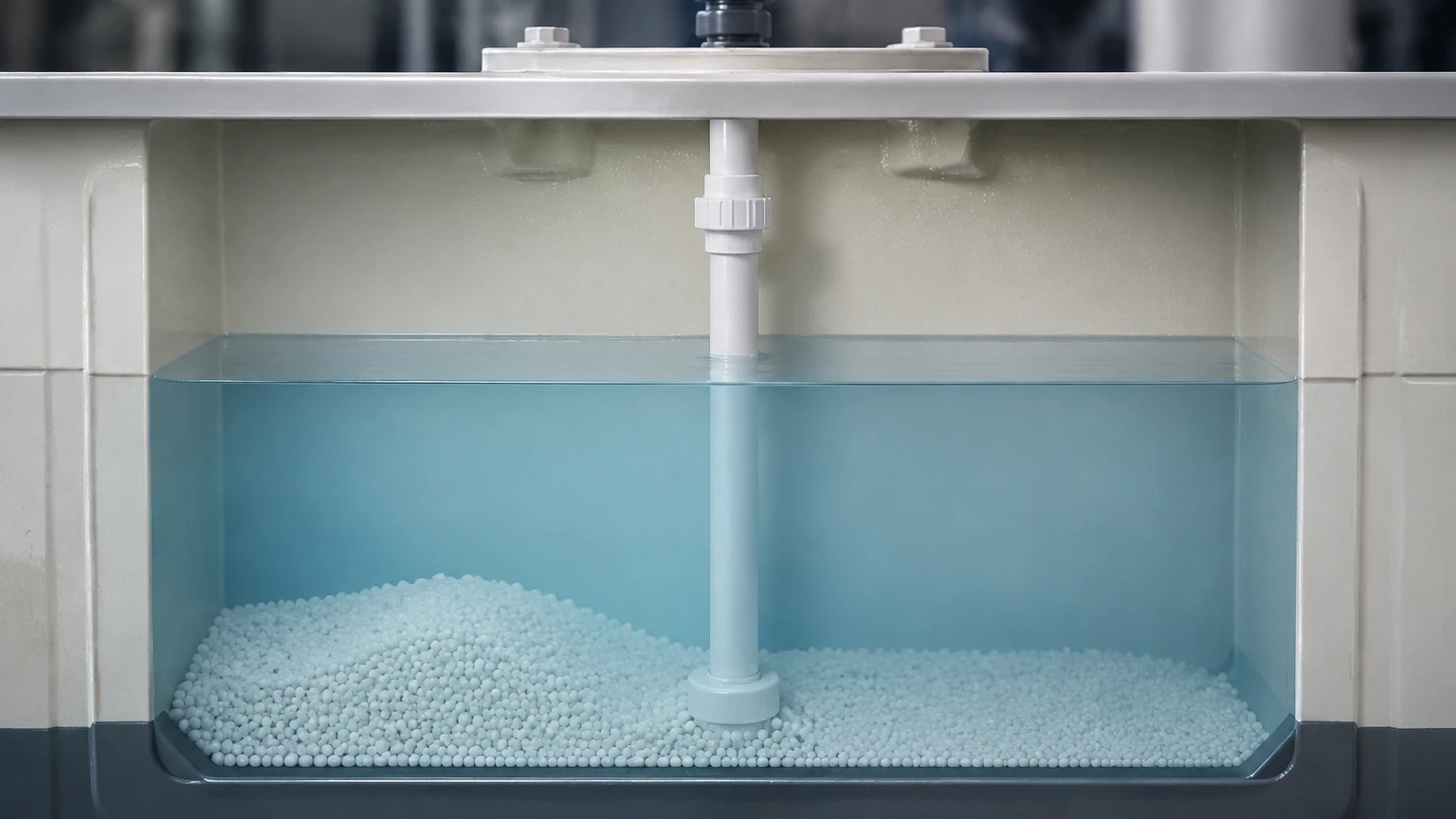
In a "wet" brine tank system, water is present in the tank throughout the entire service cycle. The water is constantly dissolving salt to ensure a saturated brine solution is ready for the next regeneration.
* Standard Level: Typically, the water level should be approximately 15 cm to 30 cm (6 to 12 inches) deep.
* Salt Relationship: The water level should generally stay below the top of the salt. If water covers the salt entirely, it can lead to "mushing," where the salt recrystallizes into a thick paste that prevents the brine valve from drawing solution.
2. Dry Brine Tanks
Dry brine tanks are common in modern, high-efficiency industrial softeners. In these systems, the tank remains dry between regeneration cycles. Water is only added to the tank about 1-2 hours before the regeneration process begins.
* Standard Level: During the fill cycle, the system will add a predetermined volume of water based on the resin capacity. Once the regeneration is complete, the tank should be nearly empty, with only a few centimeters of water remaining at the very bottom (below the salt grid).
Technical Selection Table for Brine Level Sensors
When selecting instrumentation to monitor how much water should be in my brine tank, consider the following technical parameters:
| Sensor Type | Accuracy | Corrosion Resistance | Ideal Application |
| :— | :— | :— | :— |
| Ultrasonic | ±0.25% of Range | High (Plastic Housing) | Standard atmospheric brine tanks |
| Radar (80GHz) | ±2 mm | Excellent (PTFE Flange) | Narrow tanks with internal piping |
| Hydrostatic | ±0.5% of Span | Moderate (Requires 316L/Hastelloy) | Constant density, deep brine pits |
| Magnetic Gauge | Visual | High | High-pressure chemical brine processes |
Factors Influencing Water Volume Requirements
Several operational variables dictate the specific volume of water required for an efficient brine solution.
Salt Dosage and Resin Capacity
The primary factor is the amount of salt required to regenerate the resin beads. For every 1 liter of water, approximately 360 grams of salt can be dissolved at room temperature (20°C). If your system requires 20 kg of salt for a regeneration cycle, the level control system must ensure at least 55-60 liters of water are present to achieve full saturation.
The Salt Grid (Brine Plate)
Many industrial tanks utilize a salt grid—a perforated platform at the bottom of the tank. The grid creates a chamber for the water to sit without being immediately displaced by the weight of the salt. In these configurations, the water level should ideally be 2 cm to 5 cm (1 to 2 inches) above the grid to ensure the salt is in contact with the water, but not submerged so deeply that it causes bridging.
Temperature Effects
While the solubility of salt is relatively stable, extreme cold can slow the dissolution process. In unheated industrial environments, a higher water level may be maintained to provide a larger buffer of saturated brine, ensuring the system does not draw "weak" brine during a rapid regeneration sequence.
Installation Considerations for Level Transmitters
To accurately answer "how much water should be in my brine tank" via automation, the installation of the level sensor must be precise.
1. Dead Zone Management: Every ultrasonic and radar sensor has a "dead zone" (blocking distance) near the transducer face. Ensure the sensor is mounted high enough that the maximum water level never enters this zone.
2. Stilling Wells: In tanks with high turbulence or where salt is dumped manually, installing the sensor inside a PVC stilling well can prevent surface ripples from affecting the reading.
3. Chemical Compatibility: Brine is highly corrosive. Ensure all wetted parts of the sensor (diaphragms, flanges, or probes) are made from PVC, PP, or PTFE. Welk provides a range of specialized materials for these environments, which can be reviewed on the Main Page.
4. Avoid Salt Bridges: If the sensor is monitoring the salt level rather than the water level, ensure it is positioned away from the tank walls where salt is most likely to cling and form a bridge.
Troubleshooting Common Level Discrepancies
If you find that the water level in your brine tank is inconsistent with the guidelines above, it usually indicates a mechanical or hydraulic failure.
Too Much Water (Overflowing or High Level)
* Leaking Brine Valve: If the intake valve does not close completely, water will continue to trickle into the tank.
* Clogged Injector: If the softener's injector (venturi) is clogged, it cannot create the vacuum necessary to draw the brine out of the tank during regeneration, causing the water level to rise over time.
* Incorrect Float Setting: In systems using mechanical floats, the stop-collar may have slipped, allowing too much water to enter during the fill cycle.
Too Little Water (Low Level)
* Plugged Fill Line: Sediment or salt crystals can block the small-diameter tubing used for the brine fill cycle.
* Low Feed Pressure: If the incoming water pressure is too low, the timed fill cycle may end before the required volume is reached.
* Air Leaks: An air leak in the brine line can prevent the system from drawing water properly, leading to an empty tank and hard water bypass.
Frequently Asked Questions (FAQ)
Q: Should there be standing water in my brine tank?
A: Yes, in a wet brine tank system, there should always be 15-30 cm of water. In a dry system, there should only be water during and shortly before the regeneration cycle.
Q: How do I know if my water level is too high?
A: If the water level is consistently above the salt level, or if the safety float is frequently engaged, your water level is too high. This often results in "salty" tasting water or inefficient softening.
Q: Can I use a radar meter to measure both salt and water?
A: While some advanced radar meters can detect the interface between different materials, most industrial applications use one sensor for liquid level and a separate limit switch or ultrasonic sensor to monitor salt solids levels.
Q: Does the type of salt affect the water level?
A: The type of salt (pellets, solar, or rock) affects the dissolution rate and the likelihood of bridging, but the target water level remains the same based on the system's volumetric design.
Conclusion
Maintaining the correct volume of water in a brine tank is a balance of chemistry and engineering. By understanding the specific requirements of your softening system—whether it requires a constant "wet" level or a cyclic "dry" fill—and by employing robust measurement technologies like those found at Welk, operators can ensure peak performance. Accurate level monitoring not only protects the resin bed but also optimizes salt consumption and prevents costly downtime in industrial water treatment workflows.