Pond Water Level Control
Pond Water Level Control
Effective pond water level control is a critical requirement across various industrial, agricultural, and municipal sectors. Whether managing a cooling pond for a power plant, a wastewater treatment lagoon, or an agricultural reservoir, maintaining a precise water level ensures operational safety, environmental compliance, and resource efficiency. Inconsistent level management can lead to pump cavitation, structural damage to embankments, or the discharge of untreated fluids into the surrounding environment.
Automated pond water level control systems rely on accurate sensing technologies to provide real-time data to controllers, which then actuate pumps or valves. Selecting the appropriate measurement technology requires a deep understanding of the physical principles behind the sensors and the specific environmental challenges posed by open-air pond environments.
Measurement Principles for Pond Level Sensing
Before selecting a system for pond water level control, it is essential to understand the underlying measurement principles of the most common industrial sensors. Each technology interacts differently with the liquid surface and the surrounding atmosphere.
Ultrasonic Level Measurement (Non-Contact)
Ultrasonic sensors operate on the Time-of-Flight (ToF) principle. The sensor, mounted above the water surface, emits a high-frequency sound pulse. This pulse travels through the air, reflects off the water surface, and returns to the transducer. By measuring the time taken for the pulse to return and knowing the speed of sound in air, the device calculates the distance to the water surface.
* Advantages: Non-contact nature prevents corrosion and fouling from the liquid.
* Limitations: The speed of sound is affected by air temperature. While most modern sensors include temperature compensation, extreme fluctuations or heavy wind can disperse the sound waves, leading to signal loss.
Radar Level Measurement (Non-Contact)
Radar sensors also use the ToF principle but utilize electromagnetic waves (typically in the microwave frequency range) instead of sound. These waves travel at the speed of light and reflect off the water surface due to the change in dielectric constant between air and water.
* Advantages: Radar is unaffected by air temperature, pressure, wind, or vapor. It provides the highest accuracy and reliability in outdoor pond environments where atmospheric conditions are unpredictable.
* Limitations: Higher initial capital expenditure compared to ultrasonic or hydrostatic options.
Hydrostatic Level Measurement (Contact)
Hydrostatic transmitters are submersible sensors that measure the pressure exerted by the liquid column above them. The principle is based on the formula: *P = ρgh*, where *P* is pressure, *ρ* is the liquid density, *g* is gravity, and *h* is the height of the liquid. The sensor typically uses a vented cable to compensate for changes in atmospheric pressure.
* Advantages: Simple to install in deep ponds and unaffected by surface foam or turbulence.
* Limitations: The sensor is in constant contact with the liquid, making it susceptible to fouling, silt buildup, or chemical attack in aggressive wastewater.
Comparative Analysis of Technologies for Pond Applications
Choosing the right instrument for pond water level control involves balancing accuracy requirements, environmental factors, and maintenance capabilities. The following table provides a comparison of the primary technologies used in industrial pond management.
| Feature | Ultrasonic Sensors | Radar Level Meters | Hydrostatic Transmitters |
| :— | :— | :— | :— |
| Measurement Type | Non-contact | Non-contact | Contact (Submerged) |
| Accuracy | ±0.25% of range | ±2mm to ±5mm | ±0.1% to ±0.5% of span |
| Weather Resistance | Moderate (Wind/Temp sensitive) | Excellent | High (Submerged) |
| Surface Foam Impact | High (Absorbs signal) | Moderate | None |
| Maintenance Level | Low | Very Low | Moderate (Cleaning required) |
| Typical Range | 0.5m to 15m | 0.5m to 30m+ | 1m to 200m |
For comprehensive technical specifications and to explore specific instrument models, engineers can Review product options and application support to find the best fit for their project requirements.
Installation Considerations for Pond Environments
Proper installation is as important as technology selection for ensuring the longevity and accuracy of a pond water level control system. Open-air ponds present unique challenges that are not typically found in enclosed tanks.
1. Stilling Wells and Wave Dampening
Wind-induced waves and surface turbulence can cause "chatter" in level readings. For non-contact sensors (ultrasonic and radar), installing the sensor inside a stilling well—a vertical pipe with small inlet holes at the bottom—can provide a calm surface for measurement. For hydrostatic sensors, a stilling well protects the unit from physical debris and reduces the impact of rapid flow changes.
2. Mounting and Positioning
Sensors should be mounted away from inlet pipes where falling water can create localized turbulence or air bubbles. For non-contact sensors, the "dead zone" or "blanking distance" must be considered; the sensor must be mounted high enough that the maximum expected water level does not enter this zone, which would result in false readings.
3. Environmental Protection
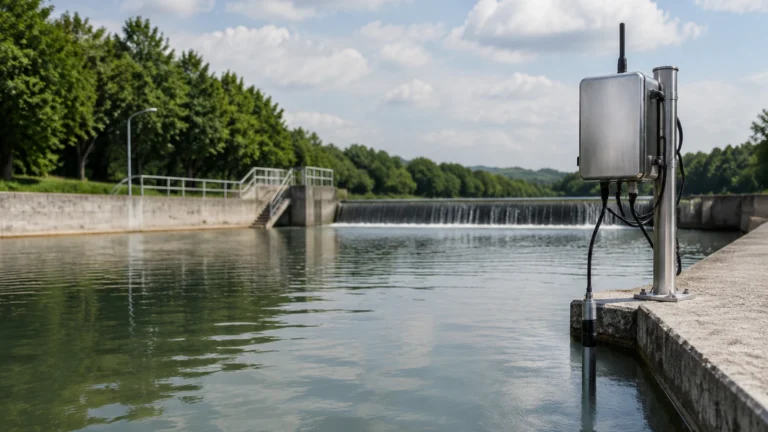
In outdoor pond water level control applications, lightning protection and surge suppression are critical. Sensors should be properly grounded. Additionally, in regions prone to freezing, hydrostatic sensors must be positioned below the ice line, and non-contact sensors must be protected from frost buildup on the transducer face.
Common Risks and Limitations in Pond Level Control
While automation significantly improves efficiency, several risks can compromise the integrity of a pond water level control system. Understanding these limitations allows for the implementation of redundant safety measures.
* Silt and Sedimentation: In many ponds, especially those used for runoff or industrial settling, silt can accumulate at the bottom. This can bury hydrostatic sensors or change the effective bottom of the pond, leading to inaccurate volume calculations.
* Biological Growth: Algae and barnacles can grow on submerged sensors. In ultrasonic sensors, spiders or insects may spin webs across the transducer face, obstructing the signal. Regular inspection intervals are necessary to mitigate these risks.
* Power and Signal Loss: Remote ponds may rely on solar power or long-distance signal transmission (e.g., 4-20mA or RS485). Voltage drops over long cable runs or insufficient battery capacity during winter months can lead to system failure. Integrating low-power wireless LoRaWAN or NB-IoT solutions can often resolve these connectivity issues.
Integration with Control Systems
A sensor alone does not constitute pond water level control; it must be integrated into a wider control loop. Typically, the level transmitter sends a signal to a Programmable Logic Controller (PLC) or a dedicated level controller.
1. On/Off Control: The simplest form of control where a pump starts at a high-level setpoint and stops at a low-level setpoint. This is common in drainage ponds.
2. Proportional Control (PID): Used in processes where a constant level must be maintained despite fluctuating inflows, such as in chemical process ponds. The controller adjusts a Variable Frequency Drive (VFD) on a pump or modulates a control valve to match the outflow with the inflow.
3. Alarming: Independent high-high and low-low level switches should be used as redundant safety backups to the primary continuous level transmitter. These switches can trigger emergency shutdowns or sirens if the primary control loop fails.
Frequently Asked Questions (FAQ)
Q: Can I use an ultrasonic sensor if my pond has heavy foam?
A: Generally, no. Foam absorbs ultrasonic sound waves, leading to erratic readings or a complete loss of signal. Radar or hydrostatic transmitters are much more effective in foamy conditions.
Q: How do I prevent my hydrostatic sensor from being damaged by ice?
A: The sensor should be installed in a location where the water does not freeze solid. Often, this involves placing the sensor in a deeper section of the pond or using a stilling well that extends below the frost line. If the entire pond freezes, the sensor should be removed for the season or protected by an aeration system.
Q: What is the maximum distance a sensor can be from the control panel?
A: For a standard 4-20mA analog signal, distances up to 1,000 meters are possible with high-quality shielded cabling. For longer distances, digital protocols or wireless transmission technologies are recommended to maintain signal integrity.
Q: Is radar always better than ultrasonic for pond water level control?
A: While radar is more robust against environmental factors like wind and temperature, ultrasonic sensors are often more cost-effective for smaller, less critical ponds where extreme precision is not required and the environment is relatively stable.
By carefully evaluating the physical properties of the pond and the specific requirements of the application, engineers can design a robust pond water level control system that provides reliable service for years. For more information on selecting the right hardware for industrial level measurement, visit the Main Page for detailed technical resources and product support.