Fuel Level Monitor
Fuel Level Monitor
In industrial operations, fuel is more than just a commodity; it is a critical resource that powers generators, fleets, and heating systems. Effective management of this resource requires a robust fuel level monitor system to ensure operational continuity, prevent fuel theft, and optimize procurement cycles. For engineers and facility managers, selecting the right monitoring technology involves understanding the physical properties of the fuel, the geometry of the storage vessel, and the environmental conditions of the site.
Industrial fuel storage typically involves diesel, gasoline, kerosene, or heavy fuel oils (HFO). Each of these liquids presents unique challenges, such as volatility, temperature-dependent density changes, and varying dielectric constants. This guide provides a technical overview of the primary measurement principles used in fuel level monitoring and offers practical advice for selection and installation.
Core Measurement Principles for Fuel Level Monitoring
Before selecting a fuel level monitor, it is essential to understand how different sensors perceive the liquid level. Most industrial applications rely on one of four primary technologies: hydrostatic pressure, radar, ultrasonic, and magnetic displacement.
Hydrostatic Pressure Measurement
Hydrostatic level transmitters measure the pressure exerted by the liquid column above the sensor. The principle is based on the formula: $P = \rho \cdot g \cdot h$, where $P$ is pressure, $\rho$ is the density of the fuel, $g$ is gravity, and $h$ is the height of the liquid.
In fuel applications, these sensors are often submersible or mounted at the bottom of the tank. Because fuels like diesel have a lower density than water (typically around 0.832 to 0.850 kg/L), the sensor must be calibrated to the specific gravity of the fuel to ensure accuracy. If the fuel temperature fluctuates significantly, the density will change, which can introduce errors in hydrostatic systems unless temperature compensation is integrated.
Radar (Non-Contact) Technology
Radar level meters use Time-of-Flight (ToF) technology. The sensor emits a high-frequency microwave signal (often 26 GHz or 80 GHz) that reflects off the fuel surface and returns to the receiver. The distance is calculated based on the time taken for the signal to travel.
Radar is highly preferred for volatile fuels because the signal is unaffected by vapors, pressure, or temperature changes in the tank headspace. However, the dielectric constant ($ε_r$) of the fuel is a factor. Most hydrocarbon fuels have low dielectric constants (typically between 1.9 and 2.1), which results in weaker signal reflections compared to water. Modern high-frequency radar sensors from manufacturers like Welk are designed with high sensitivity to track these low-reflection surfaces reliably.
Ultrasonic Measurement
Similar to radar, ultrasonic sensors use ToF but rely on sound waves rather than microwaves. These are cost-effective solutions for atmospheric tanks. However, they have limitations in fuel monitoring. The speed of sound is affected by the composition of the air/vapor mixture in the tank. In heavy vapor environments, such as gasoline storage, the accuracy of ultrasonic sensors can degrade significantly. They are best suited for stable diesel storage where vapor concentrations remain low.
Magnetic Level Gauges
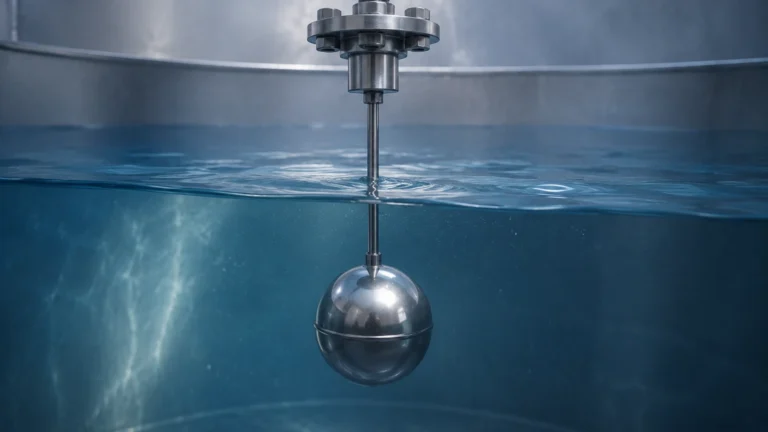
Magnetic gauges involve a float containing a magnet that moves with the fuel level inside a bypass chamber or directly in the tank. This movement interacts with an external indicator or a reed-switch transmitter. This is a mechanical-electrical hybrid approach that provides both a visual local reading and a remote signal. It is particularly useful for high-pressure fuel systems or where a visual backup is required for safety protocols.
Selection Criteria for Fuel Level Monitors
Choosing the appropriate fuel level monitor requires a systematic evaluation of the application's specific constraints. Engineers should prioritize the following factors:
1. Fuel Type and Volatility: Highly volatile fuels like gasoline require non-contact radar or explosion-proof (Ex-rated) sensors. For stable fuels like heavy fuel oil (HFO), which may be viscous, non-contact methods are preferred to avoid clogging or coating of the sensor.
2. Tank Geometry: Tall, narrow tanks may require guided wave radar (GWR) to ensure the signal follows a probe, whereas wide, open tanks are ideal for standard non-contact radar.
3. Accuracy Requirements: For inventory management and custody transfer, high-precision radar (accuracy of ±1 mm to ±3 mm) is necessary. For basic low-level alarms in generator day tanks, hydrostatic or ultrasonic sensors are often sufficient.
4. Environmental Conditions: Outdoor tanks in extreme climates require sensors with high IP ratings (IP67/IP68) and integrated temperature compensation. If the tank is pressurized, hydrostatic sensors must be of the differential pressure type to account for the headspace pressure.
Comparative Selection Table
The following table compares the most common technologies used in industrial fuel monitoring to assist in the initial screening process.
| Technology | Accuracy | Suitability for Volatile Fuel | Maintenance Needs | Typical Application |
| :— | :— | :— | :— | :— |
| Radar (Non-contact) | High (±2mm) | Excellent | Low | Bulk storage, refinery tanks |
| Hydrostatic | Medium (±0.5% FS) | Moderate | Moderate (cleaning) | Vented diesel tanks, underground tanks |
| Ultrasonic | Medium (±0.25% FS) | Low | Low | Small diesel day tanks, water-fuel separators |
| Magnetic Gauge | Medium (±5mm) | Good | Moderate | High-pressure boiler fuel feed |
| Guided Wave Radar | High (±2mm) | Excellent | Low | Small tanks with internal obstructions |
Installation Best Practices and Considerations
Proper installation is as critical as sensor selection. Even the most advanced fuel level monitor will fail to provide accurate data if poorly positioned.
Avoiding Obstructions
For radar and ultrasonic sensors, the "beam angle" must be considered. The sensor should be mounted away from the tank walls and internal structures like ladders, heating coils, or agitators. Reflections from these objects can create "ghost echoes" that the sensor might mistake for the fuel level. Modern software can often "map out" these obstructions, but physical clearance is always the best practice.
Dead Zones (Blocking Distance)
Every non-contact sensor has a "dead zone" or blocking distance directly beneath the sensor face where measurements cannot be taken. If a tank is frequently filled to the brim, the sensor must be mounted on a nozzle or standpipe to elevate it, ensuring the maximum fuel level remains outside the dead zone.
Stilling Wells
In tanks where turbulence is common—such as those with high-velocity return lines from engines—a stilling well (a vertical pipe with vent holes) should be used. This provides a calm surface for the sensor to measure, preventing erratic readings caused by surface ripples or foam.
Grounding and Safety
Since fuels are flammable, all electronic monitoring equipment must be properly grounded to prevent static discharge. In many jurisdictions, sensors installed in fuel tanks must be intrinsically safe (IS) or explosion-proof, adhering to ATEX or IECEx standards. For more detailed technical specifications on certified equipment, you can Main Page to review product options and application support.
Operational Challenges and Limitations
While modern technology has simplified fuel monitoring, several physical factors can still limit performance:
* Foaming: During high-speed filling, some fuels (especially diesel) can foam. Ultrasonic sensors often struggle with foam as it absorbs the sound waves. Radar is more resilient but may still experience signal attenuation if the foam is exceptionally thick and dense.
* Paraffin Precipitation: In cold climates, diesel fuel can develop paraffin wax crystals (clouding). These crystals can coat submersible hydrostatic sensors or mechanical floats, leading to sluggish response or total failure. In these environments, non-contact radar is the superior choice.
* Tank Bottom Sludge: Over time, fuel tanks accumulate a layer of water and sediment (sludge) at the bottom. Hydrostatic sensors mounted at the very bottom may become buried in this layer, leading to inaccurate pressure readings. Regular tank cleaning or mounting the sensor slightly above the floor is recommended.
Frequently Asked Questions (FAQs)
Q: How do I monitor fuel levels in a horizontal cylindrical tank?
A: Monitoring horizontal tanks is more complex because the relationship between level and volume is non-linear. You must use a level monitor that supports a "strapping table" or volume linearization function. The sensor measures the height, and the internal controller calculates the volume based on the tank's diameter and length.
Q: Can one fuel level monitor be used for different types of fuel?
A: Yes, but recalibration may be required. For hydrostatic sensors, you must update the density setting. For radar sensors, you should ensure the sensitivity is high enough to detect the fuel with the lowest dielectric constant in your inventory.
Q: Why is my radar sensor losing signal when the tank is nearly empty?
A: This is often due to the "multi-path reflection" effect from the tank bottom. If the tank bottom is flat or sloped, the radar signal might reflect away from the sensor rather than back to it. Using a sensor with a higher frequency (like 80GHz) or a focusing lens can help mitigate this, as can installing a reference plate on the tank floor.
Q: How often should a fuel level monitor be calibrated?
A: For standard industrial use, an annual calibration check is recommended. However, for systems used in financial transactions or high-precision inventory, semi-annual verification against a manual dip-tape measurement is best practice.
Conclusion
Implementing a reliable fuel level monitor system requires a balance between technology, cost, and environmental reality. While hydrostatic sensors remain a staple for simple applications due to their ease of use, the industry is increasingly moving toward non-contact radar for its superior accuracy and low maintenance requirements in volatile environments. By carefully considering the fuel properties and tank configuration, and following strict installation guidelines, facilities can ensure they have the precise data needed for efficient energy management and operational security.