Ultrasonic Level Sensor Price South Africa
Ultrasonic Level Sensor Price South Africa: A Comprehensive Engineering and Procurement Guide
In the South African industrial landscape—ranging from the massive water treatment plants in Gauteng to the mining operations of the North West—accurate level measurement is a critical component of operational efficiency. Among the various technologies available, ultrasonic level measurement remains a preferred choice due to its non-contact nature and versatility. However, for procurement officers and engineers, understanding the factors that influence the ultrasonic level sensor price in South Africa is essential for balancing budget constraints with technical requirements.
This guide explores the fundamental principles of Ultrasonic Level Meters, provides a detailed breakdown of pricing drivers, and offers practical selection criteria for local applications.
Understanding the Measurement Principle
Before evaluating costs, it is vital to understand how these instruments function. Ultrasonic level sensors operate on the "Time of Flight" (ToF) principle. The sensor’s transducer emits high-frequency ultrasonic sound pulses (typically between 20 kHz and 200 kHz). These pulses travel through the air, strike the surface of the medium (liquid or solid), and reflect back to the transducer.
The Calculation
The distance from the sensor to the material surface is calculated using the formula:
Distance = (Speed of Sound × Time) / 2
Because the speed of sound in air is approximately 343 meters per second at 20°C but varies with temperature, high-quality sensors include integrated temperature compensation. This ensures that as the ambient temperature in a South African summer rises, the sensor adjusts its calculations to maintain accuracy.
Factors Influencing Ultrasonic Level Sensor Price in South Africa
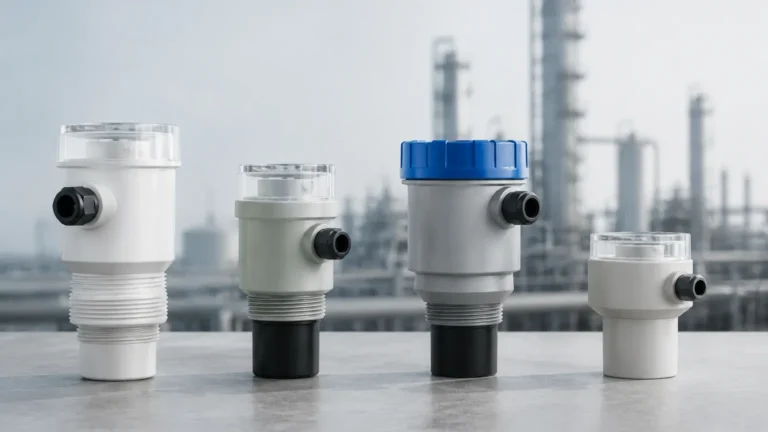
When searching for an ultrasonic level sensor price in South Africa, buyers will notice a wide range of quotes, typically spanning from R3,500 to over R30,000 per unit. This variance is driven by several technical and logistical factors:
1. Measurement Range
The maximum distance a sensor can measure significantly impacts the price. A sensor designed for a 5-meter range requires a less powerful transducer than one designed for a 30-meter range. In South African silos or deep reservoirs, higher-powered units are necessary to penetrate dust or overcome signal attenuation over long distances.
2. Accuracy and Resolution
Standard industrial sensors offer an accuracy of approximately 0.25% to 0.5% of the measured range. High-precision units required for custody transfer or sensitive chemical processing command a premium price due to more advanced signal processing algorithms.
3. Material and Environmental Protection
* Housing Material: Plastic (ABS/PVC) housings are cost-effective for water tanks, whereas Stainless Steel or PVDF-coated sensors are required for corrosive chemicals or food-grade applications.
* IP Rating: In South Africa’s outdoor environments, an IP67 or IP68 rating is often required to protect against heavy rain and dust ingress.
* Hazardous Areas: If the sensor is installed in an environment with explosive gases or dust (common in mining and petrochemical sectors), it must be Ex-rated (Intrinsically Safe). This certification can double the base price of the instrument.
4. Output and Connectivity
Basic models typically provide a 4-20mA analog output. More expensive models offer digital communication protocols such as Modbus RTU, HART, or Profibus, which allow for remote configuration and advanced diagnostics.
5. Local Logistics and Support
Prices in South Africa are also influenced by import duties, shipping costs, and the volatility of the Rand (ZAR). Furthermore, purchasing from a supplier that provides local technical support and calibration services may involve a higher initial cost but reduces the Total Cost of Ownership (TCO) by minimizing downtime.
Selection Table: Comparing Ultrasonic Level Meter Tiers
| Feature | Entry-Level (General Purpose) | Mid-Range (Industrial) | High-End (Specialized) |
| :— | :— | :— | :— |
| Typical Range | 0.3m – 5m | 0.4m – 15m | 0.5m – 30m+ |
| Accuracy | ±0.5% | ±0.25% | ±0.1% |
| Housing | Plastic / ABS | Reinforced Plastic / SS | PVDF / PTFE / 316L SS |
| Output | 4-20mA | 4-20mA + HART | Modbus / Profibus / Wireless |
| Certifications | CE / IP65 | IP67 / ATEX Zone 2 | ATEX Zone 0 / SIL 2 |
| Typical Application | Small water tanks, sumps | Chemical storage, wastewater | Mining silos, explosive zones |
Practical Installation Considerations
To ensure the longevity and accuracy of your investment, several installation factors must be considered during the procurement phase:
1. The Dead Zone (Blocking Distance): Every ultrasonic sensor has a minimum distance (dead zone) near the transducer face where it cannot measure. If the tank is filled into this zone, the sensor will provide an error or a false reading. Ensure the sensor is mounted high enough to avoid this.
2. Beam Angle and Obstructions: The ultrasonic pulse spreads out in a cone. If there are internal ladders, pipes, or agitators within this cone, they will cause false echoes. Selecting a sensor with a narrower beam angle or advanced "false echo suppression" software is necessary for complex tanks.
3. Mounting Orientation: The transducer face must be perfectly parallel to the liquid surface. A slight tilt can cause the signal to bounce away from the sensor rather than returning to it.
4. Venting: In closed tanks, ensure there is adequate venting to prevent pressure build-up, which can change the air density and affect the speed of sound.

Limitations of Ultrasonic Technology
While highly effective, ultrasonic level meters are not suitable for all environments. Engineers should be aware of the following limitations:
* Vacuum Conditions: Sound waves require a medium (air/gas) to travel. Ultrasonic sensors will not work in a vacuum.
* Heavy Foam: Thick foam on the surface of a liquid can absorb the ultrasonic pulse, leading to a loss of signal.
* High Pressure/Temperature: Extreme pressure changes the density of the air, and temperatures exceeding 80°C to 100°C can damage standard transducers or cause significant measurement errors.
* Heavy Dust/Steam: While some dust can be penetrated, extreme steam or dust clouds can scatter the signal. In these cases, radar level measurement is often recommended as an alternative.
Frequently Asked Questions (FAQ)
Q1: How often do ultrasonic level sensors need calibration?
In stable environments, once-yearly calibration is usually sufficient. However, in applications with extreme temperature fluctuations or corrosive vapors that might affect the transducer face, bi-annual checks are recommended.
Q2: Can I use one sensor for both liquids and solids?
Yes, but with caution. Solids (like grain or coal) do not have a flat surface; they form cones (angle of repose). This scatters the signal, so you typically need a sensor with a higher power rating and specialized software for solid level measurement.
Q3: Why is my sensor reading "Full" when the tank is empty?
This is often caused by the sensor being mounted too close to a wall or an internal obstruction, causing a strong reflection that the sensor interprets as the liquid level. It can also happen if the liquid has entered the "dead zone."
Q4: Does the color of the liquid affect the measurement?
No. Unlike optical sensors, ultrasonic technology is unaffected by the color, transparency, or opacity of the medium.
Conclusion
When evaluating the ultrasonic level sensor price in South Africa, it is important to look beyond the initial purchase price. A cheaper sensor that fails due to chemical corrosion or provides inaccurate readings due to poor temperature compensation will ultimately cost more in maintenance and lost productivity.
Welk provides a robust range of Ultrasonic Level Meters designed to withstand the rigorous demands of industrial automation. By understanding your specific range requirements, environmental conditions, and connectivity needs, you can select a solution that offers the best balance of performance and value for your South African operation.
Download Ultrasonic Level Sensor Price South Africa as a PDF