Level Switch Types
Level Switch Types
In industrial process control, point level detection is a critical function for preventing tank overflows, protecting pumps from dry running, and managing inventory. Level switches are the primary instruments used for these tasks. Unlike continuous level transmitters that provide a constant reading of the volume or height, a level switch is designed to trigger a discrete electrical signal when a substance reaches a specific threshold.
Selecting the correct level switch requires an understanding of the physical properties of the medium, the environmental conditions of the vessel, and the specific measurement principles employed by different technologies. This guide provides a technical overview of the various level switch types, their operating principles, and practical selection criteria for engineering applications.
Fundamental Measurement Principles
Before evaluating specific level switch types, it is essential to understand the physical principles that govern their operation. Most industrial level switches fall into three broad categories based on how they detect the presence of a medium:
1. Mechanical and Buoyancy-Based: These rely on the physical displacement of a component. As the liquid level rises, a float or displacer moves, mechanically or magnetically actuating a switch. These are generally robust but have moving parts that can wear over time.
2. Electronic and Frequency-Based: These utilize electrical properties such as conductivity, capacitance, or vibration frequency. When the medium contacts the sensor probe, it changes the electrical circuit or the mechanical resonance, which the electronics then interpret as a "level reached" state.
3. Non-Contact and Optical: These use light, sound, or electromagnetic waves to detect the interface between the air and the medium. Because they do not rely on physical contact with the material, they are often preferred for highly corrosive or hygienic applications.
Common Level Switch Types and Their Applications
1. Float Level Switches
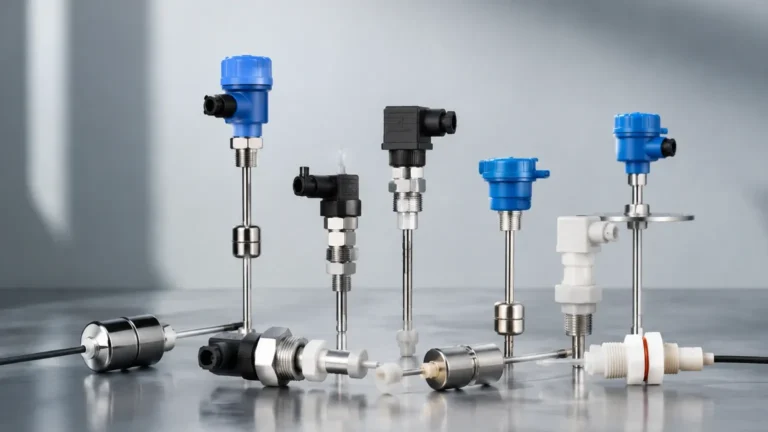
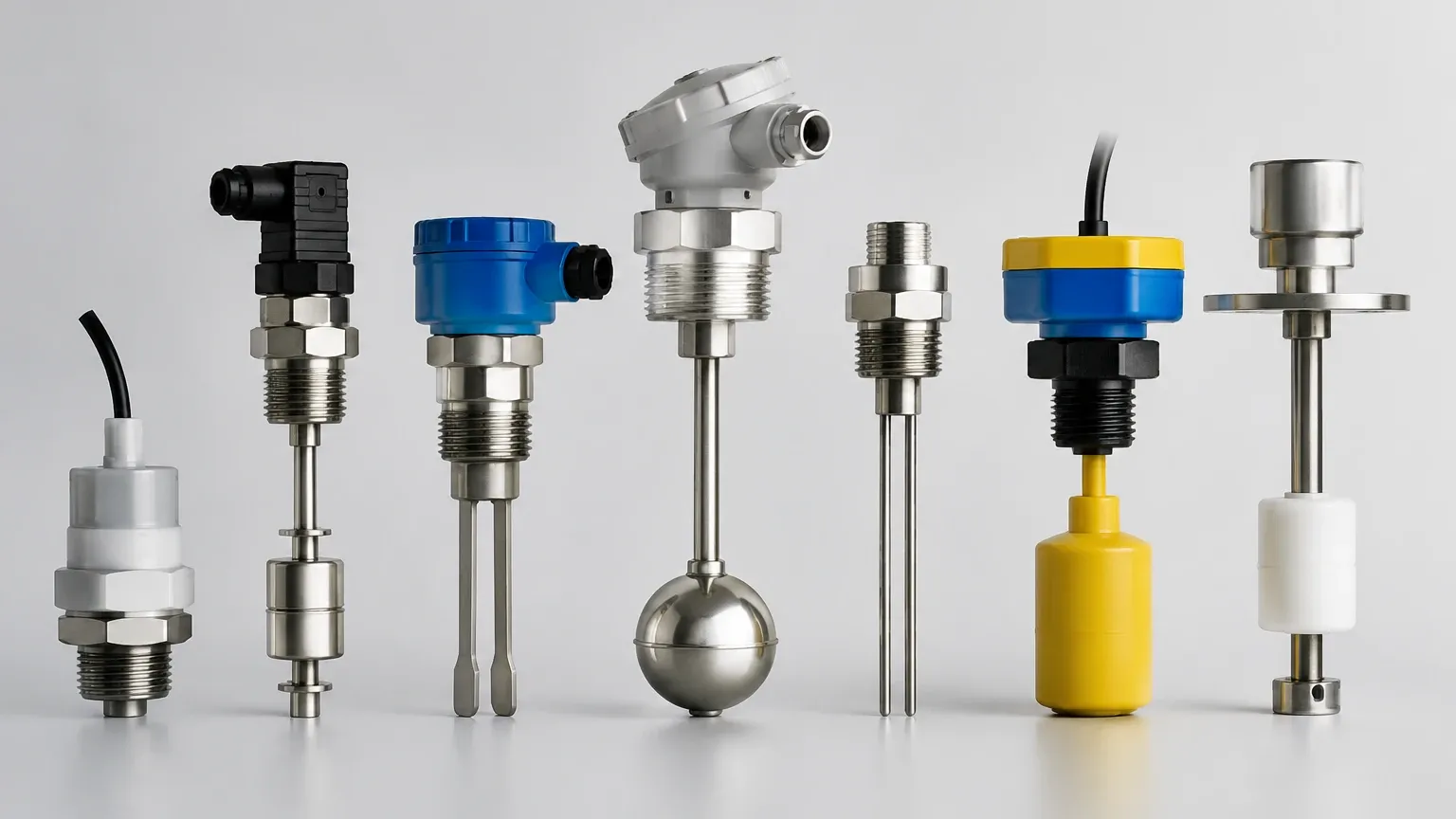
Float switches are among the most established technologies for liquid level detection. They operate on the principle of buoyancy. A float containing a magnet moves with the liquid level. When the float reaches a predetermined point, the internal magnet actuates a hermetically sealed reed switch located within the stem.
* Best For: Clean liquids, water treatment, and fuel tanks.
* Limitations: Not suitable for high-viscosity liquids or fluids containing debris that could jam the float mechanism. They are also sensitive to turbulence unless a stilling well is used.
2. Vibrating Tuning Fork Level Switches
Vibrating level switches use a tuning fork-shaped sensing element that is energized by a piezoelectric crystal to vibrate at its natural resonance frequency in the air. When the fork is submerged in a liquid or covered by a solid, the frequency changes or the vibration is damped. The internal electronics detect this shift and trigger the output.
* Best For: A wide range of liquids, powders, and fine-grained solids. They are highly reliable because they are unaffected by flow, bubbles, foam, or vibration in the tank.
* Limitations: While very versatile, extremely high-viscosity materials may cause a "clogging" effect between the tines of the fork, leading to false readings.
3. Capacitance Level Switches
Capacitance switches treat the sensor probe and the tank wall as two electrodes of a capacitor. The medium acts as the dielectric material. As the level rises and covers the probe, the dielectric constant changes, which in turn changes the measured capacitance. This change is converted into a switching signal.
* Best For: Corrosive liquids, pastes, and bulk solids. They are particularly effective for detecting the interface between two different liquids (e.g., oil and water).
* Limitations: They require calibration based on the dielectric constant of the material. Coating or buildup on the probe can lead to inaccuracies unless a "coat-reject" circuit is included.
4. Conductive Level Switches
Conductive switches are used exclusively for conductive liquids. The system consists of a low-voltage power source and two or more electrodes. When the liquid touches the electrodes, it completes an electrical circuit. One electrode serves as the reference, while others are set at high or low alarm points.
* Best For: Wastewater, acids, and caustic solutions.
* Limitations: They cannot be used with non-conductive liquids like oils or ultrapure water. There is also a risk of electrolysis in some chemical applications.
5. Rotary Paddle Level Switches
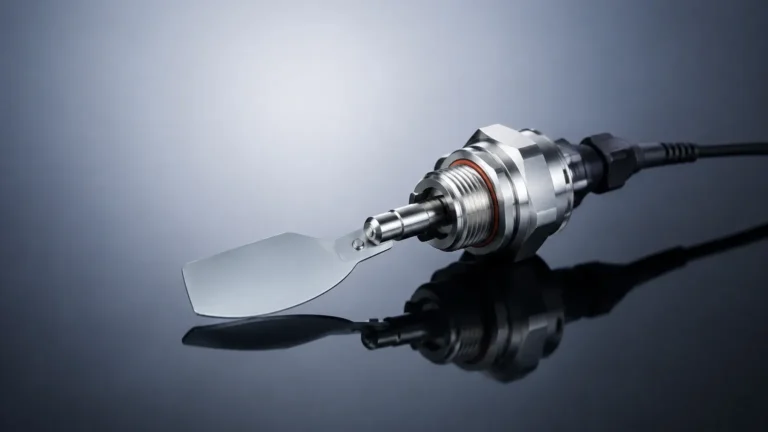
Designed specifically for bulk solids, these switches use a low-speed motor that rotates a paddle. When the material reaches the paddle, it creates a torque that stalls the motor and triggers the switch. Once the material level drops, a spring returns the motor to its original position and the paddle resumes rotating.
* Best For: Silos containing grain, sand, plastic pellets, or cement.
* Limitations: Mechanical wear is a factor, and they are not suitable for liquid applications.
6. Ultrasonic Level Switches
Ultrasonic switches emit high-frequency sound waves across a gap in the sensor head. When the gap is filled with liquid, the sound waves are transmitted efficiently; when the gap is filled with air, the waves are attenuated. This difference is used to determine the presence of the liquid.
* Best For: Hazardous chemicals and high-purity fluids where non-contact or minimal contact is required.
* Limitations: They can be affected by heavy foam or high-pressure vapors that interfere with sound wave transmission.
Technical Selection Criteria
Choosing between different Level Switches requires a systematic evaluation of the process environment. Engineers should consult the following table to narrow down the appropriate technology for their specific project.
Selection Comparison Table
| Technology | Media Type | Temp. Range (Typical) | Pressure Range (Typical) | Key Advantage |
| :— | :— | :— | :— | :— |
| Float | Clean Liquids | -40°C to 150°C | Up to 40 bar (580 PSI) | Simple, no power required |
| Tuning Fork | Liquids/Solids | -50°C to 250°C | Up to 64 bar (928 PSI) | Maintenance-free, versatile |
| Capacitance | Liquids/Solids | -100°C to 400°C | Up to 100 bar (1450 PSI) | High temp/pressure capability |
| Conductive | Conductive Liquids | -20°C to 100°C | Up to 10 bar (145 PSI) | Low cost, multi-point control |
| Rotary Paddle | Bulk Solids | -20°C to 80°C | Atmospheric | Robust for heavy solids |
| Ultrasonic | Liquids | -40°C to 135°C | Up to 20 bar (290 PSI) | No moving parts, reliable |
Installation and Engineering Considerations
Correct installation is as vital as selecting the right technology. Failure to account for the physical dynamics within the vessel can lead to premature sensor failure or false alarms.
Mounting Orientation
Level switches can be mounted horizontally (side of the tank) or vertically (top of the tank).
* Horizontal Mounting: Ideal for high or low-level alarms in large tanks. Ensure the switch is positioned away from the inlet flow to avoid mechanical stress from the falling medium.
* Vertical Mounting: Often used for multi-point detection or in narrow tanks. Ensure the probe length is accurately calculated to match the desired switching points.
Turbulence and Agitation
In tanks with mixers or high-velocity inflows, the liquid surface may be turbulent. Mechanical switches (floats) are particularly susceptible to damage or false triggering in these environments. In such cases, electronic switches like tuning forks or capacitance probes are preferred. If a float switch must be used, a stilling well (a pipe surrounding the float) should be installed to dampen the surface movement.
Material Compatibility
The wetted parts of the switch must be chemically compatible with the process medium. Common materials include Stainless Steel (304 or 316L) for general industrial use, and plastics like PVC, PP, or PVDF for corrosive chemical applications. For highly aggressive media, specialty coatings like PTFE (Teflon) are often applied to the probes.
Electrical and Safety Requirements
In environments containing flammable vapors or dust, level switches must be rated for hazardous areas (e.g., ATEX, IECEx, or Class/Division ratings). Furthermore, the output type—whether Relay, PNP/NPN, or NAMUR—must be compatible with the facility's PLC or control system.
Limitations and Common Risks
While level switches are designed for reliability, certain conditions can compromise their performance:
* Build-up and Scaling: In applications like wastewater or mining slurries, material can build up on the sensor. This is a common cause of "stuck" signals in capacitance and tuning fork switches. Selecting a switch with a "coat-rejection" feature or a polished surface can mitigate this risk.
* Specific Gravity Changes: Float switches rely on the density of the liquid. If the process involves different fluids with varying specific gravities, a float designed for a heavy liquid may not rise in a lighter one.
* Electromagnetic Interference (EMI): Electronic switches, particularly capacitance and ultrasonic types, can be sensitive to electrical noise from nearby high-power motors or variable frequency drives (VFDs). Proper shielding and grounding are essential.
Frequently Asked Questions (FAQ)
Q: Can a level switch be used for continuous level measurement?
A: No. A level switch only provides a binary (on/off) signal at a specific point. For continuous tracking (0-100%), a level transmitter (such as radar or ultrasonic) is required.
Q: What is the difference between NPN and PNP outputs in electronic level switches?
A: These refer to the type of transistor switching. PNP (Positive-Negative-Positive) switches the positive load, while NPN (Negative-Positive-Negative) switches the negative load. The choice depends on the input requirements of your PLC.
Q: How do I test if a level switch is functioning correctly?
A: Most modern electronic level switches include a manual test button or a magnetic test point that simulates a "full" condition. For mechanical switches, a physical check of the float movement and a continuity test of the contacts are standard procedures.
Q: Are tuning fork switches better than float switches?
A: Tuning forks are generally more reliable because they have no moving parts to wear out and are less affected by liquid properties like turbulence or bubbles. However, float switches are more cost-effective for simple, clean-water applications and do not always require external power.
Conclusion
Understanding the variety of level switch types is the first step toward ensuring process safety and efficiency. By matching the measurement principle to the specific characteristics of the media—such as viscosity, conductivity, and density—engineers can prevent costly overflows and equipment damage. Whether utilizing the simplicity of a float switch or the advanced resonance of a tuning fork, proper selection and installation remain the cornerstones of effective industrial level control.