Level Switch Price
Level Switch Price
In industrial automation and process control, point level detection is a critical safety and operational requirement. Whether preventing a tank overflow or protecting a pump from running dry, the selection of a level switch is often dictated by a balance between technical specifications and budgetary constraints. Understanding the factors that influence the level switch price requires a deep dive into the underlying measurement principles, material requirements, and the specific demands of the operating environment.
For procurement managers and process engineers, the initial purchase price is only one component of the total cost of ownership. Reliability, maintenance frequency, and compatibility with the medium are equally vital. This guide explores the engineering logic behind different Level Switches and provides a framework for evaluating costs in a professional B2B context.
Measurement Principles and Their Impact on Cost
The technology used to detect the presence or absence of a material at a specific point is the primary driver of the level switch price. Each technology offers different levels of complexity in its electronic and mechanical design.
Float Level Switches
Float switches operate on the principle of buoyancy. A float containing a magnet moves with the liquid level; when it reaches a certain point, the magnetic field actuates a reed switch or a microswitch.
* Cost Profile: Generally the most economical option for clean, non-coating liquids.
* Complexity: Low. No external power is usually required for the sensing element itself.
Vibrating Tuning Fork Level Switches
These sensors utilize piezoelectric crystals to vibrate a metal fork at its natural resonance frequency in air. When the fork is covered by a liquid or solid, the frequency changes or the vibration is dampened. The electronics detect this shift and trigger the output.
* Cost Profile: Mid-range. The precision required in manufacturing the fork and the sophisticated electronics increase the price compared to simple floats.
* Complexity: Moderate. Requires external power and features built-in diagnostics.
Capacitive Level Switches
A capacitive sensor acts as one plate of a capacitor, while the vessel wall (or a second probe) acts as the other. As the material covers the probe, the dielectric constant changes, altering the capacitance.
* Cost Profile: Mid-range. Highly versatile for solids and liquids, but price varies based on the sophistication of the "active shield" technology used to ignore material buildup.
* Complexity: Moderate. Requires calibration to the specific dielectric constant of the medium.
Ultrasonic and Radar Switches
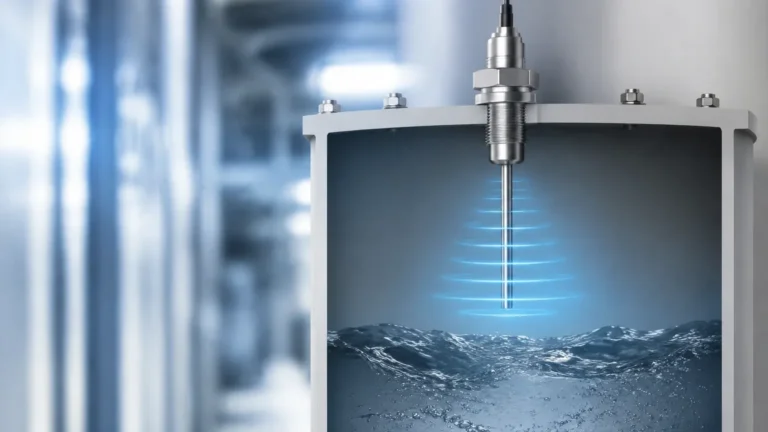
Non-contact switches use sound waves or high-frequency electromagnetic waves to detect the surface. While often used for continuous measurement, they are also configured as high-accuracy point level switches for aggressive or high-purity media.
* Cost Profile: High. The advanced signal processing and transducer technology command a premium.
* Complexity: High. Offers the advantage of no moving parts and no contact with the medium.
Key Factors Influencing Level Switch Price
When requesting a quote for industrial level instruments, several variables will cause the price to fluctuate. Understanding these allows engineers to specify only what is necessary for the application.
1. Material of Construction (MOC)
The medium being measured dictates the material requirements. A standard 304 Stainless Steel switch is the baseline. However, if the medium is highly corrosive (such as sulfuric acid), the price will increase significantly for materials like 316L Stainless Steel, PTFE (Teflon) coatings, or exotic alloys like Hastelloy and Monel.
2. Process Temperature and Pressure
Standard level switches are typically rated for temperatures up to 80°C (176°F) and pressures up to 10 bar (145 psi). Applications involving steam jackets, high-pressure reactors, or cryogenic storage require specialized seals, cooling fins, and reinforced housings, which can double or triple the level switch price.
3. Certifications and Safety Ratings
In many B2B sectors, such as oil and gas or chemical processing, instruments must be certified for use in hazardous areas.
* Explosion-proof (Ex d) or Intrinsically Safe (Ex i): These certifications require rigorous testing and specialized enclosures (e.g., flameproof aluminum or stainless steel), adding a significant margin to the cost.
* SIL (Safety Integrity Level): Switches used in Safety Instrumented Systems (SIS) require SIL2 or SIL3 certification, reflecting the high reliability of the internal components.
4. Customization and Probe Length
Off-the-shelf switches with standard 50mm (2 in) probes are the most cost-effective. If a project requires a custom insertion length of 2000mm (approx. 78 in) to reach deep into a vessel, the additional material and shipping logistics will be reflected in the final quote.
Technical Selection Table
To assist in the preliminary budgeting phase, the following table compares common technologies based on their typical application and relative cost.
| Technology | Typical Media | Relative Price | Key Advantage | Limitation |
| :— | :— | :— | :— | :— |
| Float | Water, Oil, Fuel | Low | Simple, No Power | Moving parts can jam |
| Conductivity | Conductive Liquids | Low | Very Compact | Only for conductive media |
| Tuning Fork | Liquids, Powders | Medium | Reliable, No Calibration | Sensitive to heavy buildup |
| Capacitive | Solids, Slurries | Medium | No moving parts | Requires calibration |
| Ultrasonic | Corrosive Liquids | High | Non-contact | Affected by foam/vapor |
| Radar | High-temp/High-pressure | High | Extreme Accuracy | Highest initial investment |
Installation and Maintenance Considerations
The "true" level switch price includes the labor and hardware required to put the device into service. Engineers should consider the following during the planning phase:
* Mounting Connections: Standard NPT or G threads are standard. Custom flanges (ANSI or DIN) add to the manufacturing cost and may require additional gaskets and bolting hardware.
* Wiring and Integration: Switches with simple relay outputs are easy to integrate into existing PLC systems. However, switches offering IO-Link or 4-20mA digital outputs may require more sophisticated wiring but provide better data for predictive maintenance.
* Calibration Time: Technologies like capacitance may require on-site calibration with the actual medium. If the process involves multiple media, the labor cost for recalibration should be factored into the choice of a more "plug-and-play" technology like a tuning fork switch.

Limitations and Common Risks
Selecting a level switch based solely on the lowest price often leads to higher long-term costs.
1. Material Buildup: A cheap capacitive switch without coating rejection will trigger a false high-level alarm if the material sticks to the probe, potentially shutting down a production line.
2. Turbulence and Foam: Mechanical float switches can be damaged by high-velocity inflow or turbulent surfaces. In these cases, a dampened tuning fork or a non-contact sensor is necessary despite the higher initial cost.
3. Mechanical Wear: In abrasive applications (like mining slurries), mechanical switches will fail prematurely. Investing in a hardened or non-contact sensor reduces the frequency of replacement.
Frequently Asked Questions (FAQ)
Q: Why is there such a large difference in level switch price between brands?
A: Price differences usually reflect the quality of the internal electronics, the thickness of the sensing elements, and the rigor of the quality control process. Professional manufacturers like Welk prioritize long-term stability and provide comprehensive documentation and support, which is reflected in the pricing.
Q: Can I use a liquid level switch for dry bulk solids?
A: Generally, no. Float switches require buoyancy, which does not exist in solids. Tuning fork switches for solids are designed with larger, more robust forks to handle the weight and abrasion of powders or grains. Using the wrong type will lead to immediate failure.
Q: Does the length of the cable or probe significantly affect the price?
A: For cable-suspended float switches, the price increases linearly with the cable length. For rigid probe switches (like capacitive or tuning fork), the price increases based on the additional stainless steel and the structural reinforcement needed to ensure the probe does not bend under process flow.
Q: Are electronic level switches better than mechanical ones?
A: "Better" depends on the application. Mechanical switches are excellent for simple, low-cost power-free applications. Electronic switches (vibrating, capacitive) are superior for high-cycle applications where mechanical wear would lead to failure.
Conclusion
Navigating the level switch price landscape requires a clear understanding of the process environment and the technical requirements of the application. While budget constraints are a reality in any industrial project, the cost of a single sensor failure—resulting in an environmental spill, equipment damage, or unplanned downtime—far outweighs the savings of a cheaper, ill-suited instrument.
By focusing on the measurement principle, material compatibility, and necessary safety certifications, engineers can select a solution that provides reliable performance for years. For detailed technical specifications and to explore a wide range of industrial sensing solutions, professionals are encouraged to Review product options and application support to ensure their selection aligns with both engineering standards and project budgets.