Radar Level Sensor Advantages and Disadvantages
Radar Level Sensor Advantages and Disadvantages: A Technical Engineering Guide
In modern industrial process automation, selecting the correct level measurement technology is critical for operational safety, inventory accuracy, and process efficiency. Among the various technologies available, Radar Level Meters have emerged as a leading solution for challenging environments. This guide provides a comprehensive analysis of radar level sensor advantages and disadvantages, explaining their operating principles, selection criteria, and practical installation constraints for B2B industrial applications.
Understanding Radar Measurement Principles
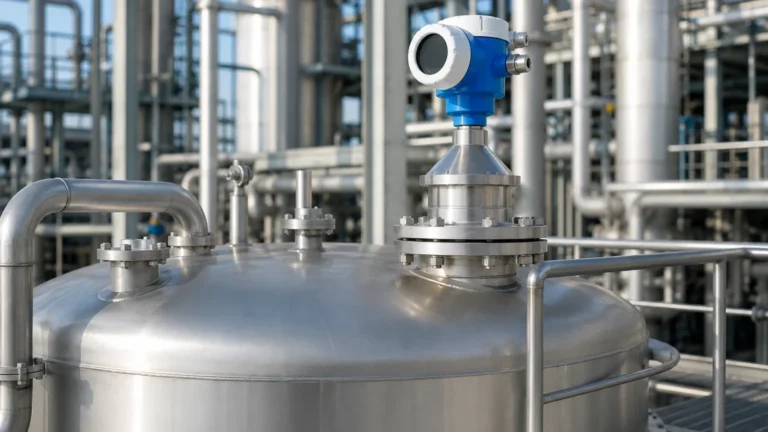
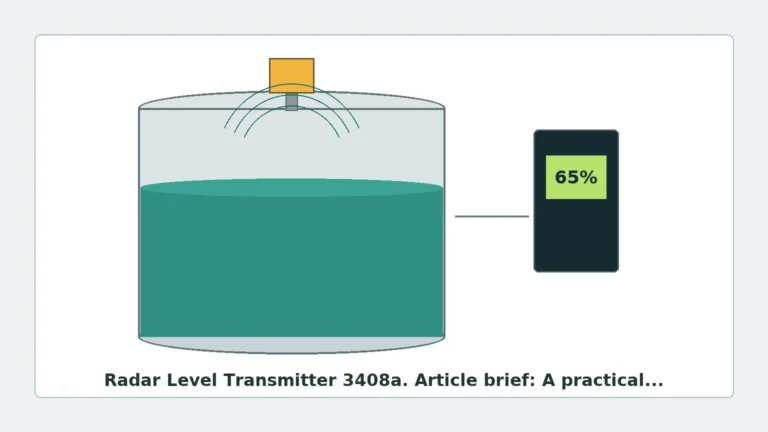
Before evaluating the specific pros and cons, it is essential to understand how radar technology functions in a process vessel. Radar level sensors utilize electromagnetic waves, typically in the microwave frequency range (from 6 GHz up to 120 GHz), to determine the distance to a product surface.
Time of Flight (ToF)
Most radar sensors operate on the Time of Flight principle. The sensor emits a microwave pulse that travels through the air (or vapor space), reflects off the surface of the medium, and returns to the receiver. Because the speed of light ($c \approx 300,000$ km/s) is constant in a vacuum and nearly constant in air, the distance ($D$) is calculated as:
$$D = \frac{c \times t}{2}$$
where $t$ is the measured transit time.
FMCW vs. Pulse Radar
There are two primary methods for processing these signals:
1. Pulse Radar: The transmitter sends a short microwave pulse and measures the time it takes to return. This is energy-efficient and suitable for many standard applications.
2. FMCW (Frequency Modulated Continuous Wave): The transmitter emits a continuous signal with a varying frequency. The distance is determined by the frequency difference between the transmitted and received signals. FMCW generally offers higher precision and better signal-to-noise ratios, making it ideal for low-dielectric media or turbulent surfaces.
Contact vs. Non-Contact Radar
* Non-Contact Radar: The antenna is located at the top of the tank and never touches the medium. This is the preferred choice for corrosive, hygienic, or extremely hot materials.
* Guided Wave Radar (GWR): A probe or cable extends into the medium, guiding the microwave pulse. This is highly effective for low-dielectric liquids and applications with heavy foam or steam.
—
Radar Level Sensor Advantages
Radar technology offers several distinct benefits that justify its higher initial investment compared to ultrasonic or hydrostatic sensors.
1. High Precision and Reliability
Radar sensors are capable of millimetric accuracy (often $\pm 1$ mm to $\pm 3$ mm). Unlike ultrasonic sensors, which rely on sound waves that are affected by air temperature and density, radar waves are electromagnetic and remain stable regardless of the gas composition in the vapor space.
2. Resistance to Environmental Factors
One of the most significant radar level sensor advantages and disadvantages considerations is environmental resilience. Radar is virtually unaffected by:
* Temperature Extremes: Can operate from $-40^\circ\text{C}$ to $+450^\circ\text{C}$ ($-40^\circ\text{F}$ to $842^\circ\text{F}$).
* High Pressure: Functional in vacuum conditions and high-pressure vessels up to 160 bar (2320 psi).
* Dust and Vapor: Microwaves penetrate dust, steam, and vapor clouds that would otherwise scatter ultrasonic signals.
3. Non-Contact Measurement
Because the sensor does not touch the medium, there is no risk of chemical corrosion or mechanical wear. This makes radar ideal for measuring aggressive acids, slurries, and viscous food products where hygiene is paramount. Maintenance requirements are significantly lower than for contact-based systems like float switches or displacers.
4. Versatility Across Media
Radar can measure both liquids and solids (powders, grains, and aggregates). Advanced high-frequency radar (80 GHz and above) features a narrow beam angle, allowing it to measure levels in tall, narrow silos or tanks with internal obstructions.
—
Radar Level Sensor Disadvantages
Despite their technical superiority, radar sensors are not a universal solution and have specific limitations.
1. Dielectric Constant Dependency
The strength of the reflected signal (echo) depends on the dielectric constant ($\varepsilon_r$) of the medium. Materials with a low dielectric constant, such as liquid nitrogen ($\varepsilon_r \approx 1.4$) or certain hydrocarbons, reflect very little energy. If the $\varepsilon_r$ is too low, the radar signal may pass through the product and reflect off the bottom of the tank instead.
2. Higher Initial Cost
Compared to hydrostatic pressure transmitters or ultrasonic sensors, radar level meters represent a higher capital expenditure. For simple water storage applications where precision is not critical, the cost of radar may not be justified.
3. Sensitivity to Foam and Turbulence
While radar is robust, heavy, dense foam can absorb or scatter the microwave signal, leading to signal loss. Similarly, extreme surface turbulence caused by high-speed agitators can disperse the signal, requiring advanced software filtering or the use of a stilling well.
4. Installation Constraints
Radar sensors require a clear "line of sight." Internal tank structures like ladders, heating coils, or agitator blades can create false echoes. While modern sensors use "false echo suppression" software to ignore these reflections, poor placement can still degrade performance.
—
Selection Table: Radar vs. Alternative Technologies
| Feature | Radar Level Meter | Ultrasonic Sensor | Hydrostatic Pressure | Magnetic Level Gauge |
| :— | :— | :— | :— | :— |
| Measurement Type | Non-contact / Contact | Non-contact | Contact | Contact |
| Accuracy | Excellent ($\pm 1$ mm) | Good ($\pm 0.25\%$) | Moderate | Good |
| Effect of Vacuum | None | Cannot operate | None | None |
| Effect of Vapor | Minimal | Significant | None | None |
| Medium Dielectric | Critical | Irrelevant | Irrelevant | Irrelevant |
| Maintenance | Very Low | Low | Moderate | Moderate |
| Relative Cost | High | Low to Medium | Medium | Medium to High |
—

Engineering Installation Considerations
To maximize the performance of a radar level sensor, engineers must adhere to specific installation guidelines:
1. Nozzle Height and Diameter: The antenna should ideally extend slightly below the mounting nozzle to prevent internal reflections. If the nozzle is narrow and long, a high-frequency radar (80 GHz) is recommended due to its narrow beam.
2. Avoid the Center: Do not mount the sensor in the exact center of a domed tank. This can cause multiple reflections to converge, amplifying noise. Conversely, avoid mounting too close to the tank wall (maintain a minimum distance of 200 mm to 500 mm depending on frequency).
3. Agitators and Obstructions: If an agitator is present, the sensor should be mounted where the beam will not strike the blades. If this is unavoidable, use a Guided Wave Radar or a stilling well to isolate the measurement area.
4. Blocking Distance (Dead Zone): Every radar has a minimum distance near the antenna where measurement is not possible (typically 50 mm to 300 mm). Ensure the maximum fill level does not enter this zone.
—
Application-Specific Recommendations
Water and Wastewater Treatment
In open channels or wet wells, non-contact radar is superior to ultrasonic because it is unaffected by air temperature fluctuations and wind. For these applications, a standard 26 GHz radar is usually sufficient.
Chemical and Petrochemical
For volatile organic compounds (VOCs) or high-pressure reactors, Guided Wave Radar (GWR) is often preferred. GWR provides a stronger return signal in low-dielectric fluids and is unaffected by the heavy vapors often found in chemical storage.
Solids and Powders
In cement or grain silos, dust is a major factor. High-frequency 80 GHz radar is the gold standard here, as the narrow beam can be aimed precisely to avoid wall buildup and penetrate thick dust clouds during filling cycles.
—
Frequently Asked Questions (FAQs)
Q: Can radar measure level through a plastic tank wall?
A: Yes. Because microwaves can penetrate non-conductive materials like plastic, GRP, or glass, radar sensors can often measure the level from outside the tank, provided the wall thickness is not excessive and the material is not metallic.
Q: How does foam affect radar measurement?
A: It depends on the foam's density and moisture content. Dry, airy foam is often transparent to radar, allowing measurement of the liquid level beneath. Dense, wet foam may reflect the signal (measuring the top of the foam) or absorb it entirely. In cases of thick foam, Guided Wave Radar is the more reliable choice.
Q: Is 80 GHz always better than 26 GHz?
A: Not necessarily. While 80 GHz offers a narrower beam and better resolution, 26 GHz may be more effective in applications with heavy condensation or steam, as the longer wavelength is less susceptible to scattering by water droplets on the antenna lens.
Q: What is the dielectric constant limit for radar?
A: Most high-performance non-contact radars can measure media with $\varepsilon_r > 1.4$. For materials with a lower dielectric constant, a stilling well or Guided Wave Radar is typically required to concentrate the signal energy.
Conclusion
Radar level sensors represent a versatile and highly accurate solution for industrial level measurement, particularly in environments where temperature, pressure, and vapor render other technologies ineffective. By weighing the radar level sensor advantages and disadvantages against the specific requirements of the process—such as dielectric constant, tank geometry, and budget—engineers can ensure a reliable and long-term instrumentation solution. For complex applications, consulting with a professional manufacturer of Radar Level Meters is recommended to verify signal compatibility and antenna selection.
Download Radar Level Sensor Advantages and Disadvantages as a PDF