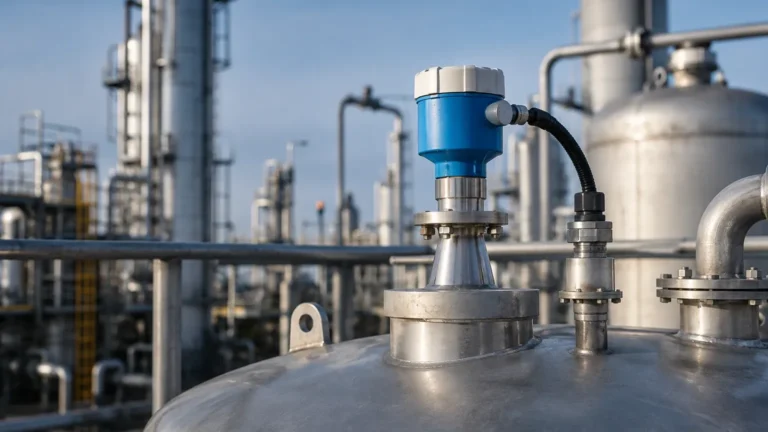
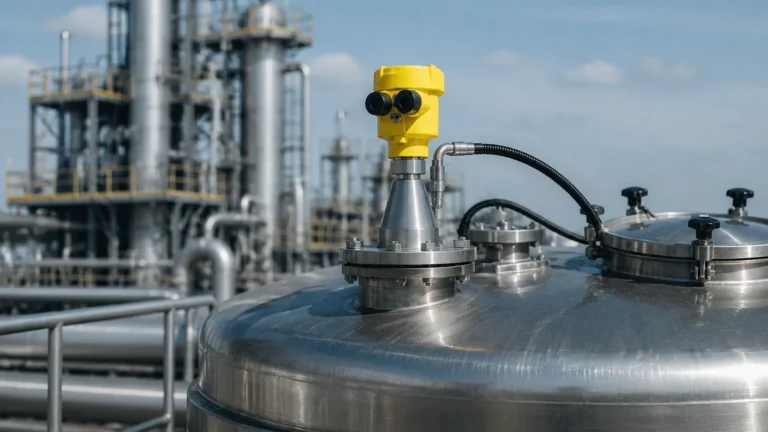
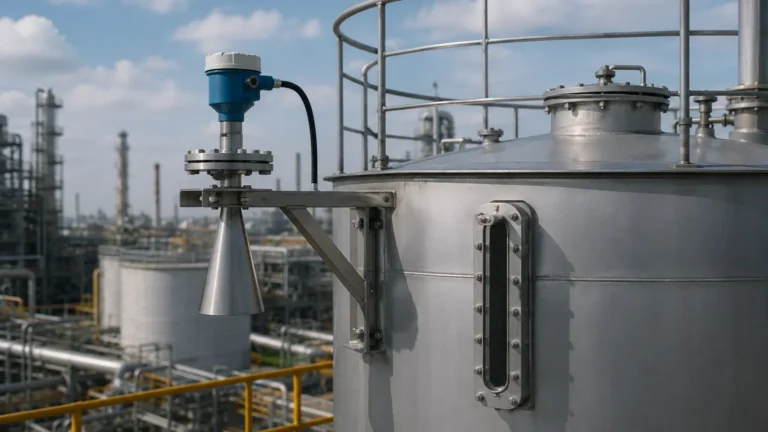
Radar Level Transmitter China
Radar Level Transmitter China: An Engineering Guide to Selection and Application
In the landscape of modern industrial automation, the demand for precise, non-contact level measurement has led to the widespread adoption of radar technology. As a professional manufacturer, Welk provides a comprehensive range of instrumentation designed to meet the rigorous demands of the chemical, water treatment, and oil and gas sectors. When sourcing a radar level transmitter china, engineers and procurement specialists must look beyond basic price points to evaluate technical specifications, signal processing capabilities, and mechanical compatibility with specific process environments.
This guide provides a technical overview of radar level measurement principles, selection criteria for various industrial media, and critical installation parameters necessary to ensure long-term operational reliability.
1. Understanding Radar Level Measurement Principles
Radar level transmitters operate on the principle of microwave propagation. These instruments emit high-frequency electromagnetic waves toward the surface of the medium being measured. When the waves encounter a change in the dielectric constant ($ε_r$) at the surface of the material, a portion of the energy is reflected back to the sensor antenna.
Pulse Radar (Time-of-Flight)
Traditional pulse radar transmitters emit short microwave pulses. The instrument measures the time elapsed between the emission of the pulse and the reception of the echo. Since microwaves travel at the speed of light, the distance ($D$) is calculated as:
$$D = \frac{c \times t}{2}$$
Where $c$ is the speed of light and $t$ is the measured transit time. This technology is robust and suitable for a wide range of standard industrial applications.
FMCW (Frequency Modulated Continuous Wave)
Modern high-precision Radar Level Meters often utilize FMCW technology. Instead of discrete pulses, the transmitter emits a continuous signal with a linear frequency sweep. The reflected signal is compared to the emitted signal at that moment, and the frequency difference (Δf) is directly proportional to the distance. FMCW provides superior resolution and a higher signal-to-noise ratio, making it the preferred choice for high-accuracy custody transfer and complex tank geometries.
2. Frequency Considerations: 26GHz vs. 80GHz
One of the most critical decisions when selecting a radar level transmitter china is the operating frequency. The frequency determines the beam angle and the instrument's ability to handle internal tank obstructions.
* 26GHz Radar: This is the industry standard for many years. It offers a balance between cost and performance. With a typical beam angle of 8° to 20° (depending on antenna size), it is suitable for medium-sized tanks and liquids with moderate agitation.
* 80GHz Radar: Representing the latest advancement in radar technology, 80GHz transmitters offer a much narrower beam angle (often as low as 3°). This narrow focus allows the signal to bypass narrow nozzles, internal baffles, and agitators without generating false echoes. It is also highly effective for measuring solids and powders where the surface may be uneven.
3. Engineering Selection Table
The following table outlines the typical application boundaries for different radar configurations provided by manufacturers like Welk.
| Feature | 26 GHz Pulse Radar | 80 GHz FMCW Radar | Guided Wave Radar (GWR) |
| :— | :— | :— | :— |
| Measurement Accuracy | ±3 mm to ±5 mm | ±1 mm to ±2 mm | ±2 mm |
| Maximum Range | 30m – 70m | 120m | 30m |
| Beam Angle | 8° – 20° | 3° – 8° | N/A (Guided) |
| Dielectric Constant (ε_r) | ε_r > 1.9 | ε_r > 1.4 | ε_r > 1.4 |
| Typical Applications | Storage tanks, water pits | Narrow vessels, silos, high-precision | Steam, foam, turbulent liquids |
| Mounting | Non-contact | Non-contact | Contact (Probe) |
4. Installation Constraints and Best Practices
Correct installation is paramount to the performance of any radar level transmitter. Even the most advanced 80GHz sensor will fail if placed incorrectly.
Mounting Position
The transmitter should ideally be installed at a distance of 1/4 to 1/6 of the tank diameter from the tank wall. Mounting the sensor too close to the wall can result in interference from wall reflections. Conversely, mounting the sensor in the exact center of a cylindrical tank can lead to multiple reflections (parabolic effect) that confuse the signal processor.
Nozzle Design
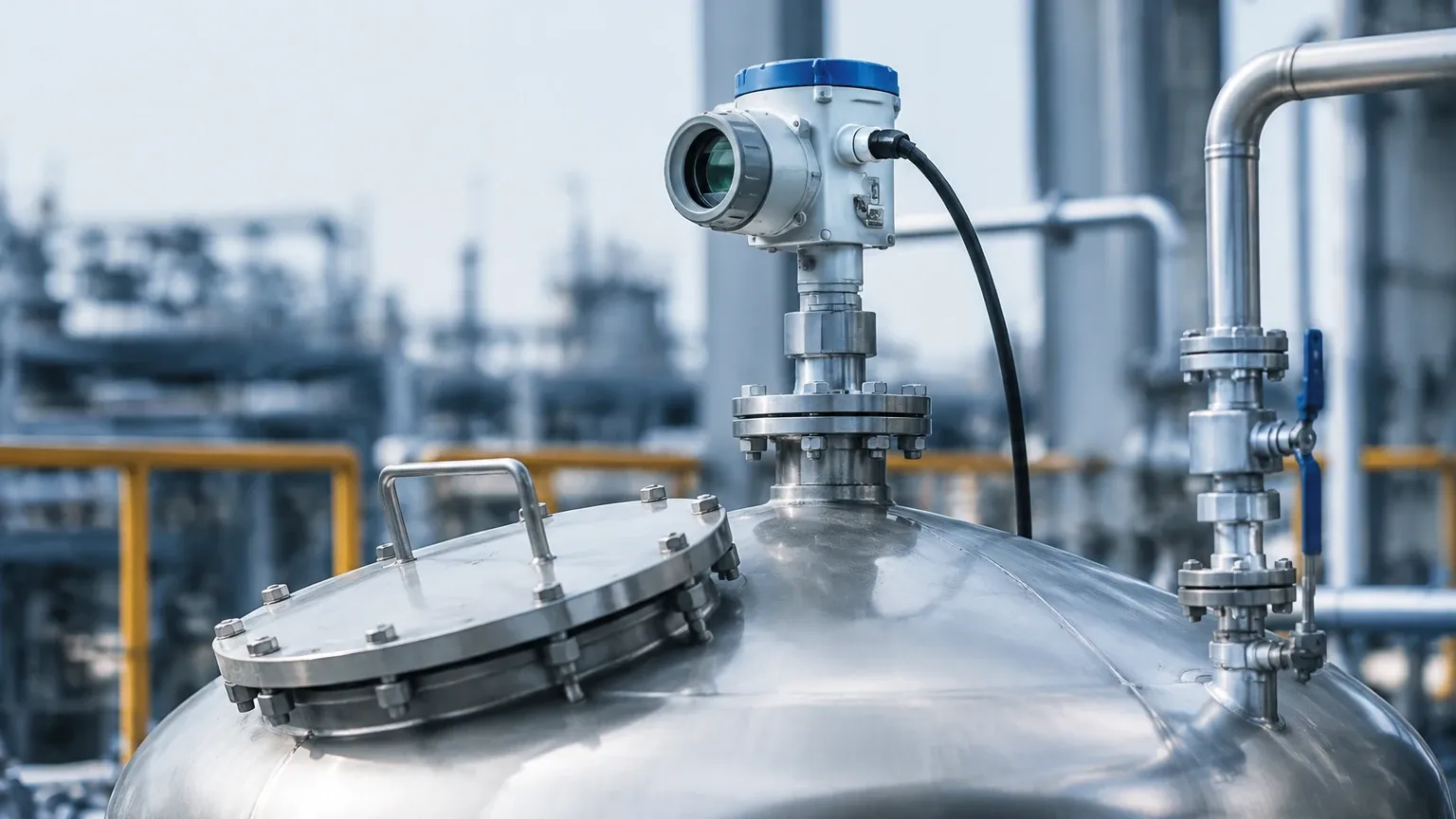
The nozzle height ($H$) and diameter ($D$) are critical. For non-contact radar, the antenna should preferably extend slightly below the nozzle into the tank to prevent signal ringing within the nozzle. If the nozzle is very narrow and long, an 80GHz lens antenna is recommended to ensure the narrow beam clears the nozzle edges.
Avoiding Obstructions
Internal structures such as heating coils, ladders, and agitators act as reflectors. When planning the installation:
1. Ensure the signal beam path is clear of obstructions.
2. If an obstruction is unavoidable, use the instrument's "False Echo Suppression" or "Echo Mapping" feature to program the transmitter to ignore these fixed reflections.
3. Ensure the signal does not intersect the filling stream of the medium.
5. Application Risks and Limitations
While radar is highly versatile, certain process conditions present significant challenges:
* Low Dielectric Media: Hydrocarbons and liquefied gases have low dielectric constants ($ε_r < 2.0$). These materials reflect very little energy. In such cases, high-sensitivity 80GHz units or Guided Wave Radar (GWR) with a coaxial probe may be required.
* Heavy Foam: Dense, thick foam can absorb the radar signal entirely, leading to signal loss. If the foam is light and airy, the radar may penetrate it and measure the liquid level, but thick aqueous foams often require a different technology, such as a magnetic level gauge or a hydrostatic transmitter.
* Dust and Condensation: In silos, heavy dust can attenuate the signal. High-frequency radar with a lens antenna is often equipped with a purging connection to keep the antenna face clean. Similarly, for applications with heavy condensation, a PTFE-coated antenna or a drip-off lens design is necessary to prevent water droplets from blocking the signal.
6. Sourcing Radar Level Transmitters from China
When evaluating a radar level transmitter china supplier, international buyers should focus on the manufacturer's quality control processes and technical support capabilities. Welk emphasizes the following B2B advantages:
* Material Traceability: Ensuring that wetted parts (SS316L, PTFE, Hastelloy) meet international standards for chemical compatibility.
* Customization (OEM/ODM): The ability to customize process connections (Flange, Thread, Tri-clamp) and output protocols (4-20mA HART, Modbus RS485, Profibus).
* Calibration Facilities: Professional manufacturers utilize automated calibration towers to verify accuracy across the full measurement range before shipment.
* Certifications: Verification of CE, Ex-proof (ATEX/IECEx), and SIL2 ratings for hazardous area applications.
7. Frequently Asked Questions (FAQ)
Q: Can radar level transmitters be used in vacuum tanks?
A: Yes. Since radar waves do not require a medium for propagation (unlike ultrasonic waves), they function perfectly in a vacuum. However, the process connection must be vacuum-tight.
Q: How does temperature affect radar measurement?
A: Microwave speed is virtually unaffected by temperature, pressure, or gas composition in the vapor space. However, the electronics and the antenna seals have specific temperature limits (typically up to +250°C for standard high-temp versions).
Q: What is the "Blind Zone"?
A: The blind zone (or dead zone) is the area immediately below the antenna where measurement is not possible. For most radar level meters, this ranges from 50mm to 300mm. It is important to account for this when sizing the tank and nozzle.
Q: Is 80GHz always better than 26GHz?
A: Not necessarily. While 80GHz offers better precision and smaller beam angles, 26GHz is often more cost-effective for simple water storage or large tanks where obstructions are not a concern. The choice depends on the specific ROI and technical requirements of the project.
Conclusion
Selecting the right radar level transmitter requires a thorough understanding of the process medium, tank geometry, and environmental constraints. By leveraging the advanced engineering and cost-effective manufacturing of a radar level transmitter china provider like Welk, industrial operators can achieve high-precision level monitoring that enhances safety and process efficiency. For detailed product specifications and application-specific advice, engineers are encouraged to Review product options and application support to ensure the selected instrumentation meets the long-term needs of their facility.