Tunable Diode Laser
Tunable Diode Laser
In the landscape of industrial process monitoring and safety, the tunable diode laser (TDL) has emerged as a cornerstone technology for gas analysis and environmental monitoring. Often referred to as Tunable Diode Laser Absorption Spectroscopy (TDLAS), this method provides high-speed, non-contact measurement of gas concentrations, temperature, and pressure in demanding industrial environments. For engineers managing storage tanks, reactors, and combustion processes, understanding the integration of TDL technology alongside traditional level measurement systems is essential for comprehensive process control.
While level measurement instruments—such as those found on the Main Page—focus on the volume and height of materials, TDL systems analyze the chemical composition of the headspace or the process stream. This guide explores the fundamental principles, selection criteria, and practical applications of tunable diode lasers in the B2B sector.
Measurement Principles of TDLAS
The fundamental principle behind a tunable diode laser is absorption spectroscopy. Every gas molecule has a unique set of absorption lines, effectively acting as a spectral "fingerprint." TDLAS utilizes a semiconductor laser as the light source, which is specifically engineered to emit light at a wavelength corresponding to a known absorption line of the target gas.
The Beer-Lambert Law
At the core of the measurement is the Beer-Lambert Law, which describes the relationship between the intensity of light entering a gas and the intensity of light exiting it:
\[ I = I_0 e^{-\alpha L C} \]
Where:
* I is the intensity of the light after passing through the gas.
* I₀ is the initial intensity of the light.
* α is the absorption coefficient (specific to the gas and wavelength).
* L is the optical path length (the distance the light travels through the gas).
* C is the concentration of the target gas.
Wavelength Tuning
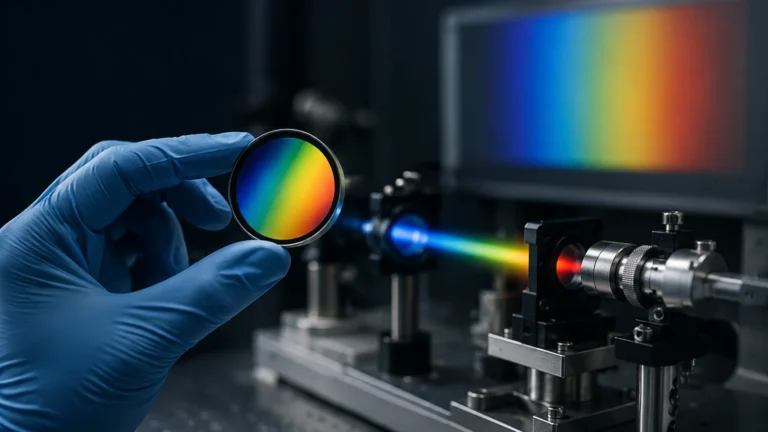
Unlike fixed-wavelength lasers, a tunable diode laser can vary its output wavelength by adjusting its operating temperature or the injection current. In a typical measurement cycle, the laser's wavelength is rapidly scanned (tuned) across the absorption line of the target gas. The detector on the opposite side (or reflected back) records the decrease in light intensity. By analyzing the shape and depth of this absorption peak, the system calculates the gas concentration with high precision.
Second Harmonic Detection (2f)
To enhance sensitivity and minimize noise from dust or window fouling, many industrial TDL systems employ a technique called Wavelength Modulation Spectroscopy (WMS). By modulating the laser at a high frequency and detecting the second harmonic of the signal, the system can extract the absorption signal from a noisy background, allowing for measurements in environments with up to 90% light obscuration.
Key Components of a TDL System
An industrial-grade TDL system generally consists of three primary modules:
1. The Transmitter Unit: Contains the tunable diode laser, the drive electronics, and the collimating optics. It is responsible for generating the precise wavelength required for the application.
2. The Receiver Unit: Contains a photodiode detector and signal processing electronics. In "cross-stack" configurations, this is mounted opposite the transmitter. In "probe" or "retro-reflective" configurations, the detector may be housed with the transmitter.
3. The Control Unit: Processes the raw electronic signals into a concentration reading (e.g., ppm or volume %), manages calibration data, and provides industrial outputs like 4-20mA, HART, or Modbus.
Selection Criteria for Industrial Applications
Choosing the right tunable diode laser system requires a detailed understanding of the process conditions. Unlike generic sensors, TDLs are often application-specific.
Target Gas and Wavelength
Common gases measured include Oxygen (O₂), Carbon Monoxide (CO), Carbon Dioxide (CO₂), Moisture (H₂O), Ammonia (NH₃), and Methane (CH₄). The choice of laser is dictated by the strongest available absorption line that does not overlap with other gases present in the process (interference-free measurement).
Path Length (L)
The optical path length significantly impacts the detection limit. For low concentrations (trace analysis), a longer path length (e.g., 5 to 10 meters) is required. For high-concentration process control, shorter path lengths or probe-style sensors are more appropriate.
Process Temperature and Pressure
Gas absorption lines broaden and shift based on temperature and pressure. High-performance TDL systems include integrated sensors or inputs for temperature and pressure compensation to ensure accuracy across varying process states.
Practical Selection Table
| Application | Target Gas | Typical Range | Path Length | Key Benefit |
| :— | :— | :— | :— | :— |
| Safety Blanketing | Oxygen (O₂) | 0–25% | 1–5m | Prevents combustion in tanks |
| De-NOx Control | Ammonia (NH₃) | 0–50 ppm | 2–8m | Optimizes reagent injection |
| Corrosion Control | Moisture (H₂O) | 0–100 ppm | 0.5–2m | Protects natural gas pipelines |
| Combustion Opt. | CO + Temp | 0–1000 ppm | 5–15m | Reduces fuel consumption |
| Flare Monitoring | Methane (CH₄) | 0–100% | 1–10m | Environmental compliance |
Installation Considerations
Proper installation is critical for the long-term reliability of a tunable diode laser. Because the measurement relies on a light beam, physical alignment and optical clarity are paramount.
1. Mechanical Alignment: In cross-stack installations, the transmitter and receiver must be perfectly aligned. Thermal expansion of large tanks or ducts can cause misalignment, so heavy-duty mounting flanges and adjustable alignment brackets are necessary.
2. Purge Gas System: To prevent the process gas from fouling the optical windows, a continuous purge of clean, dry air or Nitrogen (N₂) is used. The purge flow must be consistent to maintain a clear optical path without diluting the sample gas significantly at the measurement point.
3. Vibration Isolation: Excessive vibration can jitter the laser beam, leading to signal noise. In high-vibration environments, dampened mounts are recommended.
4. Access for Maintenance: While TDLs are low-maintenance, technicians still need access to clean windows or perform validation checks using a calibration cell.
Comparison: TDL vs. Traditional Gas Analyzers
| Feature | Tunable Diode Laser (TDL) | Electrochemical / NDIR |
| :— | :— | :— |
| Response Time | Very Fast (<2 seconds) | Slow (30–60 seconds) |
| Calibration | High stability (Months/Years) | Frequent (Weeks/Months) |
| Interference | Virtually zero (selective) | Prone to cross-sensitivity |
| Maintenance | Low (No moving parts) | High (Sensor replacement) |
| Installation | In-situ (Directly in process) | Extractive (Requires sampling system) |

Limitations and Risks
While highly effective, TDL technology is not a universal solution for every gas measurement challenge.
* Optical Obscuration: If the process contains extremely high levels of dust, soot, or liquid droplets that block more than 95% of the light, the signal may be lost.
* Gas Specificity: A single TDL instrument is typically designed for one specific gas. If you need to measure five different gases, you generally need five different lasers or a complex multi-channel system.
* Path Length Requirements: In very small pipes (under 100 mm), the path length may be too short to achieve the desired sensitivity for certain gases.
* Cost: The initial capital expenditure for TDLAS is higher than for simple electrochemical sensors, though the total cost of ownership (TCO) is often lower due to reduced maintenance.
Integration with Level Measurement Systems
In modern industrial automation, data from TDL gas analyzers is often combined with data from level meters. For example, in a chemical storage tank:
* Radar Level Meters provide the precise height of the liquid.
* TDL Analyzers monitor the Oxygen levels in the Nitrogen blanket (headspace) to prevent explosions.
By integrating these data streams into a single PLC or DCS, operators can ensure that the tank is neither overfilled nor contains a hazardous atmosphere. Information on various level sensing technologies can be reviewed on the Main Page to see how they complement gas analysis suites.
Frequently Asked Questions (FAQs)
Q: Does a tunable diode laser require frequent recalibration?
A: No. Because the measurement is based on the fundamental physical properties of the gas molecule (absorption lines), the "zero" and "span" are very stable. Most industrial TDLs only require a validation check once or twice a year.
Q: Can TDL measure gases in liquids?
A: TDLAS is a gas-phase measurement technology. To measure dissolved gases in a liquid, the gas must first be stripped from the liquid or measured in the vapor phase above the liquid.
Q: How does dust affect the measurement?
A: Thanks to Wavelength Modulation Spectroscopy, TDLs can operate in very dusty environments. The system measures the *ratio* of light absorbed, so as long as some light reaches the detector, the concentration reading remains accurate.
Q: What is the typical lifespan of the laser diode?
A: Modern industrial laser diodes are rated for 10 years or more of continuous operation under normal conditions.
Conclusion
The tunable diode laser represents the pinnacle of gas sensing technology for B2B industrial applications. Its ability to provide real-time, interference-free data in harsh environments makes it an invaluable tool for safety, efficiency, and environmental compliance. When selecting a TDL system, engineers must prioritize the specific gas species, the physical constraints of the installation site, and the integration requirements with existing level and pressure instrumentation. By doing so, they ensure a robust monitoring solution that contributes to the long-term operational excellence of the facility.