Floatless Level Switches
Floatless Level Switches
In industrial level control, the transition from mechanical float-based systems to solid-state and probe-based technologies represents a significant shift toward reliability and reduced maintenance. Floatless level switches, as the name implies, eliminate the moving parts—specifically the buoyant floats—that are traditionally prone to sticking, scaling, and mechanical failure. These devices are essential components in modern water treatment, chemical processing, and industrial automation, providing discrete point-level detection for pumps, valves, and alarms.
This guide explores the engineering principles behind floatless level switches, compares the various technologies available, and provides practical selection and installation criteria for process engineers and plant managers.
Understanding Floatless Level Switches
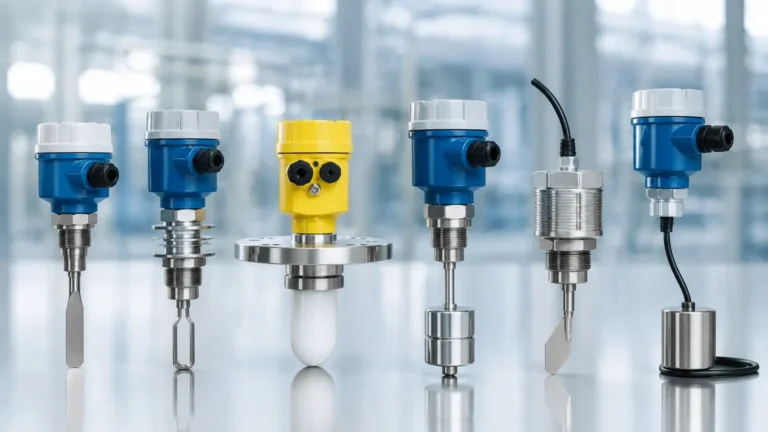
A floatless level switch is an electronic or electrical device designed to detect the presence or absence of a medium at a specific height without relying on a floating element. While the term "floatless level switch" is frequently used to describe conductive electrode systems in water and wastewater applications, it also encompasses a broader category of Level Switches including capacitive, vibrating fork, and ultrasonic point-level sensors.
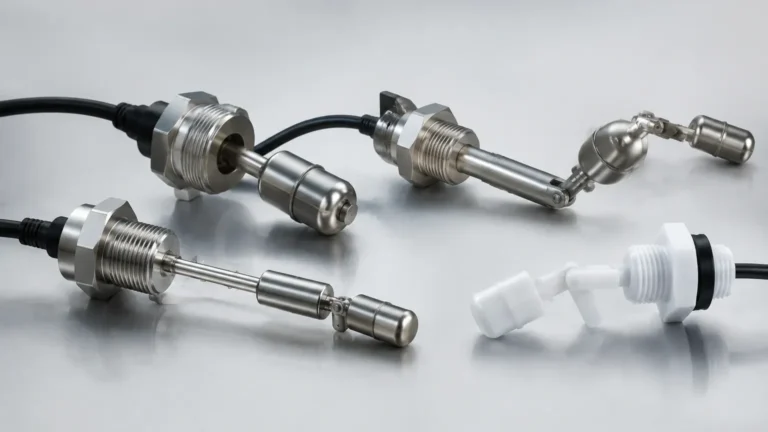
The primary advantage of these systems is the elimination of mechanical wear. In applications involving viscous liquids, wastewater with high solid content, or corrosive chemicals, mechanical floats often fail because the pivot points seize or the float becomes weighed down by buildup. Floatless designs bypass these issues by using electrical properties or physical vibrations to sense the medium.
Measurement Principles
Before selecting a specific technology, it is crucial to understand the physics of how floatless systems interact with the process material. The three most common principles used in floatless level switches are conductivity, capacitance, and vibration.
1. Conductive Principle
Conductive level switches use the liquid itself as part of an electrical circuit. The system typically consists of a controller and a set of stainless steel electrodes (probes) submerged in the tank. When the liquid reaches the level of a probe, it completes a low-voltage AC circuit between that probe and a reference probe (or the metal tank wall). The controller detects this current flow and toggles a relay.
* Requirement: The liquid must be conductive (typically >20 μS/cm).
* Common Use: Water tanks, boiler feed systems, and wastewater sumps.
2. Capacitive Principle
Capacitance switches treat the sensor probe and the tank wall as two plates of a capacitor. The air or vapor space acts as the initial dielectric. As the liquid (which has a different dielectric constant than air) rises and covers the probe, the total capacitance of the system changes. The internal electronics detect this change and trigger the switch.
* Requirement: A measurable difference in dielectric constant between the air and the medium.
* Common Use: Non-conductive oils, powders, and chemical storage.
3. Vibrating (Tuning Fork) Principle
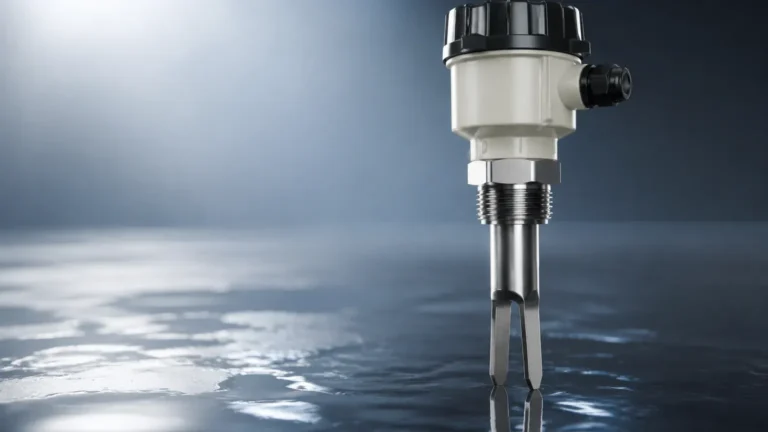
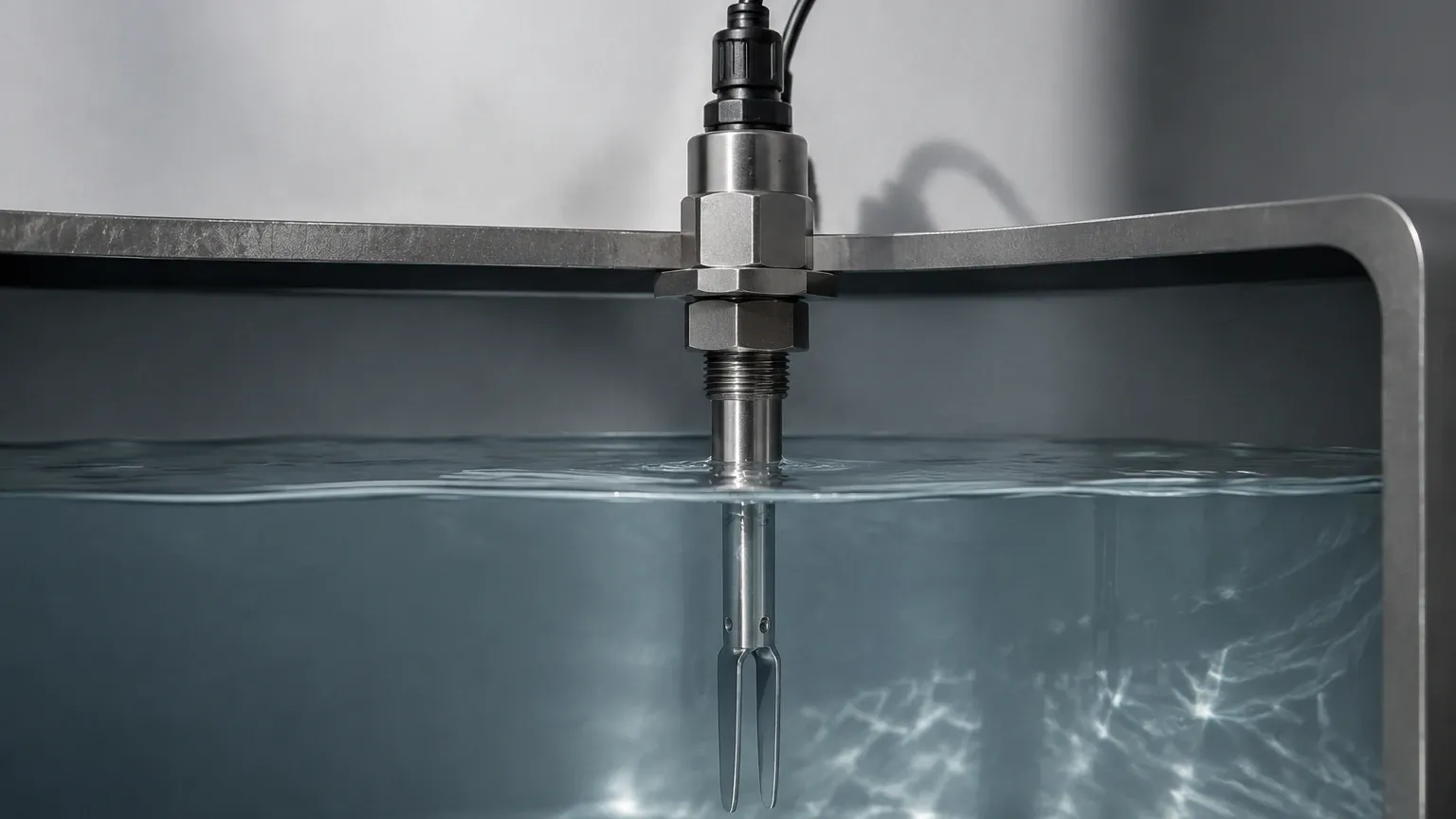
The sensor consists of a fork-shaped element that is vibrated at its natural resonance frequency by a piezoelectric crystal. When the fork is immersed in a liquid or solid, the frequency of vibration shifts or the amplitude is dampened. This change is processed by the electronics to indicate the presence of the material.
* Requirement: The medium must have sufficient density to dampen the vibration.
* Common Use: Overfill protection, pump dry-run prevention, and high-level alarms in diverse media.
Key Technologies in Floatless Level Control
Conductive Electrode Systems
Often referred to as the "classic" floatless level switch, these systems are highly cost-effective for conductive liquids. They usually involve a multi-probe assembly where different probe lengths correspond to "High," "Low," and "Common" levels.
* Advantages: No moving parts, simple to trim probes to the desired length on-site, and low initial cost.
* Limitations: Cannot be used with flammable liquids (due to electrical current), non-conductive oils, or liquids that leave an insulating coating on the probes.
Vibrating Fork Switches
Vibrating fork switches are among the most versatile floatless options. They are largely unaffected by the chemical properties of the liquid, turbulence, or bubbles. Because they rely on mechanical resonance rather than electrical conductivity, they are suitable for a wide range of industrial fluids.
* Advantages: Extremely reliable, maintenance-free, and suitable for high-pressure or high-temperature environments.
* Limitations: Not ideal for very thick, sticky media that might bridge the gap between the forks.
Capacitance Point Level Switches
Capacitive switches are ideal for media that do not conduct electricity. Modern capacitive switches often include "active shield" technology to ignore the effects of material buildup on the probe, which was a historical weakness of this technology.
* Advantages: Can detect levels through non-metallic tank walls; works with granules and powders as well as liquids.
* Limitations: Requires calibration for specific media; performance can drift if the moisture content of the medium changes significantly.
Practical Selection Table
Choosing the right floatless level switch requires matching the technology to the application's physical and chemical constraints. The following table provides a quick reference for common selection criteria.
| Feature | Conductive Probes | Vibrating Fork | Capacitance Switch |
| :— | :— | :— | :— |
| Best Media | Water, Acids, Alkalis | Most Liquids, Slurries | Oils, Powders, Solids |
| Conductivity Req. | Required (>20 μS/cm) | Not Required | Not Required |
| Viscosity Limit | Low (Avoid coating) | Medium to High | Medium (If shielded) |
| Moving Parts | None | None (Vibration only) | None |
| Pressure Range | Up to 10 bar (Typical) | Up to 64 bar+ | Up to 40 bar |
| Temperature | Up to 150°C | Up to 250°C | Up to 200°C |
| Installation | Top-down only | Top, Side, or Bottom | Top or Side |
Installation Considerations
To ensure the longevity and accuracy of floatless level switches, engineers should follow these installation best practices:
1. Avoid the Fill Stream: Never install a level switch directly under a tank's inlet. The turbulence and falling liquid can cause false triggers or premature wear on the sensor body.
2. Stilling Wells: In tanks with heavy agitation or surface waves, conductive probes and vibrating forks should be installed inside a stilling well (a vertical pipe with vent holes) to provide a stable liquid surface for measurement.
3. Grounding: For conductive level switches, proper grounding is essential. If the tank is non-metallic (plastic or fiberglass), a dedicated "common" or "ground" electrode must be used that reaches deeper than the lowest control probe.
4. Orientation: Vibrating forks should be oriented so that liquid can easily drain off the blades. If installed horizontally, the blades should be oriented vertically (on edge) to prevent material from resting on the flat surfaces.
5. Proximity to Walls: Capacitive switches must be installed with a specific clearance from the tank wall to prevent interference with the electromagnetic field, unless the wall is intended to be the reference electrode.
Limitations and Common Risks
While floatless level switches solve many problems associated with mechanical floats, they are not universal solutions. Users should be aware of the following risks:
* Coating and Scaling: If a medium leaves a conductive film on the insulation of a conductive probe, it can create a "bridge" to the tank wall, causing the controller to think the tank is full when it is empty. In such cases, vibrating forks or specialized capacitive switches with buildup compensation are preferred.
* Foam Presence: Conductive probes may trigger on foam if it is sufficiently wet, which might be undesirable if only the liquid level needs to be measured. Conversely, some ultrasonic or optical switches might fail to see the liquid through a thick foam layer.
* Dielectric Changes: For capacitive sensors, if a process switches between different fluids (e.g., switching from an oil-based product to a water-based product), the sensor will require recalibration because the dielectric constants differ significantly.
Frequently Asked Questions (FAQs)
Q: Can floatless level switches be used in deionized (DI) water?
A: Standard conductive level switches will not work in DI water because the conductivity is too low. For DI water, a vibrating fork or capacitive switch is the recommended floatless alternative.
Q: Do floatless level switches require a specific power supply?
A: Most industrial floatless switches operate on standard 24V DC or 110/220V AC. Conductive probe systems typically use a separate DIN-rail mounted controller that provides a low-voltage AC signal to the probes to prevent electrolysis.
Q: How do I handle applications with high solids or sludge?
A: Vibrating fork switches are generally the most robust for sludge, provided the solids do not bridge the forks. Conductive probes can work if they are cleaned regularly, but they are more prone to false signals from debris.
Q: Can I use floatless switches for continuous level measurement?
A: No, floatless level switches are point-level devices (On/Off). For continuous measurement (0-100%), you would need a radar, ultrasonic, or hydrostatic level transmitter.
Conclusion
Floatless level switches provide a robust, low-maintenance solution for industrial level control by removing the mechanical vulnerabilities of traditional floats. Whether utilizing the electrical conductivity of a fluid, the dielectric properties of a chemical, or the mechanical resonance of a tuning fork, these devices offer precision and longevity in demanding environments. When selecting a system, always verify the conductivity, viscosity, and chemical compatibility of the media to ensure the chosen technology aligns with the operational requirements of the facility.
For more detailed technical specifications and to explore various models tailored to specific industrial needs, you can Review product options and application support to find the ideal configuration for your project.