Level Switch Optical
Level Switch Optical
In the landscape of industrial automation and process control, point level detection serves as a critical safety and operational threshold. Among the various technologies available, the level switch optical stands out as a compact, solid-state solution designed for high-precision detection in clean liquids. Unlike mechanical float switches that rely on moving parts, or ultrasonic sensors that require complex signal processing, optical switches utilize the fundamental principles of light refraction and reflection to determine the presence or absence of a medium.
This guide explores the engineering principles behind optical level detection, provides technical selection criteria, and outlines practical installation strategies for integrating these sensors into industrial systems.
Measurement Principle of Optical Level Sensors
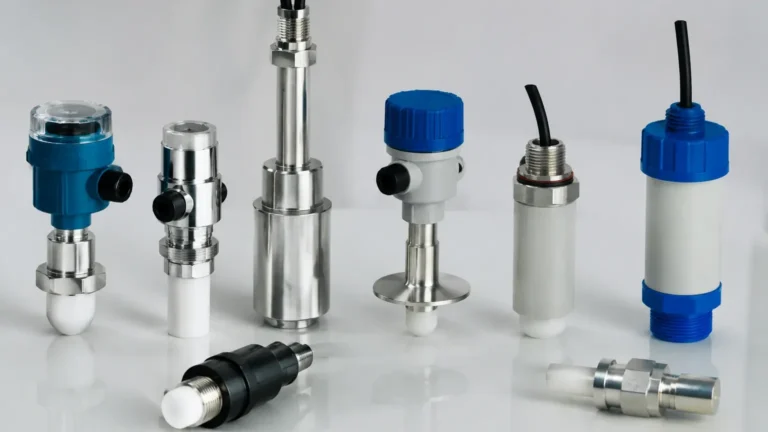
The operation of a level switch optical is based on the change in the refractive index between air (or gas) and liquid. The sensor typically consists of two primary components housed within a transparent tip (usually made of polysulfone, glass, or stainless steel with a sapphire prism): an infrared Light Emitting Diode (LED) and a phototransistor (receiver).
Reflection in Air
When the sensor tip is surrounded by air or gas, the infrared light emitted by the LED is internally reflected within the prism. Due to the difference in the refractive index between the prism material and the surrounding air, the light undergoes total internal reflection and is directed back to the phototransistor. The receiver detects a high light intensity, signaling a "dry" state.
Refraction in Liquid
When the liquid level rises and submerses the sensing tip, the refractive index of the liquid (which is closer to that of the prism material than air is) allows the light to escape the prism and dissipate into the fluid. Consequently, the amount of light returning to the phototransistor drops significantly. This loss of signal is processed by the internal electronics to trigger a switching output, signaling a "wet" state.
Because this technology does not require contact with a moving part, it is exceptionally reliable for long-term use in applications where mechanical wear would otherwise lead to failure. For a broader look at various point-level technologies, engineers often compare these to other Level Switches to ensure the best fit for specific chemical or physical environments.
Key Advantages of Optical Level Switches
Choosing a level switch optical offers several distinct advantages for B2B industrial applications:
1. Compact Form Factor: These sensors are often no larger than a standard bolt, making them ideal for tight spaces in laboratory equipment, small tanks, or hydraulic reservoirs.
2. No Moving Parts: The absence of floats or linkages eliminates mechanical fatigue and prevents sticking caused by debris or calcification.
3. High Sensitivity: They can detect even minute amounts of liquid, making them excellent for leak detection in double-walled tanks or drip trays.
4. Orientation Versatility: Optical switches can be installed horizontally, vertically, or at an angle, provided the prism is positioned to allow liquid to drain away when the level drops.
5. Fast Response Time: The transition between states is nearly instantaneous, which is vital for high-speed filling lines or overfill protection.
Technical Selection Criteria
When specifying a level switch optical for a project, engineers must evaluate the compatibility of the sensor materials and the physical properties of the liquid. The following table provides a reference for common selection parameters:
Selection Reference Table
| Parameter | Requirement/Specification | Notes |
| :— | :— | :— |
| Media Type | Clean, non-coating liquids | Avoid highly viscous or crystallizing fluids. |
| Housing Material | Stainless Steel (316L), Polysulfone, or PFA | Must be chemically compatible with the process fluid. |
| Pressure Range | Up to 50 bar (725 psi) | High-pressure versions often use glass or sapphire tips. |
| Temperature Range | -40°C to +125°C (-40°F to 257°F) | Standard electronics may require cooling or remote mounting for higher temps. |
| Output Type | NPN, PNP, or Relay | Ensure compatibility with the PLC or control system. |
| Supply Voltage | 5V DC to 24V DC | Common in industrial automation circuits. |
| Connection Thread | G 1/2", NPT 1/2", or M12 | Standard industrial threading for easy integration. |
Installation Considerations and Best Practices
Successful deployment of a level switch optical requires attention to the physical environment of the tank or pipe. While the technology is robust, certain optical interferences can lead to false readings.
Avoiding Ambient Light Interference
Since the sensor relies on infrared light, high-intensity ambient light (such as direct sunlight or powerful halogen lamps) can occasionally saturate the phototransistor. Most modern industrial sensors include IR filters and modulated light frequencies to mitigate this, but it is still recommended to avoid placing the sensor tip directly opposite a strong light source or a highly reflective surface (like a polished stainless steel wall) within 10mm to 20mm of the tip.
Orientation and Drainage
To prevent false "wet" signals caused by residual droplets, the sensor should be installed in a way that allows liquid to drain naturally off the prism. If installed horizontally, the tip should be slightly angled downward. If installed in a pipe, ensure that the sensor is not placed at the very bottom where sediment might collect, nor at the very top where air pockets might persist in a full-pipe application.
Wiring and Integration
Most optical switches are three-wire devices (Power, Ground, and Signal). It is essential to verify whether the application requires a "Normally Open" (NO) or "Normally Closed" (NC) logic. For safety-critical applications like overfill prevention, an NC configuration is preferred, as a power failure or a cut wire will trigger a "full" alarm, allowing for a fail-safe shutdown.

Limitations and Risks
While the level switch optical is highly effective, it is not a universal solution. Engineers should be aware of the following limitations:
* Coating and Film Build-up: If the liquid is highly viscous (e.g., heavy oils, syrups) or leaves a thick film upon receding, the prism may remain "wetted" in the eyes of the sensor, preventing it from returning to a "dry" state.
* Bubbles and Foam: Large bubbles can occasionally cause a momentary "dry" signal in a submerged sensor. Conversely, dense foam can sometimes be detected as a liquid, depending on the opacity and density of the foam.
* Turbidity: Extremely opaque liquids or those with high concentrations of suspended solids may absorb the light rather than refracting it, though this often mimics the "wet" state and can be accounted for in the calibration.
Comparison: Optical vs. Other Technologies
To provide context for the level switch optical, it is helpful to compare it against other common Level Switches used in B2B environments.
* Vibrating Tuning Fork: Better for viscous liquids and foam, but significantly larger and more expensive than optical sensors.
* Float Switches: Lower cost and simple to understand, but prone to mechanical failure and unsuitable for liquids with debris.
* Capacitive Switches: Effective for a wide range of liquids but can be sensitive to changes in the dielectric constant of the fluid or moisture on the tank wall.
Frequently Asked Questions (FAQ)
Q: Can an optical level switch detect the interface between two liquids?
A: Generally, no. Optical switches are designed to detect the presence or absence of a liquid relative to air. They cannot reliably distinguish between two liquids (like oil and water) unless there is a very significant and consistent difference in their refractive indices, and even then, it is not a standard application.
Q: Is the level switch optical suitable for food and beverage applications?
A: Yes, provided the housing is made of food-grade materials like 316L stainless steel and PFA or Polysulfone. Many models are designed to meet hygienic standards, though the potential for coating must be evaluated.
Q: How do I clean the sensor tip?
A: Most sensors can be cleaned with standard industrial solvents or soapy water. It is vital to avoid abrasive cleaners that could scratch the prism, as scratches can scatter light and degrade the accuracy of the sensor.
Q: Can these sensors work in vacuum conditions?
A: Yes. Because the measurement principle is optical and the sensors are typically hermetically sealed, they function perfectly well in vacuum chambers where mechanical or pressure-based sensors might struggle.
Conclusion
The level switch optical represents a sophisticated yet cost-effective solution for point level detection in modern industrial processes. By understanding the physics of light refraction and carefully matching sensor materials to the process media, engineers can implement a maintenance-free monitoring system that enhances both safety and efficiency. Whether used for low-level alarms in hydraulic reservoirs or high-level protection in water treatment tanks, the optical switch remains a cornerstone of reliable fluid management.