Non Magnetic Liquid Level Switches
Non Magnetic Liquid Level Switches
In industrial process control, point level detection is a critical safety and operational requirement. While magnetic float switches have long been a standard solution due to their simplicity, certain applications render magnetic sensing impractical or even hazardous. Non magnetic liquid level switches utilize alternative physical principles—such as vibration, ultrasonics, optics, or capacitance—to detect the presence or absence of a medium. These technologies are essential in environments where metallic particles are present, where magnetic interference must be avoided, or where the physical properties of the liquid (such as high viscosity or aggressive chemical nature) would cause mechanical floats to fail.
Selecting the correct non magnetic liquid level switches requires a deep understanding of the underlying measurement principles and how they interact with specific process fluids. This guide examines the primary technologies used in non-magnetic level detection, their selection criteria, and best practices for industrial installation.
Measurement Principles of Non-Magnetic Technologies
To move away from magnetic dependency, engineers must leverage other physical interactions between a sensor and the liquid medium. The following principles represent the most common methods for non-magnetic point level detection.
1. Vibrating Fork (Tuning Fork) Principle
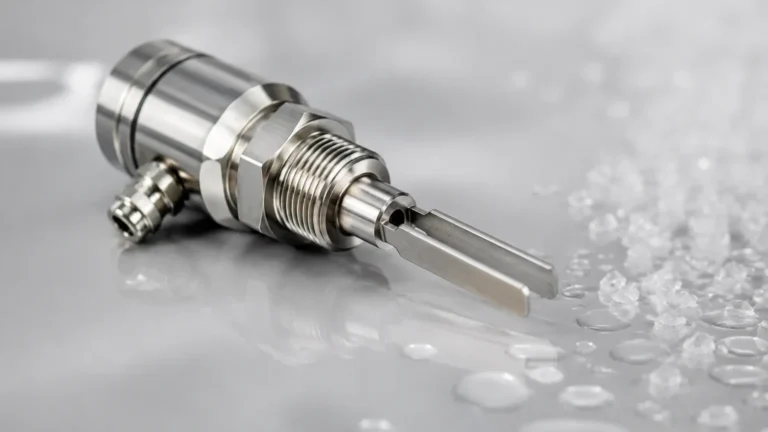
The vibrating fork sensor utilizes piezoelectric crystals to energize a metal fork, causing it to vibrate at its natural resonant frequency in air. When the fork is submerged in a liquid, the frequency of vibration changes due to the damping effect of the medium. An internal electronic circuit detects this frequency shift and converts it into a switching signal. Because this method relies on mechanical resonance rather than magnetic attraction, it is immune to the presence of ferrous debris in the fluid.
2. Ultrasonic Gap Principle
Ultrasonic gap switches consist of two piezoelectric crystals mounted opposite each other across a small physical gap. One crystal acts as a transmitter, sending a high-frequency sound signal, while the other acts as a receiver. In air, the signal cannot cross the gap effectively. When liquid fills the gap, the sound waves are transmitted through the fluid to the receiver, triggering the switch. This "wet/dry" logic is highly reliable for clean liquids and is completely non-magnetic.
3. Capacitive Principle
Capacitance level switches measure the change in electrical capacitance between a sensing electrode and the tank wall (or a reference electrode). Every liquid has a specific dielectric constant. When the liquid covers the sensor probe, the capacitance increases significantly compared to the air or vapor space. This technology is versatile but requires careful calibration to account for the dielectric properties of the specific liquid being measured.
4. Optical Refraction Principle
Optical sensors use an infrared LED and a light receiver housed within a conical prism. When the sensor is in air, the infrared light is reflected internally within the prism back to the receiver. When liquid immerses the prism, the light is refracted into the liquid rather than being reflected back. This loss of signal at the receiver indicates the presence of the liquid. These sensors are extremely compact and contain no moving parts or magnets.
5. Conductive Principle
Conductive level switches are perhaps the simplest non-magnetic option. They use a low-voltage electrode to detect the completion of an electrical circuit when a conductive liquid bridges the gap between the electrode and the tank wall. While highly effective for water-based media, they cannot be used with oils, distilled water, or other non-conductive hydrocarbons.
Key Evaluation Criteria for Selection
When specifying non magnetic liquid level switches, engineers must evaluate the following factors to ensure long-term reliability and accuracy.
Media Properties
* Viscosity: High-viscosity liquids can cause "clinging" on vibrating forks or optical prisms, leading to false positives. In such cases, ultrasonic gap switches or capacitance sensors with active shield technology are preferred.
* Conductivity: If the liquid is non-conductive (e.g., fuel, oil), conductive switches are ruled out, leaving vibrating forks or capacitive sensors as the primary options.
* Ferrous Content: In metalworking or recycling applications, liquids may contain iron filings. Non-magnetic switches are mandatory here, as magnetic floats would attract the debris, leading to mechanical jamming.
Process Conditions
* Temperature and Pressure: Piezoelectric elements in vibrating forks and ultrasonic sensors have specific temperature limits, typically ranging from -50°C to +150°C (-58°F to 302°F). High-pressure environments (above 40 bar / 580 psi) may require specialized heavy-duty housings.
* Turbulence and Foam: Heavy foam can cause false triggers in optical and ultrasonic sensors. Vibrating forks are generally more robust in foaming applications as they can be tuned to ignore the low-density foam and only react to the liquid phase.
Material Compatibility
The wetted parts of the switch must be chemically compatible with the process media. Common materials include 316L stainless steel, Hastelloy, and various plastics like PFA or PP for corrosive acids.
Technical Comparison Table
| Technology | Best For | Sensitivity to Coating | Moving Parts | Media Conductivity Required |
| :— | :— | :— | :— | :— |
| Vibrating Fork | General purpose, foam | Moderate | No (Vibrates) | No |
| Ultrasonic Gap | Clean liquids, oils | High | No | No |
| Capacitance | Slurries, interface | Low (with shield) | No | No |
| Optical | Compact spaces, OEM | High | No | No |
| Conductive | Water, acids, alkalis | Low | No | Yes |
Installation Considerations
Proper installation is as critical as technology selection. Even the most advanced non magnetic liquid level switches will fail if positioned incorrectly.
1. Orientation: Most vibrating forks can be installed horizontally or vertically. However, if installed horizontally, the forks should be oriented so that liquid can drain off them easily to prevent material buildup.
2. Nozzle Length: For ultrasonic and optical sensors, the sensing element must extend past the mounting nozzle into the tank. If the sensor is recessed within a nozzle, air pockets or liquid droplets can become trapped, leading to incorrect readings.
3. Avoid Turbulence: Sensors should not be placed directly in the path of a fill stream. The kinetic energy of the incoming liquid can cause premature wear or false switching. If a turbulent area is unavoidable, a stilling well or a protective baffle should be used.
4. Electrical Shielding: Especially for capacitive switches, ensuring the sensor is properly grounded to the metal tank (or using a reference electrode in plastic tanks) is essential to prevent signal drift.
Limitations and Risks
While non-magnetic switches solve many problems, they are not without limitations:
* Coating and Scaling: Many non-magnetic technologies are sensitive to material buildup. For example, a thick layer of dried resin on an optical prism will prevent it from functioning. Regular maintenance and cleaning cycles must be established for coating-prone media.
* Power Requirements: Unlike simple reed-based magnetic float switches which can often operate as passive components, most non-magnetic switches (vibrating, ultrasonic, optical) require an active power supply (typically 24V DC or 110/220V AC) to drive the internal electronics.
* Ambient Light: In the case of optical switches, extremely bright ambient light or infrared sources near a glass tank could potentially interfere with the sensor if not properly shielded.
Frequently Asked Questions (FAQs)
Q: Can non-magnetic switches be used in hazardous (Ex) areas?
A: Yes. Most vibrating fork and capacitive switches are available with ATEX, IECEx, or UL intrinsic safety or explosion-proof certifications. The absence of a magnet does not change the requirement for spark-free electronics in volatile environments.
Q: Do these switches require periodic calibration?
A: Vibrating forks and ultrasonic gap switches are typically "plug-and-play" and do not require field calibration. Capacitance switches, however, often require a one-time calibration to set the threshold based on the specific dielectric constant of the liquid.
Q: Are non-magnetic switches suitable for hygienic applications?
A: Absolutely. Many non-magnetic designs feature smooth, polished stainless steel surfaces and Tri-Clamp fittings, making them ideal for the food, beverage, and pharmaceutical industries where magnetic floats might harbor bacteria in mechanical crevices.
Conclusion
Transitioning to non magnetic liquid level switches allows for greater flexibility in challenging industrial environments, particularly where magnetic interference or fluid contamination is a concern. By selecting a technology based on the physical properties of the liquid—whether it be the damping of a vibration or the refraction of light—engineers can achieve higher reliability and lower maintenance overhead. For those currently designing a system or looking to replace failing mechanical components, reviewing professional Level Switches options will provide the necessary technical specifications to ensure a compatible fit for the application's specific pressure, temperature, and chemical requirements.