Local Gauge Meaning
Local Gauge Meaning
In the context of industrial process control and fluid management, understanding the local gauge meaning is essential for ensuring plant safety, operational redundancy, and accurate manual monitoring. While modern industrial facilities are increasingly automated, the requirement for a physical, on-site visual representation of tank levels remains a cornerstone of engineering best practices.
At its most fundamental level, a local gauge refers to a measurement instrument installed directly on a process vessel or pipeline that provides a visual reading to an operator standing in the immediate vicinity. Unlike transmitters that send data to a Distributed Control System (DCS) or Programmable Logic Controller (PLC), a local gauge operates independently of external power sources, making it a critical fail-safe in industrial environments.
The Fundamental Principles of Local Level Measurement
Before selecting a specific instrument, it is necessary to understand the physics that govern local level indication. Most Magnetic & Local Level Gauges rely on the principle of communicating vessels. This principle, derived from Pascal’s Law, states that a liquid in a set of connected containers will maintain the same level in each container, provided the liquid density is uniform and the pressure above the liquid is equal.
In a typical bypass installation, a chamber is mounted to the side of a tank via process connections. As the liquid level in the main tank rises or falls, the level within the chamber moves in synchronization. The local gauge then employs one of several methods to make this internal level visible to the human eye from the outside.
Displacement and Buoyancy
For magnetic variants, the measurement relies on Archimedes' Principle. A float is designed with a specific buoyancy to match the density (specific gravity) of the process medium. This float contains an internal magnet assembly. As the float rises and falls with the liquid level, its magnetic field penetrates the chamber wall to interact with an external indicating scale.
Types of Local Level Gauges
Understanding the local gauge meaning requires a breakdown of the different technologies used to achieve on-site visualization. Each type has specific applications based on pressure, temperature, and the chemical nature of the fluid.
1. Magnetic Level Gauges (MLG)
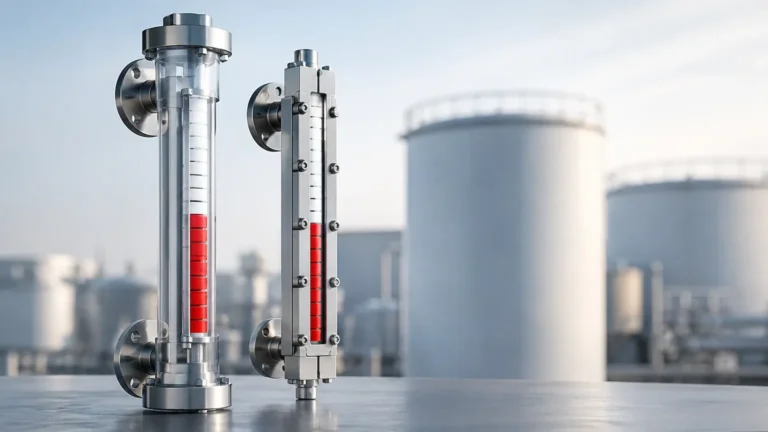
These are the industry standard for high-pressure and hazardous applications. Because the liquid is entirely contained within a sealed metallic or plastic chamber, there is no risk of glass breakage or leakage. The indicator consists of bi-color flaps or rollers that flip 180 degrees as the magnetic float passes them, typically changing from white to red to indicate the presence of liquid.
2. Reflex Glass Gauges
Reflex gauges use a prism-shaped glass window. The principle of light refraction allows the operator to see a clear distinction between gas and liquid. Light hitting the glass in the gas phase is reflected back to the observer, appearing silvery-white. Light hitting the liquid phase is absorbed, making the liquid appear dark or black.
3. Transparent Glass Gauges
These feature two pieces of transparent glass on opposite sides of the chamber. This allows light to pass through the medium, which is useful for observing the color of the liquid, interface levels between two different liquids, or for use in high-pressure steam applications where a reflex gauge might be difficult to read.
4. Tubular Glass Gauges
The simplest form of local gauge, consisting of a transparent tube connected to the tank. While cost-effective, they are limited to low-pressure, non-hazardous applications due to the risk of the tube shattering.
Technical Comparison Table
| Feature | Magnetic Level Gauge | Reflex Glass Gauge | Transparent Glass Gauge | Tubular Gauge |
| :— | :— | :— | :— | :— |
| Pressure Range | Up to 400 bar (5800 psi) | Up to 250 bar (3625 psi) | Up to 250 bar (3625 psi) | Up to 10 bar (145 psi) |
| Temp Range | -196°C to 450°C | -30°C to 400°C | -30°C to 400°C | 0°C to 100°C |
| Visibility | Excellent (High contrast) | Good (Liquid vs Gas) | Moderate (Requires light) | Good (Clear fluids) |
| Hazardous Fluids | Highly Recommended | Limited | Limited | Not Recommended |
| Maintenance | Low | Moderate (Cleaning glass) | Moderate (Cleaning glass) | High (Fragility) |
The Strategic Role of Local Gauges in B2B Operations
In a B2B engineering context, the local gauge meaning extends beyond simple measurement; it is a tool for risk mitigation. Engineers specify these devices for several strategic reasons:
* Power Independence: In the event of a total plant power failure, electronic sensors (radar, ultrasonic, or hydrostatic) will cease to function. A local gauge continues to provide accurate data, allowing operators to manage manual shutdowns or emergency drainage safely.
* Calibration Verification: Local gauges serve as the "gold standard" for verifying the accuracy of electronic transmitters. If a radar sensor reports a 50% level but the local magnetic gauge shows 45%, maintenance teams know immediately that a recalibration or inspection is required.
* Safety Interlocks: Many local gauges can be fitted with magnetic switches or reed chains. This allows the device to act as both a visual indicator and a point-level alarm or continuous transmitter, providing two functions in a single process penetration.

Installation and Engineering Considerations
To ensure the local gauge provides accurate data, several installation factors must be addressed during the design phase.
Process Connections
The gauge is typically connected via flanges or NPT/BSP threads. The distance between the center of the top connection and the center of the bottom connection is known as the "Center-to-Center" (C-C) distance. This must match the tank's nozzle configuration exactly.
Venting and Draining
Every local gauge should be equipped with a vent valve at the top and a drain valve at the bottom. This allows the chamber to be isolated from the process, drained for maintenance, and vented to prevent air pockets from affecting the level reading.
Specific Gravity (SG) Matching
For Magnetic & Local Level Gauges, the float must be engineered for the specific gravity of the fluid. If the fluid is lighter than the float's design (e.g., a float designed for water used in oil), the float will sink, providing a false low reading. Conversely, if the fluid is much denser, the float will sit too high, leading to a false high reading.
Insulation and Heat Tracing
In applications involving high-viscosity liquids or fluids that solidify at ambient temperatures (like bitumen or certain chemicals), the gauge chamber may require steam or electric heat tracing and thermal insulation to ensure the fluid remains mobile enough for the float to move freely.
Limitations and Operational Constraints
While highly reliable, local gauges are not universal solutions. Engineers must be aware of the following limitations:
1. Viscosity: Extremely viscous fluids can cause the float to stick to the chamber walls or move too slowly to reflect real-time changes.
2. Particulates: Magnetic particles in the process fluid can accumulate on the float's magnet, eventually weighing it down or causing it to jam against the chamber wall. In such cases, magnetic filters or traps are required.
3. Coating: Fluids that leave heavy deposits or scale can obscure the glass in traditional gauges or impede float movement in magnetic types.
4. Physical Access: By definition, a "local" gauge must be visible. If a tank is 20 meters (65 feet) high, a local gauge at the top is useless unless there is a walkway or platform for the operator.
Frequently Asked Questions (FAQ)
Q: Can a local gauge be used for interface measurement?
A: Yes. Specifically, magnetic level gauges can be equipped with a float weighted to sink through the upper (lighter) liquid and float on the lower (heavier) liquid, effectively showing the interface level.
Q: What is the difference between a local gauge and a level transmitter?
A: A local gauge provides a visual reading at the source without power. A level transmitter converts the level into an electrical signal (like 4-20mA or HART) to be read at a remote location, such as a control room.
Q: How often do local gauges require maintenance?
A: This depends on the fluid. For clean, non-corrosive liquids, an annual inspection is often sufficient. For fluids that tend to scale or contain solids, quarterly cleaning of the chamber and float may be necessary.
Q: Are local gauges suitable for cryogenic applications?
A: Yes, but they require specialized construction. Magnetic level gauges for cryogenic service often feature vacuum-jacketed chambers to prevent heat gain and specialized frost-free extensions on the indicator scale to ensure visibility at temperatures as low as -196°C (-320°F).
Conclusion
The local gauge meaning centers on providing a reliable, power-independent, and highly visible method of process monitoring. Whether used as a primary indicator in small-scale operations or as a critical safety backup in large industrial complexes, instruments like Magnetic & Local Level Gauges ensure that operators always have a direct window into the status of their assets. By carefully considering fluid properties, pressure requirements, and installation geometry, engineering teams can implement local gauging solutions that enhance both the safety and efficiency of their facilities.