1702 N Main St Pearland Tx 77581
1702 N Main St Pearland Tx 77581
Industrial operations in the Gulf Coast region, particularly around the Houston metropolitan area, demand rigorous standards for process control and instrumentation. For facilities managing fluid storage, chemical processing, or water treatment, the accuracy of level measurement systems is a critical factor in operational safety and efficiency. This guide examines the core technologies of industrial level measurement, selection criteria for harsh environments, and the technical support resources available near 1702 n main st pearland tx 77581 for regional engineering projects.
Fundamentals of Level Measurement Principles
Before selecting an instrument for a specific application, it is essential to understand the physical principles that govern different measurement technologies. Level measurement is generally categorized into continuous measurement and point level detection.
Radar Level Measurement (ToF)
Radar level meters operate on the Time-of-Flight (ToF) principle. The device emits high-frequency electromagnetic waves (typically in the 26 GHz or 80 GHz range) toward the material surface. These waves are reflected back to the sensor. The distance ($D$) is calculated based on the time delay ($t$) and the speed of light ($c$):
$$D = \frac{c \times t}{2}$$
Non-contact radar is highly valued in the chemical and oil industries because it does not physically touch the medium, making it ideal for corrosive or high-temperature substances. Guided Wave Radar (GWR) is a variation that uses a probe to direct the signal, which is particularly effective in low-dielectric liquids or applications with heavy turbulence.
Ultrasonic Level Sensing
Similar to radar, ultrasonic sensors use the ToF principle but employ sound waves instead of electromagnetic waves. A transducer emits an ultrasonic pulse that bounces off the liquid surface. This technology is cost-effective for water and wastewater applications. However, because sound requires a medium to travel, ultrasonic sensors are sensitive to air temperature fluctuations, heavy foam, and vacuum conditions.
Hydrostatic Level Transmitters
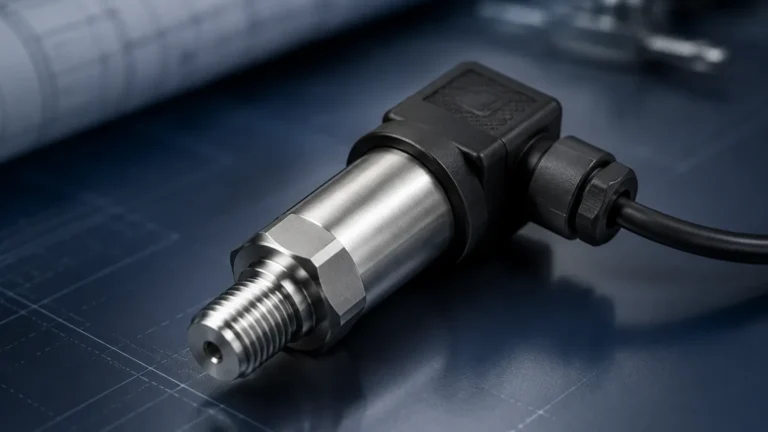
Hydrostatic measurement relies on the relationship between liquid height and the pressure exerted at the bottom of a vessel. The pressure ($P$) is proportional to the height ($h$), the density of the liquid ($\rho$), and gravity ($g$):
$$P = \rho \times g \times h$$
By measuring the pressure at a fixed point, the transmitter can calculate the level. This method is robust and widely used in open tanks and deep wells, though it requires consistent liquid density for high accuracy.
Magnetic Level Gauges
Magnetic level gauges provide a high-visibility mechanical solution. They consist of a bypass chamber connected to the vessel. Inside the chamber, a float containing a permanent magnet moves with the liquid level. Outside the chamber, magnetized flaps or a follower indicate the level. This technology is preferred for high-pressure boilers and toxic chemical storage where power-free local indication is required for safety.
Selecting Level Instruments for Texas Industrial Applications
The environmental conditions in Pearland, Texas, and the surrounding industrial corridors present specific challenges, such as high ambient humidity and extreme summer temperatures. When evaluating hardware from providers associated with 1702 n main st pearland tx 77581, engineers must prioritize ingress protection (IP) ratings and temperature compensation features.
Media Characteristics
* Dielectric Constant: Low-dielectric fluids (like oils) reflect radar signals poorly, necessitating high-frequency 80 GHz radar or Guided Wave Radar.
* Viscosity: Highly viscous fluids can coat probes, affecting GWR or float-based systems. Non-contact radar or hydrostatic sensors are often better suited here.
* Corrosivity: For acidic or alkaline media, PTFE or PFA-lined sensors are mandatory to ensure longevity.
Practical Selection Criteria and Comparison Table
The following table provides a technical comparison of common level measurement technologies used in the field.
| Technology | Accuracy | Max Range | Media Type | Key Advantage |
| :— | :— | :— | :— | :— |
| 80 GHz Radar | ±1 mm | 120 m | Liquids/Solids | Non-contact, ignores dust/vapor |
| Guided Wave Radar | ±2 mm | 30 m | Liquids/Interface | Works in low dielectric media |
| Ultrasonic | ±0.25% FS | 15 m | Water/Slurries | Cost-effective for simple tanks |
| Hydrostatic | ±0.1% FS | 200 m | Clean Liquids | Excellent for deep well/boreholes |
| Magnetic Gauge | ±5 mm | 6 m | Hazardous Fluids | No power required for indication |
For a detailed review of specific product specifications and application-specific support, engineers can consult the Main Page of Welk's technical catalog.
Installation Considerations for Process Efficiency
Proper installation is as critical as instrument selection. Failure to account for tank geometry or internal obstructions can lead to false echoes and signal loss.
1. Nozzle Dimensions: For radar and ultrasonic sensors, the nozzle height and diameter must be optimized. If a nozzle is too long or narrow, the signal may reflect off the nozzle wall rather than the liquid surface.
2. Dead Zones (Blocking Distance): Every sensor has a minimum distance it cannot measure (the "dead zone"). This must be accounted for during the design phase to prevent tank overfills.
3. Obstruction Clearance: Agitators, ladders, and heating coils can interfere with signals. Modern radar units use "false echo suppression" software to map out these obstructions, but physical clearance is always preferred.
4. Flange Alignment: For hydrostatic transmitters, ensuring the flange is flush and the seal is airtight is paramount to preventing pressure leaks that skew level readings.

Limitations and Operational Constraints
While modern instrumentation is advanced, every technology has its boundaries:
* Foam: Heavy, dense foam can absorb ultrasonic and radar signals. In these cases, Guided Wave Radar or hydrostatic transmitters are the standard alternatives.
* Vacuum Conditions: Ultrasonic waves cannot travel in a vacuum. Radar or differential pressure (DP) transmitters must be used in vacuum-sealed reactors.
* Temperature Gradients: Rapid temperature changes in the vapor space can affect the speed of sound, leading to errors in ultrasonic readings if the sensor does not have integrated temperature compensation.
Local Support and Resources at 1702 N Main St Pearland Tx 77581
Proximity to technical expertise is a significant advantage for facilities in the Pearland area. The location at 1702 n main st pearland tx 77581 serves as a focal point for industrial services and procurement in the region. Local engineering teams and plant managers often utilize this hub for:
* On-site Calibration: Ensuring that hydrostatic and radar meters are calibrated to NIST-traceable standards.
* Emergency Spares: Rapid access to level switches and transmitters to minimize downtime during unplanned outages.
* Custom Manifold Assembly: Building bypass chambers for magnetic level gauges tailored to specific vessel dimensions.
Working with local experts ensures that the selected instrumentation complies with both international standards (like API or ASME) and regional safety regulations prevalent in the Texas industrial sector.
Frequently Asked Questions (FAQs)
Q: How does 80 GHz radar differ from 26 GHz radar in practical applications?
A: 80 GHz radar has a much narrower beam angle, which allows it to avoid internal tank obstructions more effectively. It also provides better resolution for measuring thin liquid layers or solids with low reflectivity.
Q: Can hydrostatic transmitters be used in pressurized tanks?
A: Yes, but you must use a Differential Pressure (DP) setup. One sensor measures the pressure at the bottom, and another measures the gas pressure at the top. The system subtracts the top pressure to find the true hydrostatic head of the liquid.
Q: What is the maintenance schedule for a magnetic level gauge?
A: Magnetic gauges are relatively low-maintenance. However, the bypass chamber should be flushed periodically to prevent sediment buildup, especially in applications involving heavy oils or wastewater.
Q: Is ultrasonic measurement suitable for chemical storage?
A: It depends on the chemical. If the chemical produces heavy vapors or is stored in a pressurized tank, radar is usually a more reliable choice. For simple atmospheric storage of water-based chemicals, ultrasonic is often sufficient.
Q: What information is needed to get a quote for a level meter near 1702 n main st pearland tx 77581?
A: You should provide the medium name, tank height, operating temperature, operating pressure, process connection type (e.g., 2" ANSI flange), and the required output signal (e.g., 4-20mA HART or Modbus).
By integrating advanced measurement principles with localized technical support, industrial facilities can achieve the high levels of precision required for modern process automation. For further technical data and product comparisons, visiting the Main Page is recommended for engineering professionals.