Ace 2026 Washington Dc
Ace 2026 Washington Dc
The American Water Works Association (AWWA) Annual Conference & Exposition, known as ACE, is the premier event for the global water community. As the industry prepares for ace 2026 washington dc, the focus shifts toward the intersection of infrastructure resilience, regulatory compliance, and advanced automation. For process engineers, water utility managers, and industrial automation specialists, this event serves as a critical platform to evaluate the next generation of level measurement technologies that will define water management for the next decade.
In the context of the 2026 gathering in the U.S. capital, the demand for precise, reliable, and digitally integrated level sensing has never been higher. Whether managing municipal wastewater treatment, industrial process water, or chemical storage, selecting the right instrumentation is fundamental to operational efficiency. This guide examines the core measurement principles and selection criteria that professionals should consider as they look toward the technological landscape of 2026.
Core Measurement Principles in Modern Level Sensing
Before selecting a device for a specific application, it is essential to understand the physics behind the primary measurement technologies. In the water and wastewater sectors, four technologies dominate the market: Radar, Ultrasonic, Hydrostatic, and Magnetic.
1. Radar Level Measurement (ToF)
Radar sensors operate on the Time-of-Flight (ToF) principle. The device emits a high-frequency electromagnetic wave (typically in the 26 GHz or 80 GHz range) toward the medium. The signal reflects off the surface and returns to the sensor. The distance is calculated based on the time interval between emission and reception.
* 80 GHz Technology: The industry trend moving toward 2026 is the adoption of 80 GHz radar. This higher frequency allows for a narrower beam angle, which minimizes interference from internal tank structures like ladders or agitators.
* Advantages: Non-contact, unaffected by temperature fluctuations, vacuum, or high pressure.
2. Ultrasonic Level Sensing
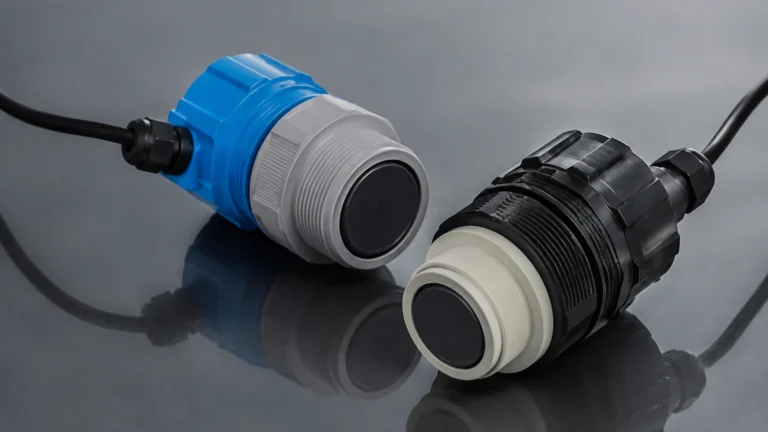
Ultrasonic sensors use sound waves rather than electromagnetic waves. The transducer emits an ultrasonic pulse that bounces off the liquid surface. The time taken for the echo to return is proportional to the distance.
* Considerations: Because sound requires a medium (air) to travel, changes in air temperature, humidity, or the presence of heavy foam can affect the speed of sound and, consequently, the accuracy of the reading.
* Advantages: Highly cost-effective for open-channel flow and simple liquid level monitoring.
3. Hydrostatic Pressure Measurement
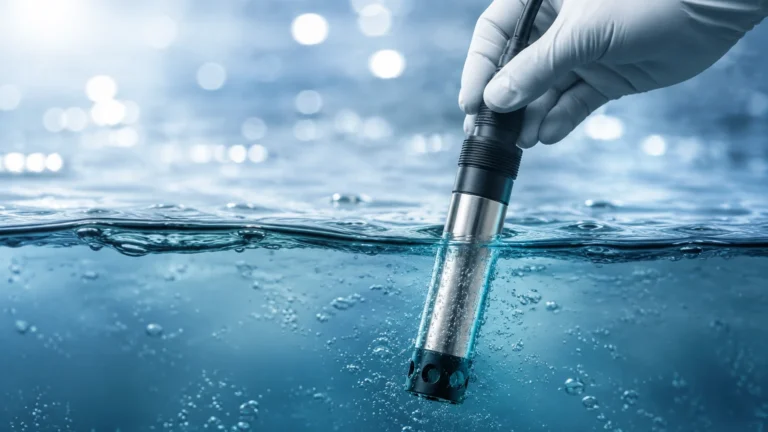
This method measures the liquid level by sensing the pressure exerted by the liquid column at a specific depth. The pressure is directly proportional to the height of the liquid and its density ($P = \rho \cdot g \cdot h$).
* Implementation: Submersible transmitters are common in deep wells and reservoirs, while flange-mounted transmitters are used for vented or pressurized tanks.
* Advantages: Simple installation and high reliability in deep-water applications.
4. Magnetic Level Gauges
Magnetic gauges provide a visual indication and can be equipped with transmitters for remote monitoring. A float containing a magnet moves with the liquid level inside a bypass chamber, flipping magnetic flaps or flags on the outside of the chamber.
* Advantages: No power required for local visual indication; excellent for high-pressure or corrosive chemical tanks.
Technology Selection for Water Industry Applications
When attending events like ace 2026 washington dc, engineers must match technology to the specific constraints of their facility. The following table provides a practical framework for technology selection based on common application types.
| Application | Preferred Technology | Alternative Technology | Key Selection Factor |
| :— | :— | :— | :— |
| Potable Water Reservoirs | Ultrasonic | Radar | Cost vs. Accuracy requirements |
| Wastewater Lift Stations | Radar (80 GHz) | Hydrostatic | Resistance to grease and foam |
| Chemical Dosing Tanks | Radar | Magnetic Gauge | Chemical compatibility of wetted parts |
| Deep Groundwater Wells | Hydrostatic | Guided Wave Radar | Depth of measurement (up to 200m+) |
| Open Channel Flow | Ultrasonic | Radar | Cost-effectiveness for flumes/weirs |
| Sludge Digesters | Radar | Hydrostatic | Presence of turbulence and vapors |
For a comprehensive overview of specific product specifications and to Review product options and application support, consulting a specialized manufacturer is recommended to ensure the instrument meets local regulatory standards.
Critical Installation Considerations
Even the most advanced sensor will fail if installed incorrectly. As we approach 2026, the focus on "smart" installation is increasing to reduce maintenance costs.
1. Beam Path Clearance: For radar and ultrasonic sensors, the signal "cone" must be kept clear of obstructions. A sensor with a 3° beam angle (typical of 80 GHz radar) requires significantly less clearance than a 10° beam angle sensor.
2. Dead Zones (Blocking Distance): Every non-contact sensor has a minimum distance it cannot measure (the dead zone). Ensure the sensor is mounted high enough that the maximum liquid level never enters this zone.
3. Stilling Wells: In applications with heavy turbulence or surface foam, installing the sensor inside a stilling well (a vertical pipe) can stabilize the surface and provide a much cleaner signal.
4. Submersible Venting: Hydrostatic sensors must have a vented cable to compensate for changes in atmospheric pressure. Ensure the vent tube is protected by a moisture filter (desiccant) to prevent internal condensation.
Emerging Trends at ACE 2026 Washington DC
The Washington DC event is expected to highlight several shifts in how level data is utilized within the broader "Water 4.0" framework.
* IIoT Integration: Level meters are no longer isolated devices. Expect to see a heavy emphasis on Bluetooth commissioning, HART (Highway Addressable Remote Transducer) protocols, and cellular-connected sensors that transmit data directly to cloud-based SCADA systems.
* Sustainability and Power Efficiency: With the rise of remote monitoring in decentralized water systems, low-power sensors capable of running on battery or solar power for years are becoming the standard.
* Enhanced Diagnostics: Modern sensors now provide "health scores," alerting operators to buildup on the sensor face or signal degradation before a total failure occurs.

Practical Limitations and Common Risks
While technology has advanced, certain physical limitations remain. Engineers should remain vigilant regarding the following risks:
* Foam Interference: Heavy, dense foam can absorb ultrasonic signals and scatter radar signals. In such cases, hydrostatic or guided wave radar (GWR) is often a more reliable choice.
* Vapor and Condensation: High-humidity environments can lead to condensation on the sensor face. Look for sensors with PTFE-faced antennas or integrated "drip-off" designs that shed water droplets.
* Density Fluctuations: Hydrostatic level measurement assumes a constant liquid density. If the density changes (e.g., due to temperature or chemical concentration changes), the level reading will be inaccurate unless compensated for by a secondary sensor.
Frequently Asked Questions (FAQ)
Q: Why is 80 GHz radar becoming the preferred choice for wastewater?
A: The 80 GHz frequency allows for a very narrow beam and better signal processing, which helps the sensor distinguish between the actual liquid level and surface foam or grease buildup common in wastewater lift stations.
Q: How often should hydrostatic level transmitters be calibrated?
A: In stable water applications, annual calibration is standard. However, in corrosive or high-sediment environments, semi-annual checks are recommended to ensure the diaphragm has not been damaged or coated.
Q: Can I use ultrasonic sensors for chemical tanks?
A: Yes, provided the sensor housing and transducer materials are compatible with the chemical vapors. However, if the chemical produces heavy vapors (like fuming nitric acid), radar is generally superior as electromagnetic waves are not affected by vapor density.
Q: What impact will the ACE 2026 Washington DC conference have on procurement?
A: The event typically influences procurement by showcasing federally compliant (e.g., BABA – Build America, Buy America) instrumentation and highlighting technologies that meet new EPA standards for water quality and monitoring.
Conclusion
As the industry looks toward ace 2026 washington dc, the integration of more precise and communicative level measurement tools is inevitable. By understanding the fundamental principles of Radar, Ultrasonic, and Hydrostatic sensing, and by applying rigorous selection criteria, water professionals can ensure their facilities remain resilient and efficient. For those seeking to upgrade their current systems or specify new projects, visiting the Main Page of a dedicated manufacturer provides the technical documentation and support necessary to make an informed decision in an evolving regulatory landscape.