Bin Level Indicator
Bin Level Indicator
In the realm of industrial bulk solids handling, the bin level indicator serves as a critical component for inventory management, process safety, and operational efficiency. Whether managing grain silos, cement hoppers, or chemical powder bins, accurate level detection prevents costly overfills, ensures a continuous supply for downstream processes, and protects equipment from running dry.
As a professional manufacturer of industrial level measurement instruments, Welk provides a range of solutions designed to withstand the harsh environments often found in bulk storage. This guide explores the fundamental principles, technology options, and selection criteria necessary for implementing effective bin level monitoring.
Understanding Bin Level Measurement Principles
Before selecting a bin level indicator, it is essential to understand the physics of how these devices interact with bulk solids. Unlike liquids, which maintain a flat surface, solids form a cone-like shape known as the angle of repose. This characteristic significantly influences how a sensor perceives the "full" or "empty" state of a vessel.
Mechanical vs. Electronic Detection
Measurement principles generally fall into two categories: mechanical and electronic.
1. Mechanical Detection: These devices rely on physical contact with the material. When the material reaches a certain height, it exerts force on a paddle or probe, triggering a switch. These are primarily used for point level detection.
2. Electronic/Electromagnetic Detection: These sensors use waves (ultrasonic or radar) or electrical properties (capacitance) to detect the presence or distance of the material. They can provide either point level alerts or continuous level data.
The Role of Material Characteristics
The effectiveness of any bin level indicator is dictated by the material's bulk density (measured in kg/m³), dielectric constant, moisture content, and particle size. For instance, a low-density powder may not provide enough resistance to stop a standard rotary paddle, requiring a more sensitive vibrating rod or a non-contact radar sensor.
Point Level vs. Continuous Level Monitoring
Industrial applications typically require one of two monitoring strategies: point level detection or continuous level measurement.
Point Level Indicators
Point level indicators are used to detect when a material reaches a specific height in the bin. They are most commonly installed at the top (high-level alarm) to prevent overfilling and at the bottom (low-level alarm) to signal when a refill is required.
* Advantages: Lower cost, simple installation, and high reliability for basic automation.
* Common Technologies: Rotary paddles, vibrating rods, and capacitance switches.
Continuous Level Measurement
Continuous level indicators provide real-time data on the exact amount of material in the bin at any given time. This is essential for inventory tracking and supply chain management. For advanced industrial automation, these sensors often output a 4-20mA or digital signal (such as Modbus or HART) to a central control system.
* Advantages: Precise inventory control, trend analysis, and reduced need for manual inspections.
* Common Technologies: 80GHz radar and ultrasonic transmitters.
For a broader look at the technical specifications of these systems, engineers can consult the Main Page of specialized instrument manufacturers to compare performance across different media.
Key Technologies for Bin Level Indicators
Selecting the right technology depends on the specific challenges of the application, such as dust, temperature, or material abrasiveness.
1. Rotary Paddle Switches
The rotary paddle is a classic mechanical bin level indicator. A small motor drives a paddle at approximately 1 RPM. When the material covers the paddle, the rotation is impeded, which triggers a microswitch to signal an alarm and cut power to the motor.
* Best for: Granular materials like sand, grain, and plastic pellets.
* Limitations: Not ideal for very light powders or extremely heavy, abrasive rocks that might damage the paddle.
2. Vibrating Rod and Tuning Fork Sensors
These sensors use piezoelectric crystals to vibrate a rod or fork at its natural frequency. When the material covers the probe, the vibration is dampened. The electronic circuit detects this change and switches the output.
* Best for: Fine powders and low-density materials.
* Pros: No moving parts to wear out; often features self-cleaning properties due to the vibration.
3. Radar Level Meters (Non-Contact)
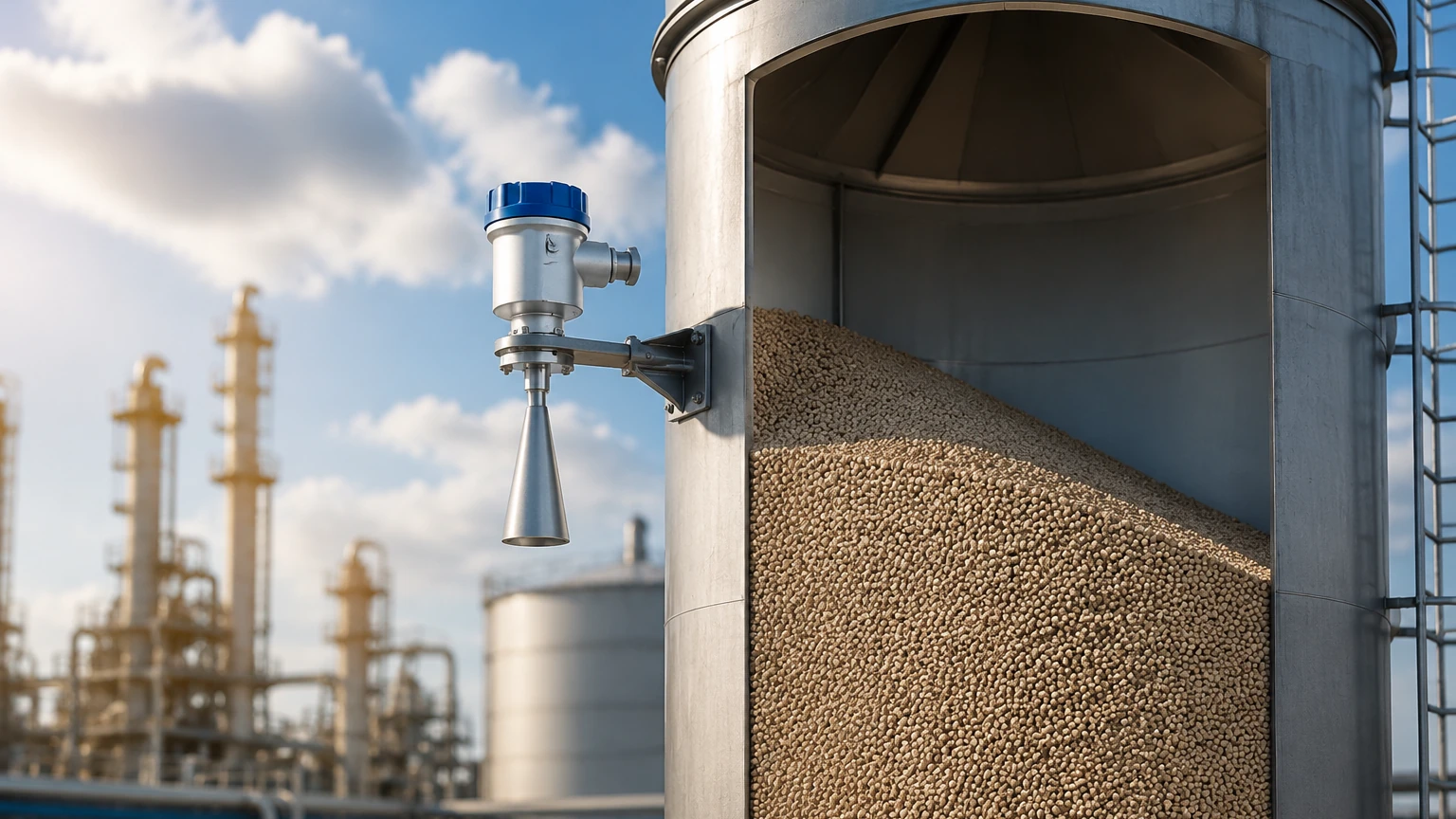
Modern radar level meters, particularly those operating at 80GHz, have revolutionized bin level monitoring. They emit a high-frequency signal that reflects off the material surface. By measuring the time-of-flight, the sensor calculates the distance.
* Best for: High-dust environments, tall silos (up to 120m), and materials with varying dielectric constants.
* Pros: Unaffected by dust, temperature fluctuations, or vacuum conditions.
4. Ultrasonic Level Sensors
Ultrasonic sensors use sound waves to measure the distance to the material. While cost-effective, they are generally less reliable in bins than radar because heavy dust can absorb the sound waves, leading to signal loss.
Selection Criteria for Bulk Solid Applications
Choosing the correct bin level indicator requires a systematic evaluation of the process environment. The following table provides a general comparison of common technologies.
| Technology | Measurement Type | Recommended Media | Dust Tolerance | Bulk Density Requirement |
| :— | :— | :— | :— | :— |
| Rotary Paddle | Point Level | Granules, Pellets | High | >160 kg/m³ |
| Vibrating Rod | Point Level | Fine Powders | High | >20 kg/m³ |
| Capacitance | Point/Continuous | Liquids/Solids | Moderate | N/A (Dielectric-based) |
| 80GHz Radar | Continuous | All Solids | Excellent | N/A |
| Ultrasonic | Continuous | Non-dusty Solids | Low | N/A |
Environmental Factors
* Temperature and Pressure: High-temperature cement or pressurized chemical bins require sensors with specialized process connections and seals.
* Abrasiveness: For highly abrasive materials like coal or ores, non-contact radar is preferred to avoid physical wear on the sensor.
* Dust: If the filling process creates a thick dust cloud, ultrasonic sensors should be avoided in favor of high-frequency radar.
Installation Guidelines and Best Practices
Proper installation is just as important as selecting the right technology. An incorrectly placed bin level indicator will provide false readings or fail prematurely.
1. Avoid the Fill Stream
Never install a sensor directly in the path of the incoming material. The force of the falling material can damage mechanical probes and cause "noise" or false echoes for radar and ultrasonic sensors.
2. Consider the Angle of Repose
When a bin is filled, the material forms a peak; when emptied, it forms a crater. For point level indicators, the mounting position (near the wall vs. near the center) will determine at what actual volume the switch triggers. Generally, mounting the sensor 1/6th of the diameter from the wall is a standard engineering practice to achieve an "average" level reading.
3. Mounting Nozzles
For radar and ultrasonic sensors, ensure the mounting nozzle is short and the sensor face protrudes slightly into the bin. This prevents the signal from reflecting off the nozzle walls (ringing), which can create a "dead zone" at the top of the bin.
4. Aiming and Alignment
In tall silos, using an adjustable aiming flange allows the radar beam to be directed toward the discharge outlet. This helps in tracking the material level even when the surface is steeply angled during drawdown.
Limitations and Troubleshooting
While modern bin level indicators are robust, they are not immune to issues. Understanding these limitations helps in designing a more resilient system.
* Material Build-up: In sticky or high-moisture applications, material can cake onto the sensor. Vibrating rods are somewhat resistant to this, but capacitance probes may require "shielded" sections to ignore build-up.
* Signal Absorption: Very light, fluffy materials (like fumed silica) can sometimes absorb radar or ultrasonic signals. In these cases, high-sensitivity mechanical switches or specialized low-frequency radar may be necessary.
* Static Electricity: The movement of dry bulk solids can generate significant static charges. Ensure all sensors are properly grounded and, if necessary, use ATEX/IECEx certified explosion-proof models for combustible dust environments.
Frequently Asked Questions (FAQ)
Q: Can a bin level indicator be used for both liquids and solids?
A: Some technologies, like radar and capacitance, work for both. However, mechanical devices like rotary paddles are strictly for solids, and vibrating forks must be specifically tuned for the density of the medium (liquid vs. powder).
Q: How do I handle bins with internal obstructions like baffles or agitators?
A: Non-contact radar sensors with narrow beam angles (e.g., 3 degrees) are ideal for avoiding internal obstructions. Additionally, most modern transmitters allow for "false echo suppression," where the software is taught to ignore reflections from fixed internal structures.
Q: What is the maximum range for a radar bin level indicator?
A: High-end 80GHz radar units can measure distances up to 120 meters (approx. 393 feet), making them suitable for the largest industrial silos.
Q: Do these sensors require regular calibration?
A: Mechanical switches generally do not require calibration but need periodic physical inspection. Electronic sensors like radar are typically calibrated once during commissioning and do not drift over time, though software updates or re-mapping may be required if the bin's internal structure changes.
Conclusion
Effective bulk solids management starts with selecting a bin level indicator that matches the physical properties of the material and the environmental conditions of the silo. From the simplicity of a rotary paddle to the precision of 80GHz radar, the right choice ensures process safety and accurate inventory data. For those in the planning stages of a project, reviewing technical documentation and product options on the Main Page of a dedicated manufacturer is a vital step toward achieving reliable level control.