Caudalímetro
Caudalímetro
In the landscape of industrial process control, the measurement of fluid movement is as critical as the measurement of volume or pressure. A caudalímetro, or flow meter, is a precision instrument designed to quantify the rate at which a liquid, gas, or steam passes through a specific point in a system. Whether the requirement is for volumetric flow (the volume of fluid passing per unit of time) or mass flow (the mass of fluid passing per unit of time), selecting the correct technology is fundamental to operational efficiency, safety, and fiscal accountability.
For engineers and plant managers, the caudalímetro serves as the "eyes" of the piping network. It provides the data necessary for dosing chemicals in water treatment, balancing heat exchangers in HVAC systems, and managing custody transfer in the oil and gas sector. This guide provides a comprehensive technical overview of flow measurement principles, selection criteria, and the integration of flow data with broader level management systems.
Understanding the Caudalímetro: Core Principles and Functions
Before selecting a specific device, it is essential to understand the physical principles that govern flow measurement. Flow meters do not all "measure" flow in the same way; rather, they use various physical phenomena to infer the flow rate.
Velocity-Based Measurement
Most industrial flow meters measure the velocity of the fluid. By knowing the cross-sectional area of the pipe ($A$) and the velocity of the fluid ($v$), the volumetric flow rate ($Q$) can be calculated using the formula $Q = A \times v$. Technologies such as electromagnetic, ultrasonic, and turbine meters fall into this category.
Differential Pressure (DP)
This principle relies on Bernoulli’s equation. By placing a restriction (like an orifice plate or Venturi tube) in the pipe, a pressure drop is created. The square root of this pressure difference is proportional to the flow rate. While older, DP remains a staple in steam and high-pressure gas applications.
Mass Flow Measurement
Unlike volumetric meters, mass flow meters (such as Coriolis or Thermal meters) measure the actual mass of the fluid. This is critical in applications where the fluid's density changes due to temperature or pressure fluctuations, such as in compressed gas or high-precision chemical blending.
Primary Technologies for Industrial Flow Measurement
Selecting a caudalímetro requires matching the technology to the fluid properties. Below are the most common industrial technologies utilized in modern process automation.
Electromagnetic Flow Meters (Magmeters)
Electromagnetic meters operate based on Faraday’s Law of Electromagnetic Induction. When a conductive liquid flows through a magnetic field generated by the meter, it produces a voltage proportional to its velocity.
* Best For: Conductive liquids, slurries, and wastewater.
* Advantages: No moving parts, zero pressure drop, and high accuracy (typically ±0.5%).
* Limitations: Cannot measure non-conductive fluids like oils, demineralized water, or gases.
Ultrasonic Flow Meters
Ultrasonic meters use sound waves to determine flow velocity. There are two primary types: Transit-time and Doppler.
1. Transit-time: Measures the time difference between signals sent upstream and downstream. It is ideal for clean liquids.
2. Doppler: Measures the frequency shift of signals reflected off particles or bubbles in the fluid. It is designed for dirty or aerated liquids.
* Best For: Non-invasive measurement (clamp-on models) and large diameter pipes.
* Advantages: No contact with the process fluid, no pressure drop, and easy installation.
Vortex Flow Meters
Vortex meters utilize the Von Kármán effect. As fluid flows past a "shedder bar," vortices (swirls) are created. The frequency of these vortices is directly proportional to the fluid velocity.
* Best For: Steam, gases, and low-viscosity liquids.
* Advantages: High durability, wide temperature range, and excellent long-term stability.
The Synergy Between Level and Flow: Open Channel Measurement
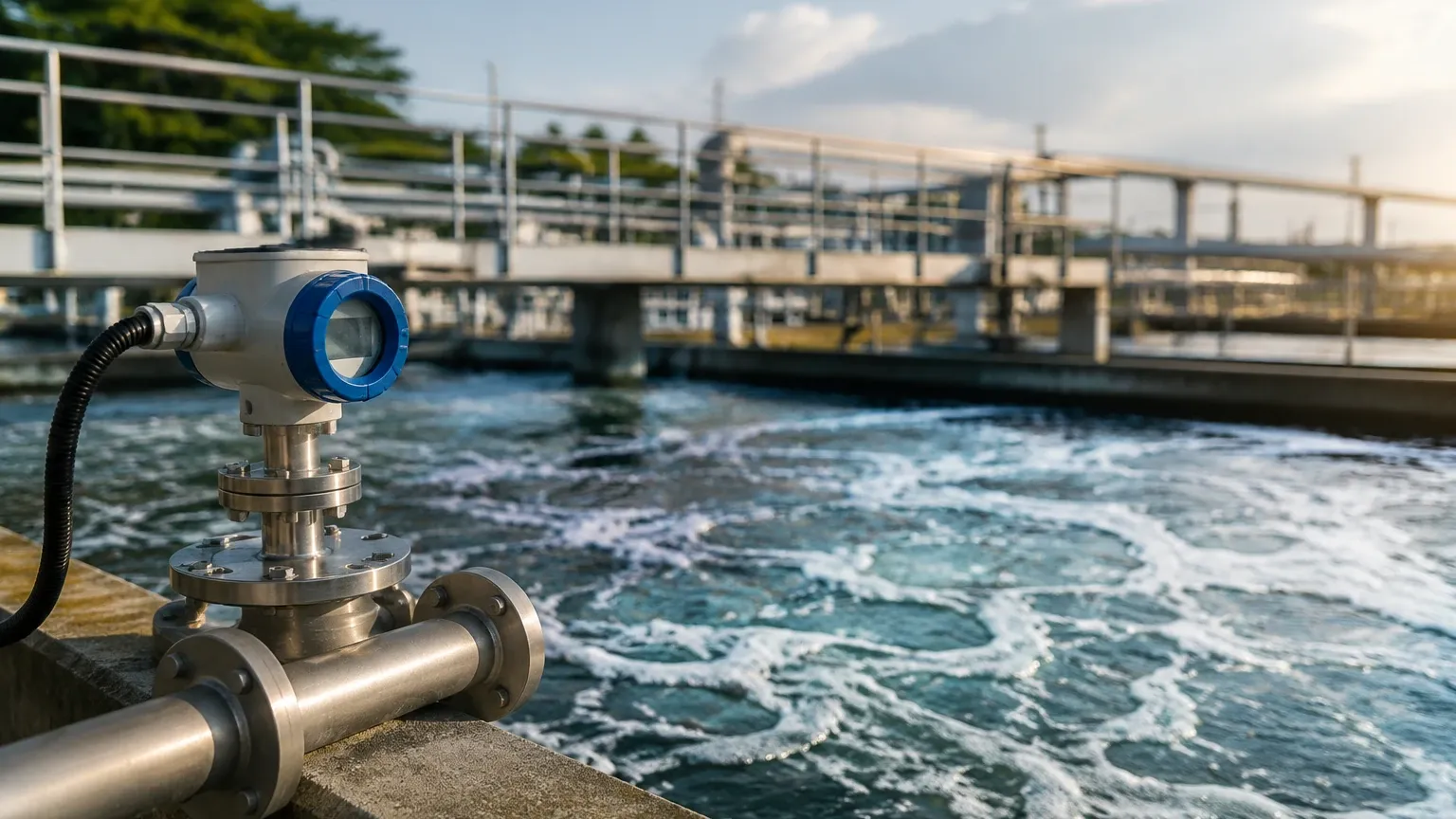
In many industrial environments, particularly water and wastewater treatment, fluids are not always contained in closed pipes. They often flow in open channels, such as flumes or weirs. In these scenarios, the measurement of flow is inextricably linked to level measurement.
Using an ultrasonic or radar level transmitter, the "head" (the height of the liquid) is measured at a specific point in the flume. Because the geometry of the flume is known, the level can be converted into a flow rate using standardized formulas. This application highlights the importance of high-accuracy level sensors in flow calculations. For professionals seeking integrated solutions for these complex environments, it is advisable to Review product options and application support to ensure that level and flow data are synchronized for accurate reporting.
Technical Selection Criteria for Industrial Applications
Choosing the wrong caudalímetro can lead to significant measurement errors, premature equipment failure, or excessive maintenance costs. Use the following table as a preliminary selection guide:
| Technology | Fluid State | Minimum Conductivity | Accuracy (Typical) | Pressure Drop |
| :— | :— | :— | :— | :— |
| Electromagnetic | Liquid | > 5 μS/cm | ±0.5% | None |
| Ultrasonic | Liquid | N/A | ±1.0% to ±2.0% | None |
| Vortex | Liquid/Gas/Steam | N/A | ±1.0% | Medium |
| Differential Pressure | Liquid/Gas/Steam | N/A | ±1.0% to ±3.0% | High |
| Coriolis | Liquid/Gas | N/A | ±0.1% | Low to Medium |
Key Considerations for Selection:
1. Fluid Properties: Is the fluid corrosive, abrasive, or viscous? For corrosive chemicals, an electromagnetic meter with a PTFE liner and Hastelloy electrodes is often required.
2. Flow Profile: Most meters require a "fully developed flow profile." This means the fluid must be moving uniformly through the pipe, which is achieved by having sufficient straight pipe runs before and after the meter.
3. Rangeability (Turndown Ratio): This is the ratio between the maximum and minimum flow the meter can accurately measure. If your process has high seasonal variance, you need a meter with a high turndown ratio (e.g., 100:1).
4. Environmental Conditions: Will the meter be exposed to extreme temperatures, high-pressure washdowns (IP69K), or explosive atmospheres (ATEX/IECEx)?
Installation Best Practices and Engineering Considerations
Even the most expensive caudalímetro will fail to provide accurate data if installed incorrectly. Engineering teams must adhere to strict installation protocols to ensure laminar flow and signal integrity.
Straight Pipe Requirements
Turbulence caused by elbows, valves, and pumps can distort flow readings. A general rule of thumb is the "10D Upstream / 5D Downstream" rule, where 'D' is the pipe diameter. For example, a 100 mm pipe would require 1000 mm of straight pipe before the meter and 500 mm after it. If space is limited, flow conditioners or specific meter types (like certain electromagnetic models) may reduce these requirements.
Orientation and Filling
For liquid applications, the pipe must always be completely full. Installing a meter in a vertical pipe with upward flow is often the best way to ensure the pipe remains full and to prevent air bubbles from being trapped. Horizontal installations should avoid the very top of the pipe (where air collects) and the very bottom (where sediment settles).
Grounding and Shielding
Electromagnetic flow meters are sensitive to electrical noise. Proper grounding of the fluid to the meter body is essential, especially in plastic or lined pipes where grounding rings must be used. Signal cables should be shielded and kept away from high-voltage power lines to prevent interference.
Maintenance, Calibration, and Troubleshooting
To maintain the integrity of a process, regular maintenance and periodic calibration are necessary.
* Zero-Point Calibration: This should be performed during commissioning and periodically thereafter. It involves ensuring the meter reads zero when there is absolutely no flow and the pipe is full.
* Sensor Fouling: In applications involving slurries or wastewater, electrodes or sensors can become coated with debris. Some modern magmeters include "electrode cleaning" functions, but manual inspection may still be required.
* Signal Verification: Many digital flow meters now offer internal diagnostics that can verify the health of the transmitter and sensor without removing the device from the line.
Frequently Asked Questions (FAQ)
Q: Can a caudalímetro measure flow in both directions?
A: Many technologies, such as electromagnetic and ultrasonic meters, are inherently bi-directional. However, the transmitter must be configured to handle bi-directional data, and the installation must account for straight-run requirements in both directions.
Q: How does viscosity affect flow measurement?
A: Viscosity has a significant impact on mechanical meters (like turbines) and DP meters because it changes the Reynolds number of the fluid. Electromagnetic meters are generally unaffected by viscosity, making them ideal for thick liquids, provided they are conductive.
Q: What is the difference between a flow meter and a flow switch?
A: A caudalímetro provides a continuous measurement of the flow rate (e.g., 50 m³/h). A flow switch only detects if flow is above or below a certain threshold and provides a discrete signal (on/off) for alarm or safety shutdown purposes.
Q: Why is my ultrasonic meter giving inconsistent readings?
A: This is often due to air bubbles or suspended solids in the fluid (if using transit-time) or insufficient signal strength due to pipe wall scaling. Ensure the pipe is full and the transducers are properly coupled to the pipe surface with acoustic gel.
Conclusion
The selection and implementation of a caudalímetro are pivotal steps in optimizing industrial processes. By understanding the underlying physics—whether it be electromagnetic induction, ultrasonic transit times, or vortex shedding—engineers can choose a solution that balances accuracy with long-term reliability.
As industrial automation continues to evolve, the integration of flow data with level, pressure, and temperature parameters becomes increasingly important for comprehensive site management. For those looking to explore high-performance instrumentation and technical guidance tailored to specific industrial challenges, visiting the Main Page provides access to a wide range of measurement technologies designed for the most demanding applications.