Cems Equipment
Cems Equipment
In the modern industrial landscape, regulatory compliance and environmental stewardship are no longer optional. Continuous Emission Monitoring Systems (CEMS) represent the standard for tracking and reporting the discharge of pollutants from industrial stacks. While the primary focus of Cems equipment is often the gas analyzer, a complete system relies heavily on auxiliary components, including precise level measurement for reagent storage and condensate management.
As a professional manufacturer of industrial level measurement instruments, Welk provides the critical sensors required to keep CEMS installations operating safely and efficiently. This guide explores the technical requirements of Cems equipment and the role of level instrumentation in ensuring system uptime and regulatory adherence.
Understanding Cems Equipment Architecture
Cems equipment is an integrated assembly of hardware designed to measure the concentration of specific gases (such as NOx, SO2, CO, CO2, and O2) and particulate matter in flue gas. These systems are typically required in power plants, waste-to-energy facilities, chemical plants, and refineries.
A standard CEMS installation consists of three primary subsystems:
1. Sampling and Conditioning System: This includes probes, heated lines, and coolers. The goal is to extract a representative sample of flue gas and remove moisture or particulates that could interfere with the analysis.
2. Gas Analyzers: These instruments use various spectroscopic methods (such as NDIR, UV, or Chemiluminescence) to quantify the pollutants.
3. Data Acquisition and Handling System (DAHS): This software records the data, performs calculations (such as converting ppm to mass flow), and generates reports for environmental agencies.
Beyond these core components, Cems equipment requires auxiliary systems for reagent storage—such as ammonia or urea for Selective Catalytic Reduction (SCR) units—and liquid management for the moisture removed during gas conditioning. This is where high-precision level measurement becomes indispensable.
The Role of Level Measurement in CEMS Auxiliary Systems
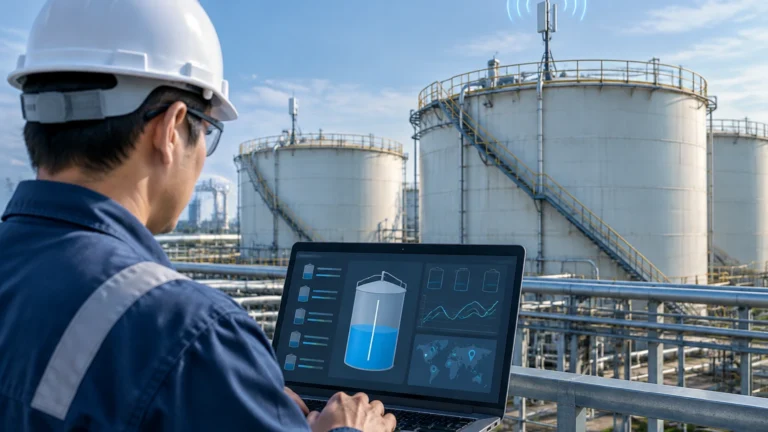
Level measurement instruments are integrated into Cems equipment workflows to manage the liquids that support the monitoring and abatement processes. Failure to monitor these levels can lead to system shutdowns, inaccurate readings, or environmental violations.
Reagent Storage (SCR and SNCR Systems)
To reduce nitrogen oxide (NOx) emissions, many facilities use SCR or Selective Non-Catalytic Reduction (SNCR) systems. These processes require the injection of ammonia or urea. These chemicals are stored in large tanks where continuous level monitoring is required to prevent overfills and ensure a steady supply for the abatement process.
Condensate Management
In extractive CEMS, flue gas is cooled to remove moisture before it enters the analyzer. This process generates condensate that must be collected and drained. Level switches or small-scale hydrostatic transmitters are used in condensate traps to trigger drainage pumps or alarms, preventing liquid from backing up into the sensitive gas analyzers.
Scrubber Level Control
Wet scrubbers used to remove SO2 depend on a constant recirculating flow of slurry. Maintaining the correct level in the scrubber sump is critical for the chemical reaction efficiency. Radar level meters are often preferred here due to the turbulent and corrosive nature of the slurry.
Measurement Principles for Level Instrumentation
Before selecting a sensor for Cems equipment support, it is essential to understand the physical principles governing different measurement technologies. Welk offers several technologies tailored to industrial environments.
Radar Level Measurement (Non-Contact)
Radar level meters emit high-frequency microwave pulses (typically in the 26 GHz or 80 GHz range). These pulses reflect off the surface of the medium and return to the sensor. The "time-of-flight" is measured to calculate the distance.
* Advantages: Radar is unaffected by temperature fluctuations, pressure changes, or the presence of vapors, making it ideal for ammonia storage tanks.
* Application in CEMS: Monitoring corrosive reagents or high-temperature scrubber sumps.
Ultrasonic Level Sensors
Ultrasonic sensors function similarly to radar but use sound waves instead of electromagnetic waves. The sensor emits an ultrasonic pulse that bounces off the liquid surface.
* Advantages: Cost-effective and easy to install for non-corrosive, atmospheric applications.
* Limitations: Sound speed is affected by air temperature and heavy vapors, which can lead to inaccuracies in volatile chemical tanks. They are best suited for water treatment or simple urea storage.
Hydrostatic Level Transmitters
These sensors measure the pressure exerted by the liquid column at the bottom of a tank. Since pressure is proportional to the height of the liquid and its density, the level can be accurately calculated.
* Advantages: Highly reliable for vented tanks and condensate collection sumps.
* Application in CEMS: Monitoring the level in condensate traps or wastewater collection tanks.
Magnetic Level Gauges
Magnetic gauges use a float containing a magnet that moves with the liquid level. This magnet interacts with an external indicator (flaps or a needle) and can be paired with a reed chain transmitter for 4-20mA output.
* Advantages: Provides a clear visual indication for operators while simultaneously sending data to the CEMS control room.
Selection Criteria for CEMS-Related Level Sensors
Choosing the right instrument requires an evaluation of the chemical compatibility, process conditions, and accuracy requirements. The following table provides a general comparison for common CEMS auxiliary applications.
| Application | Recommended Technology | Key Reason | Temperature Range |
| :— | :— | :— | :— |
| Ammonia Storage | Radar (80 GHz) | Non-contact, ignores vapors | -40°C to +150°C |
| Urea Solution | Ultrasonic | Cost-effective, reliable | -20°C to +60°C |
| Condensate Trap | Hydrostatic / Switch | Compact, simple integration | 0°C to +80°C |
| Scrubber Sump | Radar (26 GHz) | Handles turbulence/steam | Up to +200°C |
| Wastewater Tank | Ultrasonic | Ease of maintenance | -10°C to +60°C |
For more detailed technical specifications and to Review product options and application support, please visit our Main Page.

Installation and Engineering Considerations
To ensure that level sensors provide accurate data to the Cems equipment control system, several installation factors must be addressed:
1. Nozzle Positioning: For radar and ultrasonic sensors, the unit must be mounted away from the tank wall to avoid false reflections. Generally, a distance of at least 200 mm (approx. 8 inches) from the wall is recommended.
2. Obstruction Avoidance: Internal tank structures like ladders, agitators, or heating coils can interfere with the signal. Using narrow-beam 80 GHz radar can often bypass these obstacles.
3. Vapor Management: In ammonia tanks, vapor can attenuate ultrasonic signals. In such cases, radar is the technically superior choice as microwaves penetrate gas and vapor layers without significant loss.
4. Stilling Wells: In applications with high turbulence, such as a scrubber sump, installing the sensor inside a stilling well (a bypass pipe) can stabilize the liquid surface for a more consistent reading.
Maintenance and Operational Reliability
Cems equipment is subject to strict uptime requirements. If the level sensor in an SCR ammonia tank fails, the entire NOx reduction system may be compromised, leading to a forced shutdown or environmental fines.
* Calibration: Most modern digital transmitters (Radar/Ultrasonic) feature self-diagnostics. However, annual verification against a manual dip-tape measurement is recommended for compliance.
* Cleaning: In dusty or crystallizing environments (like urea storage), sensors should be checked for buildup on the transducer face. Welk radar units often feature a flush-mounted antenna design to minimize material accumulation.
* Signal Integration: Ensure that level signals are integrated into the DAHS via 4-20mA HART, Modbus, or Profibus. This allows for remote monitoring and predictive maintenance alerts.
Frequently Asked Questions (FAQ)
Q: Why is radar preferred over ultrasonic for ammonia tanks in CEMS?
A: Ammonia produces significant vapors that change the density of the air space in the tank. Since sound speed depends on air density, ultrasonic sensors will experience significant errors. Radar uses electromagnetic waves, which are not affected by these vapors.
Q: Can hydrostatic sensors be used in pressurized reagent tanks?
A: Yes, but you must use a differential pressure (DP) transmitter. A standard hydrostatic sensor only measures the pressure of the liquid plus the head pressure of the gas. A DP sensor subtracts the gas pressure to provide an accurate liquid level.
Q: How do level switches contribute to CEMS safety?
A: Level switches act as a secondary safety layer (High-High alarm). In the event of a primary transmitter failure, the switch can mechanically trigger an emergency shut-off valve to prevent a hazardous chemical spill.
Q: What is the impact of foam on CEMS level measurement?
A: Foam can absorb ultrasonic and radar signals. If foam is present (common in some scrubber applications), a guided wave radar (GWR) or a magnetic level gauge is often more reliable, as they rely on physical contact with the liquid or a float.
Conclusion
Effective Cems equipment performance relies on more than just gas analysis. The integration of robust level measurement technology ensures that the entire emission control chain—from reagent storage to condensate removal—operates without interruption. By selecting the appropriate measurement principle and following rigorous installation standards, industrial facilities can maintain compliance and optimize their environmental protection strategies.
For engineers and procurement professionals seeking reliable instrumentation for their CEMS projects, Welk offers a comprehensive portfolio of radar, ultrasonic, and hydrostatic solutions. Visit our Main Page to explore our full range of industrial level measurement instruments.