Diesel Fuel Tank Level Indicator
Diesel Fuel Tank Level Indicator
In industrial environments, diesel fuel serves as the lifeblood for backup power systems, heavy machinery fleets, and remote heating plants. Ensuring a reliable supply requires more than just storage; it demands precise monitoring. A diesel fuel tank level indicator is an essential instrument used to measure the volume or height of fuel within a storage vessel, providing data necessary for inventory management, leak detection, and operational continuity.
For facilities managers and process engineers, selecting the right technology involves understanding the physical properties of diesel—such as its dielectric constant and density—and the specific constraints of the storage environment. This guide explores the primary measurement principles, selection criteria, and installation best practices for modern diesel level sensing solutions.
Core Measurement Principles for Diesel Fuel
Before selecting a diesel fuel tank level indicator, it is vital to understand the physics behind the most common measurement technologies. Each method interacts with the fuel and the tank environment differently.
1. Radar Level Measurement (Non-Contact and Guided)
Radar technology uses high-frequency electromagnetic pulses (microwave) to determine the distance to the fuel surface.
- Non-Contact Radar: The sensor emits a signal from the top of the tank. The time it takes for the signal to reflect off the fuel surface and return to the sensor determines the level. Because radar waves are unaffected by air temperature or pressure, this is highly accurate for diesel, which has a relatively stable dielectric constant (typically between 2.0 and 2.2).
- Guided Wave Radar (GWR): This utilizes a physical probe (rod or cable) to guide the microwave pulse. It is particularly effective in narrow tanks or where internal obstructions might interfere with a free-space radar beam.
2. Ultrasonic Level Measurement
Ultrasonic sensors emit high-frequency sound waves. The sensor measures the time-of-flight for the sound to bounce off the fuel surface. While cost-effective, ultrasonic measurement can be sensitive to heavy vapor or extreme temperature fluctuations within the tank's headspace, which can alter the speed of sound and introduce errors. For standard diesel storage at ambient temperatures, however, it remains a popular choice.
3. Hydrostatic Pressure Measurement
This principle relies on the relationship between the height of the liquid and the pressure exerted at the bottom of the tank. The formula $P = \rho \cdot g \cdot h$ (where $P$ is pressure, $\rho$ is density, $g$ is gravity, and $h$ is height) allows the transmitter to calculate the level. A submersible pressure transducer or a threaded external sensor measures the "head pressure" of the diesel column. Since diesel density changes slightly with temperature, high-precision applications may require temperature compensation.
4. Magnetic Level Gauges
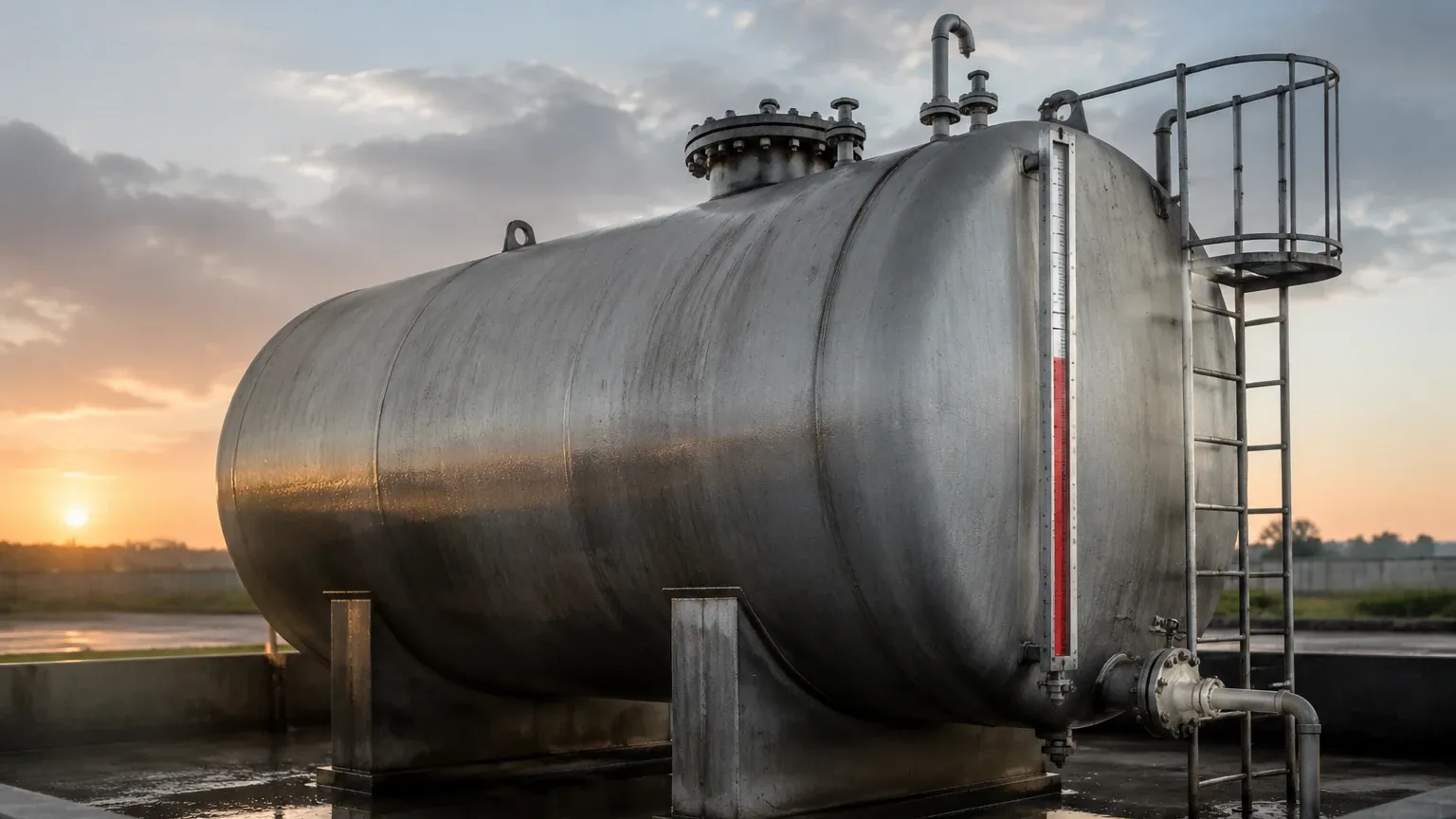
Magnetic indicators use a float containing a permanent magnet that moves with the fuel level inside a bypass chamber or directly in the tank. This magnet actuates a series of external flags (for visual indication) or a reed switch/transmitter (for electronic output). This is a robust, mechanical solution that provides local visibility even during power outages.
Comparing Technologies for Diesel Fuel Tank Level Indicators
Choosing the appropriate technology depends on the tank geometry, the required accuracy, and the budget. The following table summarizes the performance of common Welk instrumentation options for diesel applications.
| Technology | Typical Accuracy | Measurement Range | Advantages | Limitations |
| :— | :— | :— | :— | :— |
| Non-Contact Radar | ±2 mm to ±5 mm | Up to 30m (98 ft) | No moving parts; highly accurate; unaffected by vapors. | Higher initial cost; requires clear line of sight. |
| Ultrasonic | ±0.25% of range | 0.5m – 15m (1.6 – 49 ft) | Non-contact; easy to install; cost-effective. | Sensitive to foam and heavy surface turbulence. |
| Hydrostatic | ±0.1% to ±0.5% FS | 1m – 200m (3.2 – 656 ft) | Simple installation; ideal for deep or vented tanks. | Accuracy depends on constant fluid density. |
| Magnetic Gauge | ±5 mm to ±10 mm | 0.3m – 6m (1 – 20 ft) | Excellent local visual display; no power required for visual. | Moving parts can wear; bypass chamber requires space. |
For a comprehensive view of available hardware and technical specifications, engineers should consult the Main Page of the manufacturer’s catalog.
Key Selection Criteria for Industrial Applications
When specifying a diesel fuel tank level indicator, several operational factors must be confirmed to ensure long-term reliability.
Tank Geometry and Material
The shape of the tank (cylindrical, rectangular, or horizontal) affects how the volume is calculated from the level. Furthermore, the mounting point—whether it is a threaded NPT/G connection or a flange—must match the sensor's process connection. For underground storage tanks (USTs), submersible hydrostatic sensors are often preferred due to ease of access through a standard riser pipe.
Hazardous Area Classifications
Diesel fuel is combustible. Depending on the local regulations (such as ATEX in Europe or Class/Division systems in North America), the level indicator may need to be intrinsically safe (IS) or explosion-proof. Always verify that the sensor's electronics housing and wiring meet the specific zone requirements of the installation site.
Integration Requirements
Modern industrial automation requires data integration. Most diesel fuel level indicators offer several output options:
- 4-20mA Analog: The industry standard for PLC and DCS integration.
- Modbus RTU / RS485: Digital communication for multi-drop networks and remote monitoring.
- HART Protocol: Allows for remote configuration and diagnostics over the existing 4-20mA loop.
- Wireless (LoRaWAN/NB-IoT): Increasingly used for remote fuel tanks in construction or agriculture where cabling is impractical.
Installation Guidelines and Best Practices
Proper installation is as critical as the choice of technology. Incorrectly mounted sensors are the leading cause of inaccurate readings in fuel management systems.
1. Avoid the "Dead Zone": Every non-contact sensor (radar and ultrasonic) has a "dead zone" or "blocking distance" near the face of the transducer (typically 0.1m to 0.5m). Ensure the sensor is mounted high enough that the fuel level never enters this zone, or the signal will be lost.
2. Positioning Away from Inlets: Do not install the indicator directly under a fill pipe. The turbulence and splashing during refueling will cause erratic readings and may damage sensitive components.
3. Stilling Wells: In tanks with significant internal turbulence or where foam may be present, installing the sensor inside a stilling well (a vertical pipe with vent holes) can provide a stable surface for measurement.
4. Cable Protection: For hydrostatic sensors, the vented cable must be protected from moisture. The vent tube allows the sensor to compensate for changes in atmospheric pressure; if this tube is blocked or saturated with water, the level reading will drift.
5. Grounding: Ensure the instrument is properly grounded to prevent static discharge, which is a critical safety consideration in fuel storage environments.
Limitations and Operational Risks
While modern instruments are highly reliable, users must be aware of specific limitations:
- Temperature Sensitivity: Diesel expands and contracts with temperature. A level indicator measures height, not mass. If the temperature fluctuates significantly, the calculated volume may appear to change even if no fuel has been added or removed. Advanced systems use temperature-compensated volume calculations.
- Paraffin Wax Precipitation: In extremely cold climates, diesel can "cloud" as paraffin wax precipitates out of the liquid. This can coat the probes of guided wave radars or the diaphragms of hydrostatic sensors, leading to maintenance requirements.
- Dielectric Constant Changes: While diesel is generally stable, the introduction of high percentages of biodiesel can slightly alter the dielectric constant, potentially requiring a recalibration of radar-based sensors.
Frequently Asked Questions (FAQ)
Q: Can a diesel fuel tank level indicator detect water at the bottom of the tank?
A: Standard level indicators measure the top surface of the liquid. To detect water bottoms (which settle below the diesel due to higher density), a specialized interface probe or a dual-float magnetic system is required.
Q: How often should a diesel level sensor be calibrated?
A: For inventory and billing purposes, annual calibration is recommended. For general monitoring or backup generator support, a functional check every 12 to 24 months is usually sufficient, provided the sensor shows no signs of drift.
Q: Is radar better than ultrasonic for diesel tanks?
A: Generally, yes. Radar is more robust against the vapors and temperature gradients found in fuel tanks. However, ultrasonic sensors are a valid, lower-cost alternative for smaller, indoor tanks where conditions are stable.
Q: Can I use a hydrostatic sensor in a pressurized tank?
A: Standard hydrostatic sensors measure relative to atmospheric pressure. If the tank is pressurized or under vacuum, a differential pressure (DP) transmitter must be used to subtract the headspace pressure from the total bottom pressure.
Conclusion
Selecting a diesel fuel tank level indicator requires a balance between technical requirements and environmental constraints. Whether utilizing the precision of radar or the simplicity of hydrostatic pressure, the goal remains the same: ensuring that fuel is available when needed and that every drop is accounted for. For organizations looking to upgrade their monitoring capabilities, reviewing technical data on the Main Page of an established manufacturer like Welk is the first step toward a more reliable fuel management strategy.