Emerson Ultrasonic Flow Meter
Emerson Ultrasonic Flow Meter
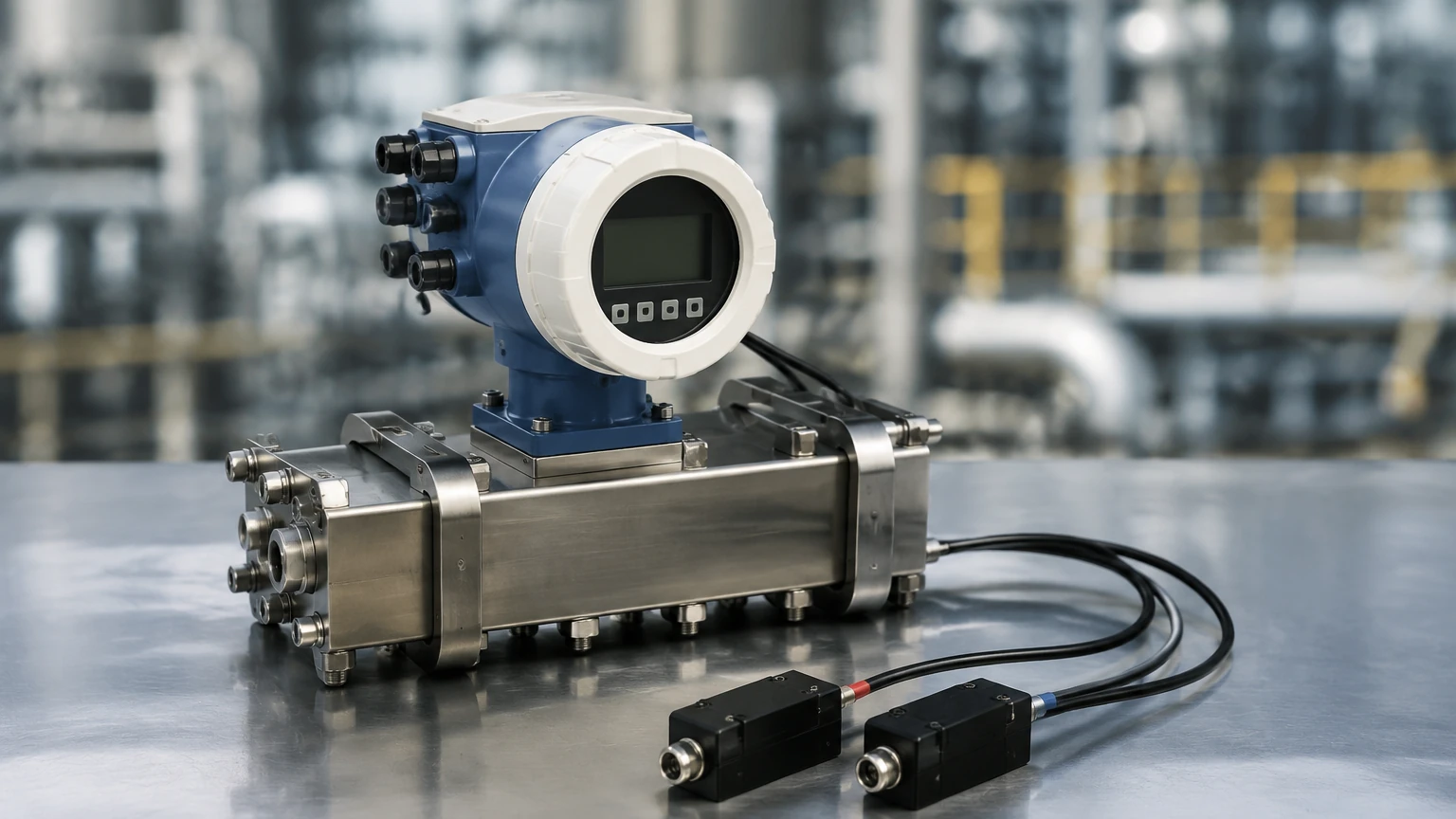
In the landscape of industrial process control, the Emerson ultrasonic flow meter represents a pinnacle of non-intrusive measurement technology. Primarily marketed under the Rosemount and Daniel brands, these instruments are engineered to provide high-accuracy flow data for both liquid and gas applications without the pressure drop or maintenance requirements associated with primary flow elements like orifice plates or turbine meters. This guide provides a technical overview of ultrasonic measurement principles, the specific capabilities of Emerson’s portfolio, and critical selection criteria for engineering professionals.
Measurement Principles of Ultrasonic Flow Meters
Before selecting a specific model, it is essential to understand the physics governing ultrasonic measurement. Emerson devices primarily utilize the transit-time (or time-of-flight) principle, though it is important to distinguish this from the Doppler effect used in other industrial applications.
Transit-Time Principle
Transit-time ultrasonic flow meters operate by transmitting and receiving high-frequency sound pulses between pairs of transducers. One transducer is located upstream and the other downstream.
1. Upstream Transmission: A pulse is sent from the downstream transducer to the upstream transducer, traveling against the flow.
2. Downstream Transmission: A pulse is sent from the upstream transducer to the downstream transducer, traveling with the flow.
3. Time Difference: The pulse traveling with the flow moves faster than the pulse traveling against it. The difference in transit time ($Δt$) is directly proportional to the velocity of the fluid within the pipe.
The governing equation for flow velocity ($v$) in a transit-time system is:
$$v = \frac{L}{2 \cos \theta} \left( \frac{1}{t_{up}} – \frac{1}{t_{dn}} \right)$$
Where $L$ is the path length, $θ$ is the angle of the ultrasonic path relative to the pipe axis, and $t$ represents the transit times. Once the velocity is determined, the meter calculates the volumetric flow rate by multiplying the velocity by the cross-sectional area of the pipe.
Multi-Path Technology
Standard ultrasonic meters may use a single path, but Emerson’s high-precision models (such as the Rosemount 3410 series) utilize multi-path configurations. By sending pulses across multiple "chords" of the pipe, the meter can account for non-uniform flow profiles, swirl, and turbulence, significantly increasing accuracy and repeatability in custody transfer applications.
Key Emerson Ultrasonic Flow Meter Series
Emerson categorizes its ultrasonic offerings based on the phase of the fluid (liquid vs. gas) and the required level of precision.
Rosemount Liquid Ultrasonic Flow Meters
These are designed for a wide range of liquids, from refined hydrocarbons to water. The Rosemount 3410 series is a common choice for industrial process measurement, offering a four-path design that minimizes the need for long straight pipe runs. For even higher precision, the 3418 model provides an eight-path configuration, often used in fiscal measurement where every drop counts.
Daniel Gas Ultrasonic Flow Meters
Acquired by Emerson, the Daniel brand is the industry standard for natural gas measurement. The Daniel 3810 series (including the 3812 and 3814) is engineered for high-pressure gas transmission. These meters are frequently found in city gate stations and large-scale industrial gas feeds. They are valued for their ability to handle high velocities without the mechanical wear seen in rotary or turbine meters.
Technical Selection Criteria
Choosing the correct Emerson ultrasonic flow meter requires a detailed analysis of the process conditions. The following table outlines the primary evaluation factors for common models.
| Feature | Rosemount 3414 (Liquid) | Daniel 3812 (Gas) | Rosemount 3411 (Liquid) |
| :— | :— | :— | :— |
| Primary Application | Custody Transfer | Gas Transmission | General Process |
| Path Configuration | 4-Path Chordal | 2-Path | 4-Path |
| Typical Accuracy | ±0.1% of rate | ±0.5% of rate | ±0.25% of rate |
| Pipe Sizes | 100 mm to 1000 mm | 50 mm to 600 mm | 50 mm to 600 mm |
| Fluid State | Clean Liquids | Dry/Wet Gas | Clean Liquids |
| Repeatability | ±0.02% | ±0.1% | ±0.05% |
Fluid Properties and Reynolds Number
Ultrasonic meters are sensitive to the Reynolds number ($Re$), which characterizes the flow regime (laminar, transitional, or turbulent). Emerson meters include sophisticated flow computers that apply correction factors based on the $Re$ to ensure accuracy across a wide range of viscosities. However, for extremely viscous fluids, the signal attenuation may increase, requiring higher-power transducers.
Installation Considerations
The performance of an Emerson ultrasonic flow meter is heavily dependent on the installation environment. Engineers must adhere to the following guidelines to ensure the integrity of the acoustic signal.
Straight Run Requirements
While multi-path meters are more resilient to flow profile distortions, a standard recommendation is to provide at least 10 diameters (10D) of straight pipe upstream and 5 diameters (5D) downstream of the meter. If the installation includes elbows, valves, or pumps in close proximity, flow conditioners (such as CPA or Zanker plates) may be required to eliminate swirl.
Orientation and Mounting
* Horizontal Pipes: Transducers should ideally be mounted in the 3 o'clock and 9 o'clock positions. This prevents bottom-dwelling sediment or top-dwelling gas bubbles from interfering with the ultrasonic path.
* Vertical Pipes: Flow should ideally move upward. This ensures the pipe remains full of liquid, which is a prerequisite for transit-time measurement.
* Transducer Access: Ensure there is sufficient clearance around the meter body to remove and inspect transducers without decommissioning the entire pipeline.
Environmental Factors
Ambient temperature and vibration can affect the electronic housing. Emerson meters typically feature remote-mount electronics options for applications where the pipe temperature exceeds 150°C or where excessive pipe vibration is present.
Limitations and Common Risks
Despite their versatility, ultrasonic flow meters are not a "one-size-fits-all" solution. Understanding their limitations is crucial for project success.
1. Entrained Air and Solids: Transit-time meters require a relatively clean medium. If the fluid contains more than 2-5% entrained air or suspended solids by volume, the ultrasonic signal may be scattered or absorbed, leading to a "signal loss" error. In such cases, a Doppler-style meter or a magnetic flow meter may be more appropriate.
2. Acoustic Noise: High-pressure drop valves located immediately upstream can generate ultrasonic noise that interferes with the meter's transducers. This is particularly common in gas applications.
3. Full Pipe Requirement: The meter cannot measure flow accurately if the pipe is only partially full. For drainage or gravity-fed systems, engineers often pair flow meters with level measurement solutions to calculate the wetted area. For comprehensive technical support on integrating level and flow data, you can visit the Main Page of industrial instrumentation specialists.
Maintenance and Diagnostics
One of the primary advantages of the Emerson ultrasonic flow meter is its advanced diagnostic suite. Modern Rosemount and Daniel meters provide real-time data on:
* Gain: The amount of amplification required for the signal. An increase in gain over time may indicate coating on the transducer faces or deteriorating fluid quality.
* Signal-to-Noise Ratio (SNR): A measure of signal clarity. Low SNR often points to external acoustic interference.
* Velocity of Sound (VoS): The meter calculates the VoS based on transit times. By comparing this to the theoretical VoS of the fluid (based on temperature and pressure), the meter can detect changes in fluid composition or the presence of contaminants.
Frequently Asked Questions (FAQ)
Q: Can Emerson ultrasonic meters be used on steam?
A: While Emerson offers specialized vortex and differential pressure meters for steam, standard ultrasonic flow meters are generally optimized for liquids and gases. High-temperature steam applications require specific transducer materials and cooling configurations.
Q: How often do the transducers need calibration?
A: Because ultrasonic meters have no moving parts, they do not suffer from mechanical wear. However, in custody transfer applications, regulatory bodies often require a flow lab calibration every 2 to 5 years. For internal process control, the internal diagnostics are usually sufficient to verify performance.
Q: Is a clamp-on version available?
A: Yes, Emerson provides Rosemount clamp-on ultrasonic flow meters for applications where cutting the pipe is not feasible. While easier to install, clamp-on meters generally offer lower accuracy (±1% to ±3%) compared to wetted, inline models.
Integration with Level Measurement
In many industrial sectors, such as water treatment or chemical processing, flow measurement is only one part of the equation. Monitoring the inventory within the tanks that feed these pipelines is equally critical. While Emerson provides high-end flow solutions, many facilities utilize a combination of technologies. For example, radar or ultrasonic level sensors from manufacturers like Welk are often used to monitor tank levels, providing the necessary head-pressure data to optimize flow meter performance.
Before finalizing a flow meter specification, project managers should confirm the fluid chemistry, the expected range of flow velocities (turn-down ratio), and the communication protocol (HART, Modbus, or Foundation Fieldbus) required for the local control system. By aligning these technical requirements with the capabilities of an Emerson ultrasonic flow meter, facilities can achieve long-term measurement stability and reduced operational costs.