Endress Hauser Greenwood
Endress Hauser Greenwood
In the landscape of North American industrial automation, the Endress+Hauser campus in Greenwood, Indiana, serves as a central pillar for manufacturing, training, and support. As a primary hub for one of the world’s leading instrumentation companies, the Greenwood facility is responsible for producing a significant portion of the level, flow, and pressure measurement devices used across the United States, Canada, and Mexico. For process engineers and procurement specialists, understanding the capabilities of such regional manufacturing centers is essential for managing supply chains and ensuring technical support for critical infrastructure.
Industrial level measurement is a complex field where the choice of technology depends heavily on the physical properties of the media, the vessel geometry, and the environmental conditions. Whether sourcing from global leaders or specialized manufacturers like Welk, engineers must prioritize measurement accuracy and long-term reliability. This guide explores the core technologies supported by major industrial hubs and provides a framework for selecting the appropriate level measurement solutions.
Core Technologies in Level Measurement: Principles and Applications
Before selecting a specific instrument, it is vital to understand the physical principles that govern different measurement methods. Most industrial applications utilize one of three primary technologies: radar, ultrasonic, or hydrostatic pressure.
Radar Level Measurement (Time-of-Flight)
Radar level meters operate on the Time-of-Flight (ToF) principle. The device emits high-frequency electromagnetic pulses (typically in the 6 GHz, 26 GHz, or 80 GHz range) toward the product surface. These pulses are reflected by the surface of the medium due to a change in the dielectric constant (εr). The instrument measures the time elapsed between the emission and reception of the signal.
Because electromagnetic waves travel at the speed of light, they are virtually unaffected by temperature, pressure, or the presence of vapors and dust. This makes radar the preferred choice for demanding chemical and oil and gas applications. Non-contact radar is particularly valued for its low maintenance requirements, as no moving parts come into contact with the process media.
Ultrasonic Level Sensing
Ultrasonic sensors also use the ToF principle but utilize mechanical sound waves instead of electromagnetic pulses. The sensor emits an ultrasonic pulse (typically between 20 kHz and 70 kHz) that bounces off the liquid or solid surface and returns to the transducer.
The speed of sound is significantly influenced by the air temperature in the tank. Consequently, high-quality ultrasonic sensors include integrated temperature compensation to maintain accuracy. While more cost-effective than radar, ultrasonic technology is sensitive to heavy foam, surface turbulence, and vacuum conditions, which can attenuate or scatter the sound waves. It remains a standard for water treatment and simple chemical storage.
Hydrostatic Level Transmitters
Hydrostatic measurement is based on the principle that the pressure at a specific depth in a liquid is proportional to the height of the liquid column above it. The relationship is defined by the formula: $P = \rho \cdot g \cdot h$, where $P$ is pressure, $\rho$ is the density of the fluid, $g$ is gravity, and $h$ is the height of the liquid.
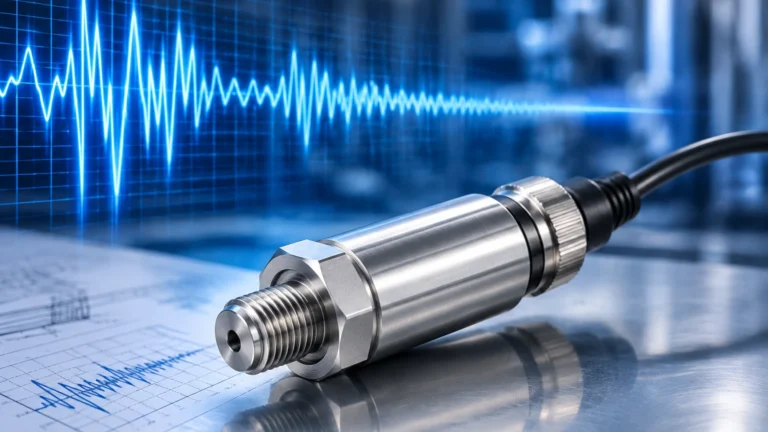
A hydrostatic level transmitter, often a submersible pressure transducer or a flange-mounted diaphragm, measures this pressure. In vented (open) tanks, a simple gauge pressure measurement suffices. In pressurized (closed) tanks, a differential pressure (DP) measurement is required to subtract the head pressure of the gas phase from the total pressure at the bottom. This method is highly reliable for liquids with constant density.
Selection Criteria for Level Measurement Instruments
Choosing the right instrument requires a systematic evaluation of the process environment. The following table provides a comparison of common technologies to assist in the initial selection phase.
| Feature | Radar (Non-contact) | Ultrasonic | Hydrostatic | Magnetic Level Gauge |
| :— | :— | :— | :— | :— |
| Accuracy | High (±1 mm to ±3 mm) | Moderate (±0.25% of range) | Moderate to High | Moderate |
| Media Type | Liquids, Solids, Slurries | Liquids, Coarse Solids | Liquids only | Liquids only |
| Pressure Range | Vacuum to 160 bar+ | Atmospheric | Varies by sensor rating | Up to 100 bar+ |
| Temp. Range | -196°C to +450°C | -40°C to +80°C | -40°C to +100°C | -196°C to +400°C |
| Foam Impact | Low (High freq. helps) | High (Can lose signal) | None | None |
| Cost | Higher | Lower | Moderate | Moderate |
| Maintenance | Very Low | Low | Moderate | Low |
When evaluating solutions from manufacturers like Endress+Hauser or looking for alternatives on the Main Page, engineers should verify that the sensor materials (e.g., 316L Stainless Steel, PTFE, Hastelloy) are chemically compatible with the process medium.
The Role of Regional Hubs: Manufacturing and Support
The significance of a facility like Endress Hauser Greenwood extends beyond simple assembly. Regional hubs provide several critical advantages for industrial operators:
1. Customization and OEM/ODM Services: Many industrial projects require customized probe lengths, specific flange connections, or specialized communication protocols (HART, PROFIBUS, Foundation Fieldbus). Local manufacturing allows for faster turnaround on these bespoke configurations.
2. Calibration Services: Precision instruments require periodic calibration to maintain ISO compliance. Facilities in Greenwood often house sophisticated calibration rigs for flow and level, ensuring that meters are traceable to national standards (NIST).
3. Training and Education: Modern instrumentation is highly digital. Training centers (often referred to as Process Training Units or PTUs) allow engineers to gain hands-on experience with live loops, simulating real-world troubleshooting scenarios.
4. Supply Chain Resilience: By producing instruments locally, manufacturers reduce the lead times associated with international shipping and minimize the impact of global logistics disruptions.

Practical Installation Considerations for Industrial Level Sensors
Even the most advanced sensor will fail to provide accurate data if installed incorrectly. Proper installation is the foundation of process safety and efficiency.
Mounting Position and Obstructions
For both radar and ultrasonic sensors, the beam must have a clear path to the surface. Avoid mounting the sensor directly above internal tank structures such as agitators, heating coils, or ladders. If obstructions are unavoidable, many modern instruments offer "false echo suppression" software that allows the sensor to recognize and ignore static reflections.
Nozzle Design
The nozzle (the pipe section where the sensor is mounted) should be as short and wide as possible. If the nozzle is too long or narrow, the signal may reflect off the internal walls of the pipe before reaching the tank, creating a "dead zone" or interference. For 80 GHz radar, nozzle influence is minimized due to the narrow beam angle, but for lower frequency devices, the nozzle diameter should be at least 50 mm to 100 mm (2 to 4 inches).
Avoiding the Fill Stream
Never install a level sensor directly in the path of the incoming product flow. The turbulence and the physical presence of the falling liquid or solid will cause erratic readings. Ideally, the sensor should be placed at a distance of at least 1/6th of the tank diameter from the tank wall, but away from the center if there is a vortex created by an agitator.
Environmental Protection
In outdoor installations, sensors should be equipped with weather shields to protect the electronics from direct sunlight (which can cause overheating) and heavy rain or snow. In hazardous areas, ensure the device carries the appropriate certifications (ATEX, IECEx, or FM) for explosive atmospheres.
Comparing Global Manufacturers and Specialized Solutions
While major players like Endress+Hauser dominate the high-end market with extensive support networks in locations like Greenwood, there is a growing demand for specialized, cost-effective alternatives. Companies like Welk focus on providing reliable, accurate level measurement solutions that cater to specific industrial needs without the overhead of massive corporate structures.
Welk’s portfolio includes radar level meters, ultrasonic sensors, and magnetic level gauges that are widely used in water treatment, chemical processing, and industrial automation. For many standard applications, these instruments provide the same level of precision and durability as larger brands, backed by strict quality control and the flexibility of OEM/ODM services. By focusing on core measurement technologies, specialized manufacturers can often offer more competitive pricing and faster response times for standard configurations.
Frequently Asked Questions (FAQs)
Q: What is the difference between guided wave radar and non-contact radar?
A: Non-contact radar sends a signal through the air. Guided Wave Radar (GWR) sends the signal down a physical probe (rod or cable). GWR is better for applications with low dielectric constants, heavy foam, or turbulent surfaces because the probe concentrates the energy and guides the signal.
Q: How do I handle level measurement in a tank with heavy foam?
A: Foam can absorb ultrasonic and radar signals. For light foam, a high-frequency radar (80 GHz) may penetrate effectively. For thick, dense foam, hydrostatic pressure or a magnetic level gauge is often a more reliable choice as they are not affected by surface conditions.
Q: When should I choose a magnetic level gauge over an electronic transmitter?
A: Magnetic level gauges provide a highly visible local indication that does not require power. They are often used in conjunction with a reed chain transmitter or a magnetostrictive sensor to provide both a local visual check and a remote signal to the PLC/SCADA system, providing redundancy for critical safety applications.
Q: Is the Endress+Hauser Greenwood facility open for technical support?
A: Yes, the Greenwood campus is the primary North American support center, offering technical assistance, field service coordination, and extensive training programs for their customer base.
In conclusion, whether an organization relies on the massive infrastructure of Endress Hauser Greenwood or seeks the specialized agility of manufacturers like Welk, the key to success lies in a deep understanding of measurement principles and a disciplined approach to instrument selection. For a comprehensive review of available technologies and application-specific support, engineers are encouraged to consult professional resources and review product options on the Main Page to ensure their level measurement systems meet the rigorous demands of modern industrial processes.