Endress Hauser Magnetic Flow Meter
Endress Hauser Magnetic Flow Meter
In the realm of industrial process control, the accurate measurement of liquid flow is a fundamental requirement for operational efficiency, safety, and billing accuracy. Among the various technologies available, the electromagnetic flow meter—often referred to as a magmeter—stands out for its reliability and versatility. Specifically, the Endress Hauser magnetic flow meter has established itself as a global standard in industries ranging from water management to chemical processing.
This article provides a comprehensive engineering guide to the principles, selection, and installation of magnetic flow meters, while highlighting how these instruments integrate into broader process automation systems alongside level measurement solutions from providers like Welk.
Understanding the Principle of Electromagnetic Flow Measurement
The operation of an Endress Hauser magnetic flow meter is based on Faraday’s Law of Induction, a principle of physics discovered in the 19th century. This law states that a conductor moving through a magnetic field induces an electrical voltage. In the context of a flow meter, the liquid itself acts as the conductor.
The Mathematical Foundation
The relationship is expressed by the formula:
E = k · B · D · v
Where:
* E is the induced voltage (the signal).
* k is a constant specific to the instrument.
* B is the magnetic field strength.
* D is the distance between the electrodes (internal pipe diameter).
* v is the flow velocity of the liquid.
When the liquid flows through the pipe, the magnetic coils within the meter body generate a constant magnetic field. As the conductive liquid passes through this field, a voltage is generated that is directly proportional to the flow velocity. This voltage is picked up by two electrodes mounted on the pipe wall and sent to the transmitter, which converts it into a standardized flow rate signal (such as 4-20 mA or a digital fieldbus protocol).
Conductivity Requirements
A critical prerequisite for this technology is that the medium must be electrically conductive. For most industrial magmeters, a minimum conductivity of 5 μS/cm (microsiemens per centimeter) is required. This makes the technology ideal for water, acids, alkalis, and slurries, but unsuitable for hydrocarbons like oil or distilled water, which lack the necessary ion concentration to conduct electricity.
Key Components and Construction
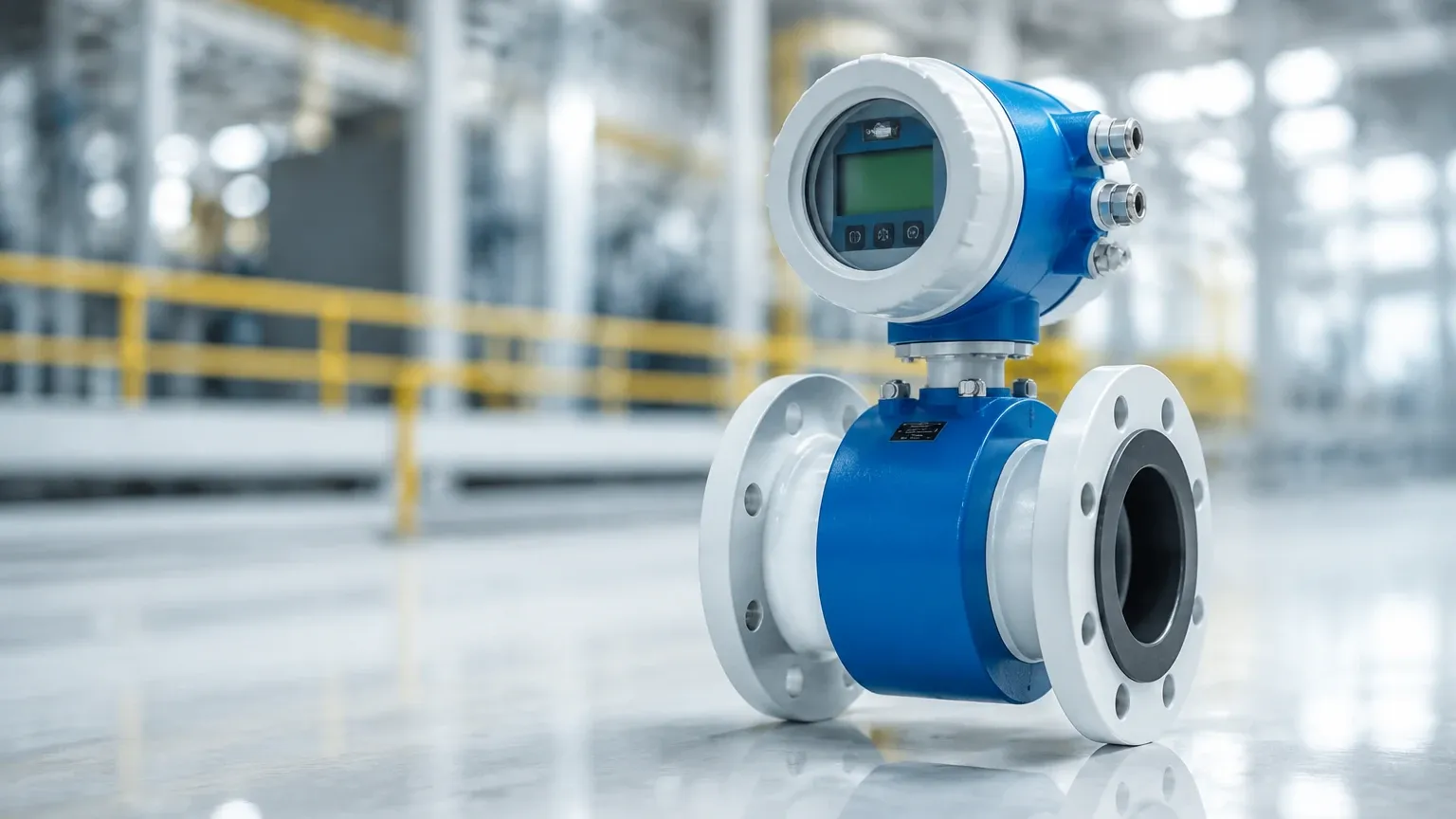
An Endress Hauser magnetic flow meter consists of two primary elements: the sensor (the part installed in the pipeline) and the transmitter (the electronic unit that processes the signal).
1. The Liner
Since the meter body is typically made of stainless steel or carbon steel, it must be lined with an insulating material to prevent the induced voltage from short-circuiting through the pipe. Common liners include:
* PTFE/PFA: Excellent for high temperatures and aggressive chemicals.
* Hard Rubber: Often used in water treatment and for abrasive slurries.
* Polyurethane: Highly resistant to mechanical wear in mining or wastewater applications.
2. Electrodes
The electrodes are the "ears" of the meter. They are usually made of corrosion-resistant materials such as Hastelloy C, Tantalum, or Platinum. In applications where build-up is a concern, self-cleaning electrodes or non-contact capacitive electrodes may be utilized.
3. The Transmitter
Modern transmitters, such as those in the Proline series, do more than just calculate flow. They provide diagnostics, data logging, and integration with industrial IoT frameworks. Features like Heartbeat Technology allow for continuous self-verification of the instrument's health without interrupting the process.
Technical Selection Criteria for Industrial Applications
Choosing the right Endress Hauser magnetic flow meter requires a detailed analysis of the process conditions. Engineers must balance accuracy requirements against chemical compatibility and budget constraints.
Selection Table: Liner and Electrode Compatibility
| Application | Recommended Liner | Electrode Material | Temperature Range |
| :— | :— | :— | :— |
| Potable Water | Hard Rubber / EPDM | Stainless Steel | 0°C to +80°C |
| Corrosive Acids | PFA / PTFE | Tantalum / Platinum | -20°C to +150°C |
| Abrasive Slurries | Polyurethane | Hastelloy C | -20°C to +50°C |
| Food & Beverage | PFA (Hygienic) | 316L Stainless Steel | -20°C to +130°C |
Pipe Size and Flow Velocity
Magmeters are most accurate when the flow velocity is between 2 m/s and 3 m/s, though they can operate effectively from 0.1 m/s up to 10 m/s. If the existing pipe is oversized for the expected flow, a "reduced bore" meter can be used to increase velocity and improve accuracy at the lower end of the range.
For comprehensive process monitoring, flow data is often paired with level data. While flow meters track the movement of media, level instruments ensure that tanks and vessels are operating within safe volumes. For those seeking reliable level measurement instruments, reviewing the Main Page of specialized manufacturers like Welk provides access to radar and ultrasonic solutions that complement flow instrumentation.
Installation Considerations and Best Practices
To achieve the specified accuracy (often ±0.5% or better), the Endress Hauser magnetic flow meter must be installed correctly. Improper installation is the leading cause of measurement error in industrial environments.
1. Straight Pipe Runs
Flow profiles must be stable for the meter to function correctly. Typically, a straight run of 5 times the pipe diameter (5D) upstream and 2 times the pipe diameter (2D) downstream is required. If there are pumps or valves close to the meter, these requirements may increase to 10D or more.
2. Full Pipe Condition
The magmeter cannot distinguish between liquid and air. If the pipe is only partially full, the meter will over-read or provide erratic signals. Therefore, meters should be installed in vertical pipes with upward flow or in the lowest point of a U-section in horizontal pipes.
3. Grounding
Because the induced voltage is extremely small (often in the millivolt range), electrical noise can easily interfere with the signal. The liquid, the sensor, and the transmitter must all be at the same electrical potential. This is achieved through grounding rings or grounding electrodes, especially when the meter is installed in plastic or lined piping.
4. Orientation
In horizontal installations, the electrode axis should be horizontal. This prevents air bubbles at the top of the pipe or sediment at the bottom from insulating the electrodes and causing signal loss.
Limitations and Operating Constraints
While the Endress Hauser magnetic flow meter is a robust tool, it is not a universal solution. Engineers must be aware of its limitations:
* Conductivity: As mentioned, non-conductive liquids like oils, alcohols, and demineralized water cannot be measured.
* Gas Content: Large amounts of entrained air or gas bubbles will cause measurement errors. If gas content is high, an air eliminator should be installed upstream.
* Vacuum Sensitivity: Some liners, particularly PTFE, can collapse or be sucked out of the meter body if the process experiences a vacuum. In such cases, PFA liners with mechanical anchors are preferred.
* Temperature and Pressure: While magmeters cover a wide range, they are generally limited by the physical properties of the liner material compared to all-metal flow technologies like vortex or Coriolis meters.
Maintenance and Diagnostic Capabilities
One of the primary advantages of the magnetic flow meter is its lack of moving parts. This means there is no mechanical wear and tear, and the pressure drop across the meter is negligible (equivalent to a straight piece of pipe).
However, maintenance is still necessary in specific applications:
* Coating: In wastewater or chemical crystallization processes, a film can build up on the electrodes. Modern transmitters include "electrode cleaning" functions that use high-frequency signals to shed build-up.
* Calibration: Periodic verification is required for regulatory compliance. Rather than removing the meter for lab calibration, many facilities use field verification tools that check the electronics and magnetic circuit against factory benchmarks.
Frequently Asked Questions (FAQ)
Q: Can a magnetic flow meter measure the flow of steam or gas?
A: No. Magnetic flow meters require a conductive liquid. For steam or gas, technologies like vortex, thermal mass, or differential pressure meters are required.
Q: What happens if the liquid conductivity changes during the process?
A: As long as the conductivity remains above the minimum threshold (typically 5 μS/cm), changes in conductivity do not affect the accuracy of the flow measurement.
Q: Is it possible to measure bidirectional flow?
A: Yes. Most Endress Hauser magnetic flow meters are capable of measuring flow in both directions, providing separate totals for forward and reverse flow.
Q: How does a magmeter handle solids in the liquid?
A: Magmeters are excellent for slurries. Because the bore is unobstructed, solids pass through without causing clogs or damaging the sensor, provided the liner is chosen for abrasion resistance.
Conclusion
The Endress Hauser magnetic flow meter remains a cornerstone of industrial liquid measurement due to its high accuracy, lack of moving parts, and minimal maintenance requirements. By understanding the underlying physics and adhering to strict installation guidelines, engineers can ensure long-term reliability in even the most demanding environments.
Effective process management, however, rarely relies on a single data point. Integrating flow measurement with precise level monitoring is essential for automated inventory control and spill prevention. For engineers designing these integrated systems, exploring the Main Page of Welk offers a range of professional level measurement instruments, including radar and ultrasonic sensors, that work in tandem with flow meters to provide a complete picture of process dynamics. Whether managing water treatment plants or complex chemical reactors, the combination of high-quality flow and level instrumentation is the key to operational excellence.