Industrial Temperature Measurement Devices
Industrial Temperature Measurement Devices
In the landscape of industrial automation and process control, temperature is one of the most frequently measured physical parameters. Whether it is monitoring the exothermic reaction in a chemical vessel, ensuring the safety of a pressurized steam line, or compensating for density changes in a water treatment facility, industrial temperature measurement devices are indispensable. For engineers and plant managers, selecting the right sensor technology is not merely a matter of measuring heat; it is about ensuring process stability, safety, and long-term reliability.
At Welk, while our primary focus remains on advanced level measurement solutions such as radar and ultrasonic sensors, we recognize that temperature is often an inseparable variable in level detection. For instance, the accuracy of hydrostatic level transmitters or ultrasonic sensors is frequently dependent on precise temperature compensation. This guide provides a technical overview of the primary technologies used in industrial temperature measurement, their selection criteria, and their integration into broader process control systems.
Core Principles of Industrial Temperature Measurement
Before selecting a device, it is essential to understand the physical principles that govern different sensor types. Industrial temperature sensors generally fall into two categories: contact and non-contact.
Resistance Temperature Detectors (RTDs)
RTDs operate on the principle that the electrical resistance of a metal increases as its temperature rises. Most industrial RTDs utilize platinum (Pt) due to its excellent stability and linear resistance-temperature relationship. The most common types are the Pt100 (100 ohms at 0°C) and Pt1000 (1000 ohms at 0°C).
* Advantages: High accuracy, excellent repeatability, and long-term stability.
* Limitations: Slower response time compared to thermocouples and sensitive to mechanical vibration.
Thermocouples
A thermocouple consists of two dissimilar metal wires joined at one end (the sensing junction). When there is a temperature difference between the sensing junction and the reference junction, a small voltage is produced (the Seebeck effect). This voltage is proportional to the temperature difference.
* Advantages: Extremely wide temperature range (up to 1,700°C or higher), fast response time, and very rugged construction.
* Limitations: Lower accuracy than RTDs, susceptible to electromagnetic interference (EMI), and requires cold-junction compensation.
Thermistors
Thermistors are ceramic-like semiconductors that exhibit a significant change in resistance with temperature. They are typically NTC (Negative Temperature Coefficient), meaning resistance decreases as temperature increases.
* Advantages: Extremely high sensitivity and fast response.
* Limitations: Non-linear output and a relatively narrow temperature range (typically -50°C to 150°C).
Infrared (IR) Pyrometers
Non-contact measurement is achieved through infrared sensors that detect the thermal radiation emitted by an object. This is essential for moving parts, extremely high-temperature molten metals, or sterile environments where contact is prohibited.
* Advantages: No physical contact required, very fast response, and ideal for hazardous or inaccessible areas.
* Limitations: Accuracy is highly dependent on the emissivity of the target surface and atmospheric interference (dust, steam).
The Relationship Between Temperature and Level Measurement
In many industrial applications, temperature measurement is a critical auxiliary input for accurate level sensing. For example, when using hydrostatic level transmitters, the sensor measures the pressure exerted by a liquid column. However, as temperature changes, the density of the liquid fluctuates. Without integrated temperature data to compensate for these density shifts, the level reading would be inaccurate.
Similarly, ultrasonic level sensors rely on the speed of sound, which varies significantly with air temperature. Most high-quality ultrasonic transmitters include a built-in temperature sensor to adjust the calculation in real-time. For complex chemical processes where both parameters are vital, engineers often look to a comprehensive Main Page of instrumentation to find compatible sensors that work in tandem to provide a holistic view of the vessel's state.
Technical Selection Criteria
Choosing the appropriate industrial temperature measurement devices requires a systematic evaluation of the process environment. The following table summarizes the key performance characteristics of the most common sensor types.
Comparison Table: Industrial Temperature Sensors
| Feature | RTD (Pt100) | Thermocouple (Type K) | Thermistor | IR Pyrometer |
| :— | :— | :— | :— | :— |
| Temperature Range | -200°C to 650°C | -200°C to 1,260°C | -50°C to 150°C | -50°C to 3,000°C |
| Accuracy | High (±0.1°C) | Medium (±1.1°C or 0.4%) | High (±0.05°C) | Low to Medium |
| Stability | Excellent | Fair | Poor | Fair |
| Response Time | Slow (1 to 50 sec) | Fast (0.1 to 10 sec) | Fast (0.1 to 5 sec) | Very Fast (<0.1 sec) |
| Linearity | Good | Fair | Poor (Exponential) | Fair |
| Cost | Moderate | Low | Low | High |
Installation and Engineering Considerations
Proper installation is as critical as sensor selection. Even the most accurate device will provide erroneous data if installed incorrectly.
1. Thermowell Selection
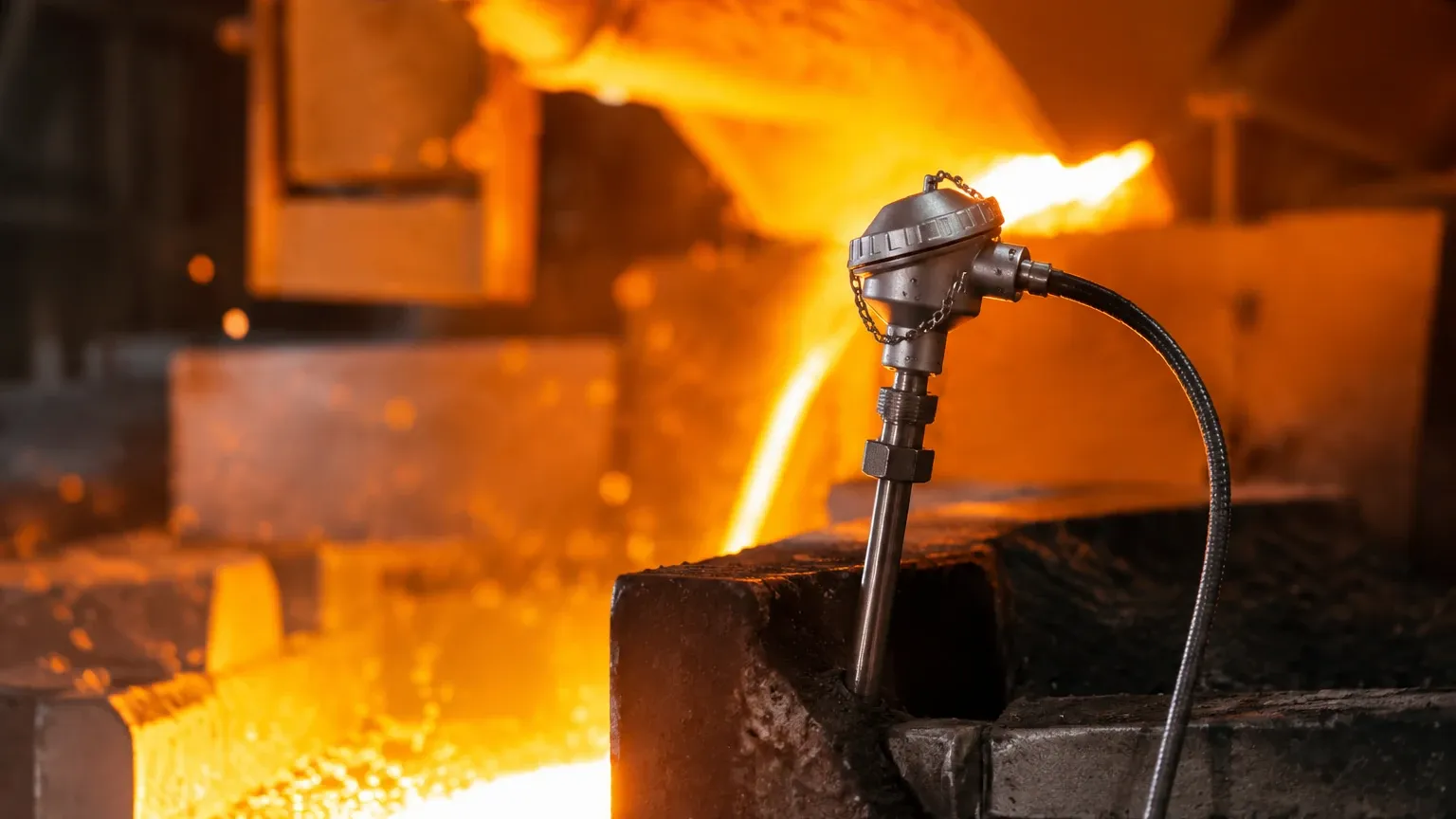
In most industrial processes, sensors are not inserted directly into the medium. Instead, they are housed in a thermowell—a pressure-tight receptacle that protects the sensor from corrosion, high pressure, and high-velocity flow.
* Material: Must be compatible with the process fluid (e.g., 316 Stainless Steel, Hastelloy, or Ceramic).
* Insertion Length: The sensor must be immersed deeply enough to avoid "stem conduction" errors, where heat conducts away from the sensor tip through the housing. A general rule is an immersion depth of at least 10 times the thermowell diameter.
2. Wiring and Signal Transmission
For RTDs, the lead wire resistance can introduce significant errors.
* 2-Wire: Only suitable for very short distances where accuracy is not critical.
* 3-Wire: The industrial standard; uses a third wire to cancel out lead resistance.
* 4-Wire: The most accurate; completely eliminates lead wire effects, typically used in laboratory or high-precision calibration.
For thermocouples, specific extension or compensating wires must be used to maintain the circuit's integrity back to the transmitter or PLC.
3. Environmental Protection
Industrial environments often involve moisture, dust, and corrosive vapors. Sensors should be specified with appropriate Ingress Protection (IP) ratings, such as IP65 or IP67. In hazardous areas (oil and gas, chemical plants), intrinsically safe or explosion-proof housings are mandatory to prevent the instrument from becoming an ignition source.
Common Risks and Limitations
Engineers must be aware of potential pitfalls that can compromise temperature data:
* Sensor Drift: Over time, exposure to high temperatures or thermal cycling can cause the sensor's output to shift. Regular calibration schedules are necessary to maintain accuracy.
* Self-Heating: In RTDs and thermistors, the current used to measure resistance generates a small amount of heat. If the excitation current is too high, it can artificially inflate the temperature reading.
* Vibration Fatigue: In high-flow pipelines, thermowells can experience wake frequency resonance, leading to mechanical failure. A wake frequency calculation should be performed during the design phase.
* Emissivity Errors: When using IR pyrometers, the "shininess" of a surface affects the reading. Uncoated metals have low emissivity, which can lead to significant measurement errors if the sensor is not correctly compensated.
Frequently Asked Questions (FAQs)
Q: When should I choose an RTD over a thermocouple?
A: Choose an RTD if you require high accuracy and stability within a range of -200°C to 650°C. Choose a thermocouple if you need to measure temperatures above 700°C, require a very fast response time, or are operating in a high-vibration environment where RTDs might fail.
Q: How often should industrial temperature measurement devices be calibrated?
A: This depends on the criticality of the process and the environment. Most industrial standards recommend an annual calibration, though harsh environments or high-precision requirements may dictate quarterly checks.
Q: Can I use a standard temperature sensor in a vacuum?
A: Contact sensors like RTDs and thermocouples work in a vacuum, but heat transfer is limited to conduction through the mounting point. IR pyrometers are often preferred for vacuum applications as they measure radiated heat.
Q: What is the impact of temperature on level measurement accuracy?
A: Temperature affects liquid density and the speed of sound. In a 10-meter tank, a significant temperature shift could result in a level error of several centimeters if not compensated. This is why Welk integrates temperature sensors into many of our level measurement solutions.
Conclusion
Industrial temperature measurement devices are the eyes and ears of thermal process control. By understanding the underlying principles of RTDs, thermocouples, and IR sensors, and by following rigorous installation standards, facilities can achieve higher efficiency and safer operations. Whether you are managing a simple water tank or a complex chemical reactor, the synergy between temperature and level measurement is a cornerstone of modern industrial automation.
For more information on integrated measurement technologies and to explore our full range of industrial sensors, please visit our Main Page. Our engineering team at Welk is available to assist with customized OEM/ODM services to meet your specific application requirements.
Download Industrial Temperature Measurement Devices as a PDF