Field Data Management Software
Field Data Management Software
In the modern industrial landscape, the accuracy of level measurement is only as valuable as the system used to interpret, store, and act upon that data. As process industries move toward Industry 4.0, the role of field data management software has evolved from a simple logging tool to a critical component of operational intelligence. For engineers and plant managers utilizing advanced instrumentation—such as radar level meters, ultrasonic sensors, and hydrostatic transmitters—the software layer serves as the bridge between raw physical measurements and informed decision-making.
Understanding Measurement Principles in Level Instrumentation
Before selecting a software solution, it is essential to understand the underlying measurement principles of the hardware generating the data. Different sensors produce different data profiles, which the software must be capable of processing.
Radar and Ultrasonic (Time-of-Flight)
Both radar and ultrasonic level meters operate on the Time-of-Flight (ToF) principle. A sensor emits a signal (electromagnetic pulses for radar, sound waves for ultrasonic) that reflects off the material surface and returns to the transducer. The distance is calculated based on the time interval.
* Radar: Operates at high frequencies (typically 26GHz or 80GHz), making it ideal for high-pressure or high-temperature environments where dust or steam might interfere with other signals.
* Ultrasonic: Best suited for liquid storage or open-channel flow where the medium does not produce heavy foam or vapors that could absorb sound waves.
Hydrostatic Pressure
Hydrostatic level transmitters measure the pressure exerted by a liquid column. The principle follows the formula $P = \rho \cdot g \cdot h$, where $P$ is pressure, $\rho$ is density, $g$ is gravity, and $h$ is the height of the liquid. The software must often account for density changes caused by temperature fluctuations to maintain accuracy.
Magnetic Level Gauges and Switches
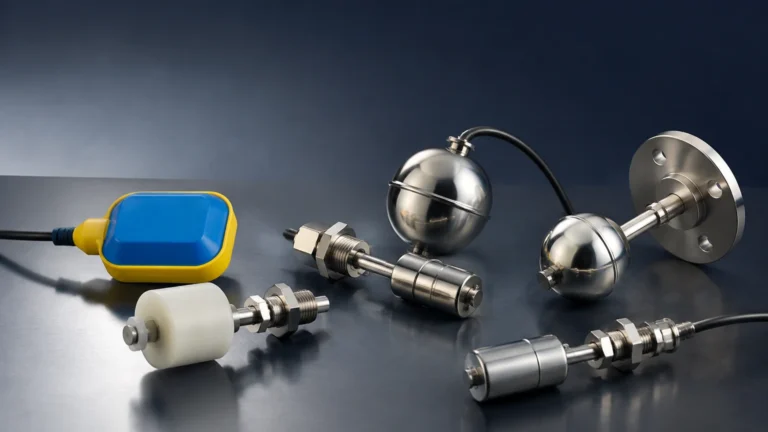
These instruments use buoyancy and magnetic coupling to provide visual indication or point-level detection. When integrated with a reed chain or magnetostrictive transmitter, they provide continuous output that requires software interpretation for volume calculation in non-linear tanks.
For a comprehensive overview of hardware options that integrate with these digital systems, professionals often consult the Main Page of leading manufacturers to ensure sensor-software compatibility.
The Role of Field Data Management Software
Field data management software acts as a centralized hub for data acquisition, visualization, and analysis. Its primary functions include:
1. Data Acquisition and Normalization: Collecting signals from various protocols (HART, Modbus, Profibus) and converting them into a standardized format.
2. Real-Time Visualization: Providing HMI (Human-Machine Interface) dashboards that show tank levels, flow rates, and system health.
3. Historical Trending: Storing data over months or years to identify seasonal patterns, usage rates, or equipment degradation.
4. Alarm Management: Configuring thresholds for high-level (overflow) or low-level (pump dry-run) alerts via SMS, email, or SCADA triggers.
Key Evaluation Criteria for Software Selection
When evaluating field data management software, engineering teams should prioritize the following technical criteria to ensure long-term reliability.
| Criteria | Requirement | Importance |
| :— | :— | :— |
| Protocol Support | Support for HART, Modbus RTU/TCP, and 4-20mA via gateways. | High – Determines hardware interoperability. |
| Scalability | Ability to add dozens or hundreds of nodes without performance lag. | Medium – Crucial for expanding facilities. |
| Data Security | End-to-end encryption and role-based access control (RBAC). | High – Protects against industrial espionage or sabotage. |
| Integration | API availability (REST, MQTT) for ERP or MES integration. | Medium – Necessary for automated inventory management. |
| Cloud vs. On-Premise | Choice between local server hosting or cloud-based SaaS. | Project Dependent – Impacts latency and accessibility. |
Installation and Integration Considerations
Successful implementation of field data management software requires careful planning during the installation phase.
Signal Conversion and Gateways
Most field instruments output an analog 4-20mA signal or a digital HART signal. To bring this into a software environment, signal converters or edge gateways are required. For example, a Modbus RTU (RS485) network can daisy-chain multiple radar level meters into a single gateway, which then pushes the data to the software via Ethernet or Wi-Fi.
Calibration and Mapping
The software must be calibrated to match the physical dimensions of the vessel. This includes entering the "Zero" point (empty tank) and the "Span" (full tank). For irregularly shaped tanks, such as horizontal cylindrical tanks with dish ends, the software must utilize strapping tables or linearization curves to accurately convert level (meters) into volume (liters or cubic meters).
Network Latency and Polling Rates
In critical applications, such as chemical dosing or high-pressure steam drum monitoring, the polling rate (how often the software asks the sensor for data) must be optimized. High polling rates provide near-instantaneous data but can congest the industrial network; low polling rates save bandwidth but may miss rapid level fluctuations.
Limitations and Common Risks
While field data management software significantly enhances operational efficiency, it is not without limitations:
* Connectivity Dependency: If the network goes down, the software loses real-time visibility. Redundant local displays on the level meters themselves are always recommended for safety-critical points.
* Data Integrity: Incorrectly configured offsets in the software can lead to systematic errors, even if the sensor is perfectly calibrated. Regular audits between the software reading and manual dip-tape measurements are essential.
* Cybersecurity Vulnerabilities: Any software connected to a network is a potential entry point for cyber threats. Isolating the industrial network (OT) from the corporate network (IT) via firewalls is a standard requirement.
* Firmware Mismatches: Occasionally, a firmware update on a level transmitter may break compatibility with an older version of the management software. Maintaining a version-control log is a best practice for maintenance teams.
Practical Selection Table: Software Tiers
| Feature | Entry-Level (Local) | Professional (Enterprise) | Advanced (Cloud/AI) |
| :— | :— | :— | :— |
| Primary User | Maintenance Tech | Plant Manager | Operations Director |
| Device Limit | 1-10 Sensors | 10-500 Sensors | Unlimited |
| Analytics | Basic Logging | Trend Analysis | Predictive Maintenance |
| Remote Access | None | VPN Required | Browser/Mobile App |
| Typical Use | Single Tank Monitoring | Full Plant Automation | Multi-site Inventory Management |
Frequently Asked Questions (FAQs)
Q: Can I use one software package for different brands of level meters?
A: Yes, provided the software supports standard industrial protocols like Modbus or HART. Most modern field data management software is brand-agnostic, allowing you to integrate Welk radar meters alongside other legacy instrumentation.
Q: How does software handle foam or turbulence in a tank?
A: While the sensor does the primary filtering (e.g., radar signal processing), the software can apply secondary damping filters. This smooths out the data spikes caused by turbulent surfaces, providing a more stable reading for the control system.
Q: Is cloud-based software safe for chemical plants?
A: Many providers offer "Private Cloud" options that combine the accessibility of the cloud with the security of a private network. For highly sensitive applications, an air-gapped on-premise server is still the preferred choice.
Q: Does the software calculate mass or just volume?
A: If the software receives data from both a level meter and a temperature/pressure sensor (to determine density), it can calculate the mass of the medium. This is particularly useful in the oil and gas industry for custody transfer applications.
Conclusion and Next Steps
Implementing field data management software is a strategic move that transforms individual level measurements into a cohesive data ecosystem. By understanding the measurement principles of your hardware—whether it be the high-frequency precision of radar or the reliable pressure sensing of hydrostatic transmitters—you can select a software solution that maximizes accuracy and safety.
Before proceeding with a software purchase, ensure you have confirmed the communication protocols of your existing field instruments and mapped out the network infrastructure of your facility. For those in the planning stages of a new project, reviewing the available hardware and its digital capabilities on the Main Page of a specialized manufacturer is the recommended starting point to ensure seamless integration from the sensor to the screen.