Flow Monitoring Services
Flow Monitoring Services
In modern industrial automation, flow monitoring services play a pivotal role in ensuring the efficiency, safety, and regulatory compliance of fluid handling systems. Whether managing wastewater treatment plants, chemical processing facilities, or oil and gas distribution networks, the ability to accurately measure and record the movement of liquids is essential. Flow monitoring is not merely about installing a meter; it is a comprehensive service that encompasses technology selection, site assessment, installation, and data integration to provide actionable insights for process optimization.
Industrial flow monitoring often relies on the relationship between fluid level and velocity, particularly in open channel environments or partially filled pipes. By utilizing advanced level measurement instruments—such as radar, ultrasonic, and hydrostatic sensors—engineers can derive precise flow rates based on established hydraulic principles. This guide explores the technical foundations of these services and provides a framework for selecting and implementing the correct monitoring solutions.
Understanding the Role of Flow Monitoring Services
Flow monitoring services are designed to address the complexities of fluid dynamics in diverse environments. In many industrial applications, fluids do not always travel through fully pressurized pipes. Open channels, such as irrigation ditches, sewer lines, and industrial effluent flumes, require specialized monitoring techniques that differ significantly from closed-loop systems.
Professional flow monitoring services provide the expertise needed to navigate these challenges. The primary objectives include:
* Regulatory Compliance: Ensuring that discharge levels meet environmental standards.
* Billing and Custody Transfer: Providing accurate data for the exchange of fluids between parties.
* Process Control: Maintaining steady-state operations in chemical and manufacturing plants.
* Leak Detection: Identifying discrepancies in flow that indicate system failures or infrastructure damage.
By integrating high-quality instrumentation with robust data logging and communication protocols, these services transform raw physical measurements into the intelligence required for high-level decision-making.
Measurement Principles: Converting Level to Flow
A core component of flow monitoring services is the application of level-to-flow conversion. This is most common in open channel flow measurement, where a primary device (such as a weir or flume) is used to create a known relationship between the liquid level (head) and the flow rate.
Open Channel Hydraulics
In an open channel, the flow rate (Q) is a function of the liquid level (H). When a flume or weir is installed, it restricts the flow, causing the level to rise in a predictable manner. The mathematical relationship is generally expressed as:
**Q = k * H^n**
Where:
* Q is the flow rate (e.g., liters per second or cubic meters per hour).
* k is a constant determined by the geometry of the primary device.
* H is the measured head level.
* n is an exponent specific to the type of weir or flume (e.g., 1.5 for a rectangular weir).
Sensor Technologies
To capture the 'H' value accurately, flow monitoring services utilize several types of sensors:
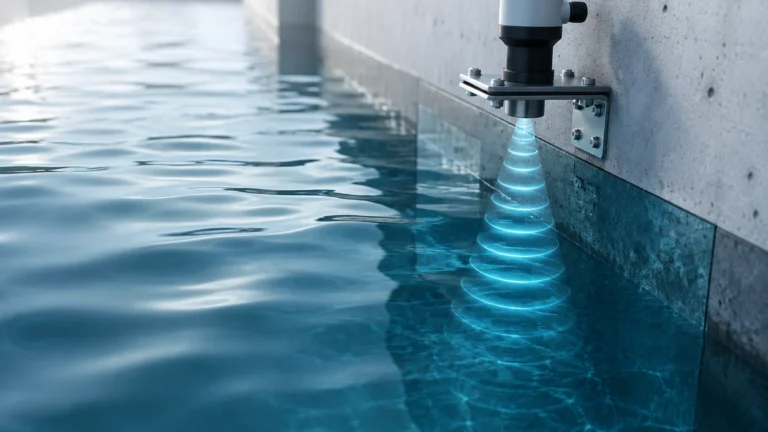
1. Ultrasonic Sensors: These use sound waves to measure the distance to the liquid surface. They are non-contact and cost-effective but can be influenced by air temperature fluctuations and heavy foam.
2. Radar Level Meters: Utilizing microwave pulses, radar sensors provide high-precision, non-contact measurement. They are largely unaffected by steam, temperature changes, or vapor, making them ideal for harsh chemical environments.
3. Hydrostatic Transmitters: These are contact-based sensors that measure the pressure exerted by the liquid column. They are highly reliable in deep tanks or areas where surface turbulence makes non-contact measurement difficult.
Selecting the Right Technology for Flow Monitoring
Choosing the appropriate technology is the most critical phase of flow monitoring services. The selection depends on the fluid characteristics, the physical environment, and the required accuracy. The following table provides a comparison of common technologies used in industrial flow monitoring.
| Technology | Measurement Type | Best For | Advantages | Limitations |
| :— | :— | :— | :— | :— |
| Radar (80GHz/26GHz) | Non-contact (Microwave) | Chemical tanks, turbulent surfaces | High accuracy, unaffected by vapors | Higher initial cost |
| Ultrasonic | Non-contact (Sound) | Water treatment, open channels | Cost-effective, easy to install | Sensitive to foam and wind |
| Hydrostatic | Contact (Pressure) | Deep wells, pressurized vessels | Robust, works in narrow spaces | Requires contact with fluid |
| Magnetic Level Gauge | Visual/Contact | High-pressure oil & gas | Clear local indication | Limited to clean liquids |
When evaluating flow monitoring services, engineers must consider the "Total Cost of Ownership," which includes not only the purchase price of the sensors but also the maintenance requirements and the longevity of the equipment in specific chemical exposures.
Installation and Site Configuration Requirements
The accuracy of flow monitoring is heavily dependent on the physical installation of the sensors. Even the most advanced radar level meter will provide inaccurate data if it is placed incorrectly. Professional flow monitoring services emphasize the following installation considerations:
1. Positioning and Alignment
For non-contact sensors (ultrasonic and radar), the sensor must be mounted perpendicular to the liquid surface. In open channel applications using flumes, the sensor must be located at a specific distance upstream from the throat of the flume (the "point of measurement") to ensure the level reading is taken in a zone of laminar flow rather than turbulent flow.
2. Dead Zone (Blocking Distance)
Every non-contact sensor has a "dead zone"—a minimum distance between the sensor face and the liquid surface where measurement is impossible. For example, if an ultrasonic sensor has a 0.3-meter dead zone, the maximum liquid level must never reach within 0.3 meters of the sensor. Failure to account for this can lead to "lost signal" errors during peak flow events.
3. Avoiding Obstructions
Internal structures such as ladders, pipes, or agitators can cause false echoes. Modern radar instruments often feature "false echo suppression" software, which allows the service technician to map out these obstructions so the sensor ignores them. However, proper physical placement remains the primary defense against signal interference.
4. Stilling Wells
In applications with significant surface turbulence or foam, a stilling well (a vertical pipe submerged in the liquid) may be required. The sensor measures the level inside the pipe, which remains calm even if the main body of liquid is agitated. This is a common recommendation in flow monitoring services for large-scale chemical reactors.

Operational Limitations and Risk Mitigation
While modern instrumentation is highly reliable, flow monitoring services must account for specific environmental risks that can compromise data integrity.
* Foam and Turbulence: Heavy foam can absorb ultrasonic sound waves, leading to signal loss. In such cases, 80GHz high-frequency radar is often recommended as it can penetrate foam more effectively.
* Temperature Gradients: Ultrasonic measurement relies on the speed of sound, which changes with air temperature. While most sensors include integrated temperature compensation, extreme gradients can still introduce errors. Radar is immune to these effects.
* Build-up and Scaling: For contact-based sensors like hydrostatic transmitters or float switches, the buildup of fats, oils, or minerals can interfere with the sensor's movement or pressure sensing diaphragm. Regular cleaning schedules are a necessary part of the service contract.
* Environmental Factors: In outdoor open channel monitoring, heavy rain or wind can affect the surface of the water. Wind can deflect ultrasonic pulses, while rain can introduce noise into the measurement. Protective sunshades and windbreaks are often installed to mitigate these risks.
Frequently Asked Questions (FAQ)
Q: How often should flow monitoring equipment be calibrated?
A: Calibration frequency depends on the criticality of the data and the harshness of the environment. For regulatory compliance in wastewater, annual calibration is standard. For high-precision chemical processes, semi-annual checks are recommended.
Q: Can level meters be used for flow monitoring in closed pipes?
A: Level meters are typically used in partially filled pipes or open channels. For full, pressurized pipes, technologies like electromagnetic flowmeters or ultrasonic transit-time meters are more appropriate. However, if a pipe is consistently less than 100% full, a level-to-flow calculation is the only viable method.
Q: What is the advantage of using radar over ultrasonic for flow monitoring services?
A: Radar offers superior accuracy (up to ±2mm) and is not affected by environmental conditions like temperature, vacuum, or steam. While ultrasonic is more budget-friendly, radar is the preferred choice for industrial applications where downtime or measurement error carries a high financial risk.
Q: Are OEM/ODM services available for specialized monitoring needs?
A: Yes, professional manufacturers like Welk provide customized solutions, including specialized mounting brackets, communication protocols (HART, Modbus, 4-20mA), and sensor housings designed for extreme chemical compatibility.
Conclusion
Effective flow monitoring services are the backbone of efficient industrial fluid management. By understanding the underlying measurement principles and carefully selecting instrumentation that matches the specific demands of the application, organizations can achieve unprecedented levels of process transparency. From the precision of radar level meters to the rugged reliability of hydrostatic transmitters, the right technology ensures that flow data is not just a number, but a reliable tool for operational excellence.
For comprehensive technical specifications and to explore the full range of instrumentation, engineers can visit the Main Page to review product options and application support. Proper instrumentation, combined with expert installation and maintenance, ensures that flow monitoring systems deliver value for years to come.