In-line Food Analyzer
In-line Food Analyzer
In the modern food and beverage industry, the transition from manual laboratory sampling to real-time process monitoring has become a standard for ensuring product consistency and safety. An in-line food analyzer typically refers to a suite of sensors and instruments integrated directly into the production line to measure chemical composition, such as moisture, fat, or protein. However, for these analytical measurements to be accurate and for the process to remain efficient, they must be supported by precise physical measurement instruments, most notably level sensors.
Reliable level measurement ensures that mixing ratios are maintained, tanks do not overflow, and pumps are protected from dry running. When selecting instrumentation for food-grade environments, engineers must balance technical precision with strict hygienic requirements. This guide explores the principles of level measurement within the context of food processing and how these systems complement the broader function of an in-line food analyzer.
The Role of Level Measurement in Food Processing
Level measurement is a fundamental component of automated food production. Whether a facility is processing liquid dairy, viscous syrups, or dry grains, knowing the exact volume of material in a vessel is critical for batch control and inventory management. In-line food analysis depends on stable process conditions; for instance, an infrared moisture sensor requires a consistent product flow and depth to provide reliable data. Level sensors provide the foundational data needed to maintain these conditions.
In food applications, sensors must often withstand extreme conditions, including high temperatures, corrosive cleaning agents, and high-pressure washdowns. The integration of level data into a centralized control system allows for the synchronization of the entire production line, reducing waste and ensuring that every batch meets the required specifications.
Measurement Principles for Food-Grade Level Sensors
Before selecting a sensor to work alongside an in-line food analyzer, it is essential to understand the physical principles governing different measurement technologies. Each method has specific strengths and limitations depending on the media being measured.
Non-Contact Radar (Microwave)
Radar level meters, particularly those operating at high frequencies like 80 GHz, are increasingly the preferred choice for food applications. These devices emit a high-frequency microwave signal that reflects off the surface of the product. The time it takes for the signal to return (Time of Flight) determines the distance to the material.
* Advantages: Non-contact measurement prevents contamination. Radar is unaffected by changes in temperature, pressure, or the presence of dust and steam.
* Food Context: Ideal for large silos of grain or agitated mixing tanks where physical contact with the probe is undesirable.
Ultrasonic Level Sensors
Ultrasonic sensors function similarly to radar but use sound waves instead of microwaves. The sensor emits an acoustic pulse that bounces off the liquid or solid surface.
* Advantages: Cost-effective and easy to install.
* Limitations: Sound waves are sensitive to air temperature fluctuations and can be absorbed by heavy foam or steam. In many food processes involving boiling or fermentation, ultrasonic sensors may require specialized compensation or may not be suitable.
Hydrostatic Pressure
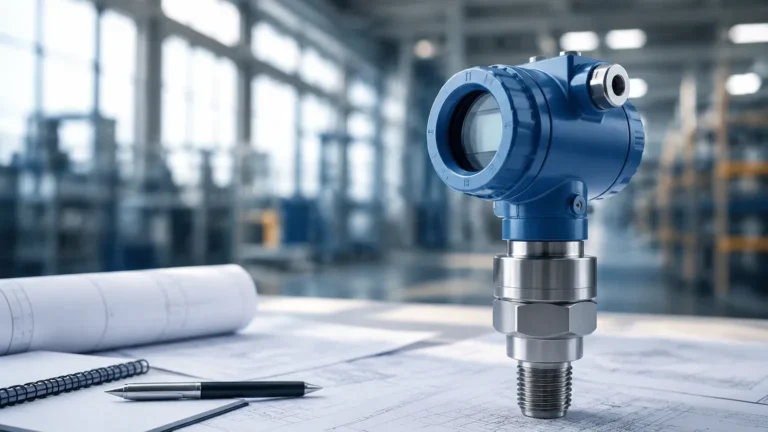
Hydrostatic level transmitters measure the pressure exerted by a liquid column at the bottom of a tank. Since pressure is directly proportional to the height of the liquid (based on its density), the level can be calculated precisely.
* Advantages: Highly accurate for liquids with consistent density.
* Food Context: Often used in milk silos and juice storage tanks where the sensor can be mounted flush with the tank wall to meet sanitary standards.
Magnetic Level Gauges
For visual monitoring combined with electronic output, magnetic level gauges use a float equipped with a magnet that moves with the liquid level. This magnet actuates a series of switches or a transmitter outside the chamber.
* Advantages: Provides a clear visual indication without requiring power, which is useful for local operator checks.
Key Evaluation Criteria for Food-Grade Instrumentation
When integrating sensors into a system that includes an in-line food analyzer, the hardware must meet specific industrial standards to ensure food safety and process integrity.
Hygienic Design and Materials
All wetted parts—the components of the sensor that come into contact with the food—must be made from non-toxic, non-corrosive materials. Stainless steel 316L is the industry standard. For seals and gaskets, materials like PTFE (Teflon) or EPDM are used because they do not leach chemicals and can withstand high temperatures.
Surface Finish
In the food industry, the smoothness of a sensor's surface is measured by its Roughness Average (Ra). To prevent bacterial growth, surfaces must typically have an Ra of less than 0.8 μm. This ensures that there are no microscopic pits where organic material can collect and rot.
CIP and SIP Compatibility
Clean-in-Place (CIP) and Steam-in-Place (SIP) are automated cleaning processes that involve circulating hot water, caustic chemicals, and steam through the production line. Any sensor installed must be rated to withstand temperatures often exceeding 130°C (266°F) and the chemical stress of detergents without losing calibration or suffering mechanical failure.
Comparison of Level Measurement Technologies
The following table provides a quick reference for selecting the appropriate level measurement technology for common food and beverage applications.
| Technology | Typical Media | Accuracy | Hygienic Suitability | Main Limitation |
| :— | :— | :— | :— | :— |
| 80GHz Radar | Liquids, Slurries, Solids | ±1 mm | Excellent (Non-contact) | Higher initial cost |
| Ultrasonic | Water, Dilute Liquids | ±0.25% of range | Good | Sensitive to foam/steam |
| Hydrostatic | Milk, Oils, Syrups | ±0.1% of span | Excellent (Flush mount) | Affected by density changes |
| Magnetic Gauge | Clear Liquids | ±5 mm | Moderate | Moving parts (float) |
| Level Switch | Overfill Protection | N/A | High | Point level only |

Installation Considerations and Best Practices
Proper installation is as critical as sensor selection. Even the most advanced in-line food analyzer or level meter will fail if it is improperly positioned within the vessel.
1. Sanitary Fittings: Use industry-standard connections such as Tri-clamp or Varivent. These fittings eliminate "dead zones" where product can stagnate and bacteria can grow.
2. Avoid Obstructions: For radar and ultrasonic sensors, ensure the signal path is clear of agitators, spray balls, or heating coils. High-frequency 80 GHz radar has a narrow beam angle, which helps in avoiding these internal tank structures.
3. Mounting Position: Sensors should generally be mounted away from the tank inlet to avoid interference from the incoming product stream. If turbulence is unavoidable, a stilling well or bypass pipe may be necessary, though these must be designed for easy cleaning.
4. Calibration: Regular calibration is necessary to maintain the accuracy required for high-quality food production. Many modern digital transmitters allow for remote calibration via HART or Profibus protocols, reducing the need for technicians to enter sterile areas.
For engineers looking to optimize their production lines with high-precision instrumentation, reviewing specialized product options is a necessary step. You can explore detailed technical specifications and application support on our Main Page.
Limitations and Common Challenges
While modern instrumentation is highly robust, certain challenges remain prevalent in the food industry:
* Foam and Bubbles: In brewing or dairy processing, foam can absorb ultrasonic signals or create false echoes for radar. Selecting a radar sensor with advanced signal processing algorithms can help filter out foam interference.
* Condensation: In hot processes, steam can condense on the sensor face. Some radar sensors feature a convex lens design or PTFE drippers that allow condensation to run off, preventing signal attenuation.
* Varying Dielectric Constants: Radar sensors depend on the dielectric constant of the material to reflect the signal. While most food products are sufficiently reflective, very dry powders may have low dielectric constants, requiring high-sensitivity radar units.
Frequently Asked Questions (FAQs)
Q: Can level sensors be used in vacuum tanks?
A: Yes, non-contact radar and hydrostatic pressure sensors can be used in vacuum conditions. However, for hydrostatic sensors, a differential pressure setup or a vacuum-compensated transmitter is required to account for the lack of atmospheric pressure.
Q: How do I handle measurement in a tank with a heavy agitator?
A: 80 GHz radar is often the best solution due to its narrow beam, which can be aimed to miss the agitator blades. Alternatively, a guided wave radar (GWR) can be used if the probe can be safely positioned away from the blades, though non-contact is usually preferred for hygiene.
Q: Are ultrasonic sensors safe for food contact?
A: While the sound waves themselves are safe, the sensor housing must be made of food-grade materials (like PVDF or Stainless Steel). Because they are non-contact, they are generally considered safe as long as they are cleaned according to facility protocols.
Q: What is the benefit of an 80 GHz radar over a 26 GHz radar?
A: The 80 GHz frequency allows for a much smaller antenna and a narrower beam (often as small as 3 degrees). This makes it much easier to install in small tanks or vessels with many internal obstructions, which are common in food processing.
Conclusion
Integrating an in-line food analyzer with reliable level measurement instruments is essential for any facility aiming for high levels of automation and quality control. By understanding the principles of radar, ultrasonic, and hydrostatic measurement, and by adhering to strict hygienic standards, manufacturers can ensure their processes are both efficient and compliant with global safety regulations. Selecting the right tool for the specific characteristics of the food media—be it a foaming liquid or a dusty solid—is the key to long-term operational success. For more information on selecting the right level measurement technology for your specific application, please visit the Main Page.