Lp 50f
Lp 50f
In the landscape of industrial process control, the precision of liquid level measurement is a fundamental requirement for operational safety, inventory management, and process efficiency. Among the various technologies available, hydrostatic level measurement remains a cornerstone due to its reliability and straightforward integration. The LP 50F series represents a specific class of high-performance hydrostatic level transmitters designed to meet the rigorous demands of chemical processing, water management, and industrial automation. This guide provides a comprehensive technical overview of the LP 50F, its underlying measurement principles, and practical considerations for engineering selection and installation.
Understanding the Measurement Principle of the LP 50F
The LP 50F operates on the hydrostatic pressure principle, which is one of the most established methods for determining liquid level in both open and closed vented vessels. This method relies on the physical relationship between the height of a liquid column and the pressure exerted at the base of that column due to gravity.
The Hydrostatic Equation
The fundamental physics governing the LP 50F is expressed by the formula:
P = ρ × g × h
Where:
* P is the hydrostatic pressure (measured in Pascals or bar).
* ρ (rho) is the density of the liquid (kg/m³).
* g is the acceleration due to gravity (approximately 9.81 m/s²).
* h is the height of the liquid column (meters).
Because gravity is a constant and the density of the process fluid is typically known, the pressure measured by the LP 50F diaphragm is directly proportional to the liquid level. For instance, in a tank containing water with a density of 1,000 kg/m³, every 1 meter (3.28 feet) of liquid height exerts approximately 9.81 kPa (0.098 bar or 1.42 psi) of pressure.
Pressure Compensation
Industrial applications often occur in environments where atmospheric pressure fluctuates. The LP 50F is typically designed as a gauge pressure sensor. It utilizes a vented cable or a reference port to ensure that the back of the sensing diaphragm is exposed to ambient atmospheric pressure. This design ensures that the transmitter only measures the pressure exerted by the liquid column, effectively "canceling out" the atmospheric pressure that acts on both the sensor and the surface of the liquid.
Technical Characteristics and Specifications
The LP 50F is engineered for durability and high-precision signal output. While specific configurations can vary based on the application, several core technical attributes define this series.
Construction Materials
To withstand corrosive environments, the LP 50F typically features a housing made of 316L stainless steel. The sensing diaphragm, which is the most critical component, may be constructed from 316L SS, Hastelloy C, or Ceramic, depending on the chemical compatibility requirements of the process fluid. For highly aggressive media, specialized coatings or Tantalum diaphragms are often employed to prevent pitting and chemical degradation.
Signal Output and Communication
Standard LP 50F units provide a 4-20mA analog output, which is the industry standard for long-distance signal transmission with high noise immunity. Many modern iterations also support the HART (Highway Addressable Remote Transducer) protocol, allowing for digital configuration, diagnostics, and multi-variable reporting over the same two-wire loop. This digital capability is essential for Industry 4.0 integration and remote maintenance.
Performance Metrics
* Accuracy: Typically ranges from ±0.1% to ±0.25% of the full-scale (FS) range.
* Long-term Stability: Often rated at ≤0.1% FS per year, reducing the frequency of required recalibrations.
* Pressure Ranges: Available from low-pressure ranges (e.g., 0-1 meter / 0-3.3 feet) to high-pressure ranges exceeding 200 meters (656 feet) of water column.
Selection Criteria and Application Suitability
Choosing the LP 50F over other technologies like radar or ultrasonic sensors depends on the specific tank geometry, fluid properties, and environmental conditions. The following table provides a comparison to assist engineers in the selection process.
| Feature | LP 50F (Hydrostatic) | Ultrasonic (Non-Contact) | Radar (Non-Contact) |
| :— | :— | :— | :— |
| Measurement Principle | Pressure at bottom | Sound wave reflection | Microwave reflection |
| Impact of Foam | Negligible | High (Absorbs signal) | Moderate (Depends on frequency) |
| Impact of Vapor/Dust | None | High (Distorts signal) | Low |
| Installation Ease | High (Submerged or Flanged) | Moderate (Requires clear path) | Moderate (Requires clear path) |
| Accuracy | High (Fixed density) | Moderate | Very High |
| Cost-Effectiveness | Excellent | Good | Moderate to High |
| Density Dependency | High (Requires constant density) | None | None |
Ideal Use Cases for LP 50F
1. Deep Well Monitoring: The submersible version of the LP 50F is ideal for groundwater level monitoring where non-contact sensors cannot be easily mounted.
2. Foaming Liquids: Since the LP 50F measures pressure at the bottom, surface foam does not affect the accuracy of the reading, unlike ultrasonic sensors.
3. Vented Storage Tanks: For standard atmospheric tanks containing water, oils, or chemicals, the LP 50F provides a cost-effective and highly reliable solution.
For a broader overview of available sensing technologies and to compare these specifications with other industrial models, engineers should review the product options and application support available on the Main Page of the Welk technical catalog.
Installation Best Practices for LP 50F Transmitters
Correct installation is paramount to ensuring the longevity and accuracy of the LP 50F. Errors in mounting or cable management are the most common causes of signal drift and premature failure.
Mounting Configurations
The LP 50F is generally available in two mounting styles:
1. Submersible (Probe Style): The sensor is lowered into the liquid via a reinforced cable. It should be positioned at a depth where it will not rest in silt or sludge at the bottom of the tank. A protective pipe (stilling well) is recommended if the liquid is subject to high turbulence or agitation.
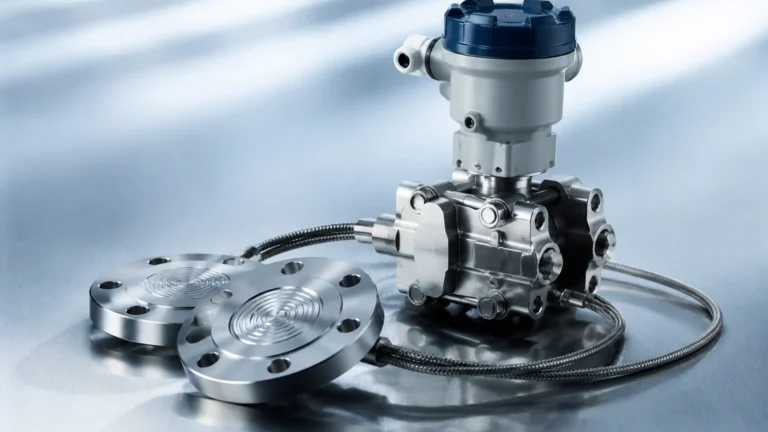
2. External (Flanged or Threaded): The sensor is mounted to a nozzle at the bottom or side of the tank. The "F" in LP 50F often denotes a flange-mounted configuration, which is preferred for hygienic applications or tanks where internal access is limited.
Cable and Venting Management
For submersible units, the cable contains a small vent tube. It is critical that this tube remains unobstructed and protected from moisture. If moisture enters the vent tube, it can lead to internal corrosion or erroneous pressure readings due to the "pumping" effect of temperature changes. Using a specialized junction box with a desiccant filter is a recommended industry practice.
Avoiding Turbulence
If the LP 50F is installed near an inlet pipe or an agitator, the kinetic energy of the moving fluid can create localized pressure fluctuations. This results in a "noisy" signal. To mitigate this, the sensor should be installed in a location with calm fluid or protected by a baffle or stilling well.

Operational Limitations and Environmental Considerations
While the LP 50F is a versatile instrument, it has specific limitations that must be accounted for during the engineering phase.
Density Sensitivity
The most significant limitation of hydrostatic measurement is its dependence on fluid density. If the temperature of the liquid changes significantly, its density will change, leading to an error in the level calculation even if the actual volume remains the same. In applications with fluctuating temperatures, a temperature-compensated transmitter or a secondary temperature sensor integrated into the PLC logic is necessary to maintain accuracy.
Pressure Limits
In pressurized (closed) tanks that are not vented to the atmosphere, a single LP 50F cannot be used alone. In these scenarios, a differential pressure (DP) approach is required, where the top pressure of the tank is subtracted from the bottom pressure. The LP 50F is primarily intended for vented vessels or submersible applications.
Media Compatibility
Although stainless steel is highly resistant, certain chemicals like hot sulfuric acid or chlorides can cause stress corrosion cracking. Engineers must verify the chemical compatibility of the diaphragm and O-ring materials (such as Viton, EPDM, or Kalrez) before deployment.
Maintenance and Calibration Procedures
The LP 50F is designed for low-maintenance operation, but periodic checks ensure system integrity.
1. Sediment Removal: In wastewater or slurry applications, sediment can build up around the diaphragm. Periodic cleaning with a soft cloth and non-corrosive solvent is necessary. Never use sharp objects to clean the diaphragm, as it is extremely thin and easily damaged.
2. Zero-Point Verification: Over time, sensors may experience a slight "zero drift." This can be checked by raising the sensor out of the liquid and verifying that the output returns to 4.00 mA (at 0 pressure).
3. Loop Testing: Periodically simulate a high-level condition to ensure that the safety interlocks and alarms in the control system are functioning correctly.
Frequently Asked Questions
Q: Can the LP 50F be used in boiling liquids?
A: It is not recommended for boiling liquids because the formation of vapor bubbles changes the effective density of the liquid column and creates significant turbulence, leading to inaccurate and unstable readings.
Q: How far can the signal be transmitted?
A: Using a standard 4-20mA loop, the signal can typically be transmitted up to 1,000 meters (approx. 3,280 feet) depending on the wire gauge and the power supply voltage, provided there is minimal electromagnetic interference.
Q: What is the difference between the LP 50F and a standard pressure transmitter?
A: While both measure pressure, the LP 50F is specifically optimized for level measurement, often featuring specialized cable seals, moisture protection for the vent tube, and diaphragm materials suited for constant immersion.
Q: Is the LP 50F suitable for food and beverage applications?
A: Yes, provided the unit is specified with a flush diaphragm and food-grade filling fluid (such as vegetable oil) instead of standard silicone oil, and meets 3-A or EHEDG sanitary standards.
For technical support regarding specific installation geometries or to request a quote for customized OEM configurations, please visit the Main Page for detailed contact information and product data sheets.