Process Raman
Process Raman
In the landscape of modern industrial automation, the ability to monitor chemical composition in real-time has become as critical as measuring physical parameters like pressure, temperature, and volume. Process Raman spectroscopy stands at the forefront of this shift, providing non-destructive, in-situ molecular analysis that allows for precise control over complex chemical reactions. Unlike traditional laboratory analysis, which requires manual sampling and introduces significant time delays, process Raman delivers continuous data directly from the production line.
For engineers and plant managers, integrating Raman spectroscopy into a process control strategy requires a deep understanding of optical physics, probe interface engineering, and data interpretation. This guide explores the fundamental principles, technical selection criteria, and practical installation requirements for implementing process Raman systems in industrial environments.
Understanding the Principles of Process Raman Spectroscopy
Process Raman is based on the Raman effect, a phenomenon of light scattering first discovered by C.V. Raman in 1928. When a high-intensity monochromatic light source, typically a laser, interacts with molecular vibrations in a sample, the energy of the scattered photons is shifted.
The Raman Scattering Effect
When laser light hits a molecule, the vast majority of the light is scattered elastically, meaning the scattered photons have the same frequency as the incident light. This is known as Rayleigh scattering. However, a very small fraction of the light—approximately one in every ten million photons—undergoes inelastic scattering. In this process, the photon exchanges energy with the molecule's vibrational modes.
1. Stokes Shift: If the molecule absorbs energy from the photon, the scattered light has a lower frequency (longer wavelength) than the incident light.
2. Anti-Stokes Shift: If the molecule is already in an excited vibrational state and transfers energy to the photon, the scattered light has a higher frequency (shorter wavelength).
Because every chemical functional group (such as C-H, C=O, or N-H bonds) has unique vibrational frequencies, the resulting Raman spectrum serves as a "molecular fingerprint." This allows for the simultaneous identification and quantification of multiple components within a complex mixture.
Why Use Raman for Process Monitoring?
Raman spectroscopy offers several distinct advantages for industrial applications:
* Water Insensitivity: Unlike Near-Infrared (NIR) spectroscopy, water is a very weak Raman scatterer. This makes Raman ideal for monitoring aqueous solutions and fermentation processes.
* Fiber Optic Compatibility: Raman signals can be transmitted over long distances (up to several hundred meters) using standard silica fiber optics, allowing the sensitive spectrometer to be housed in a controlled environment while the probe is located in a hazardous or high-temperature process zone.
* Non-Destructive Analysis: The measurement does not consume the sample or require reagents, making it suitable for high-purity applications.
Key Components of an Industrial Process Raman System
A robust process Raman installation consists of four primary modules: the laser source, the spectrometer, the fiber optic interface, and the sampling probe.
1. The Laser Source
Most industrial systems utilize stabilized diode lasers. The choice of wavelength is a critical engineering decision. A 785 nm laser is the most common because it provides a strong Raman signal with relatively low background noise. However, for samples that exhibit high fluorescence (which can overwhelm the Raman signal), a 1064 nm laser is often preferred, despite the weaker signal intensity.
2. The Spectrometer
The spectrometer must be designed for long-term stability in industrial settings. It uses a diffraction grating to spread the scattered light into its constituent wavelengths and a Charge-Coupled Device (CCD) or Indium Gallium Arsenide (InGaAs) detector to record the intensity of the light at each wavelength.
3. Fiber Optic Probes
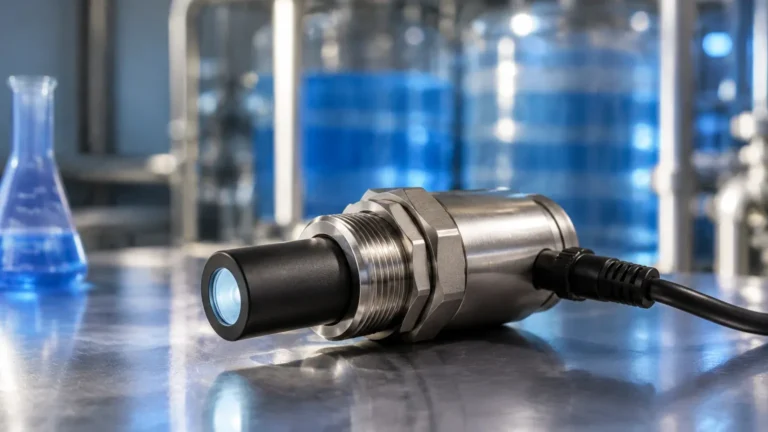
The probe is the only component in direct contact with the process. It must withstand the chemical and physical rigors of the environment. Industrial probes are typically constructed from stainless steel or Hastelloy and feature sapphire windows for optical clarity and chemical resistance.
Technical Selection Criteria for Process Raman
Selecting the right system involves balancing sensitivity, spectral range, and environmental resilience. The following table provides a comparison of typical specifications based on the phase of the material being measured.
Process Raman Selection Matrix
| Feature | Liquid Phase Applications | Solid/Slurry Applications | Gas Phase Applications |
| :— | :— | :— | :— |
| Typical Laser Wavelength | 785 nm or 830 nm | 1064 nm (to reduce fluorescence) | 532 nm or 785 nm |
| Probe Interface | Immersion probe (NPT/Flange) | Non-contact optic or large-spot probe | High-pressure gas cell |
| Spectral Range | 100 to 3400 cm⁻¹ | 200 to 2500 cm⁻¹ | 100 to 4000 cm⁻¹ |
| Pressure Rating | Up to 300 bar | Ambient to 50 bar | Up to 500 bar |
| Temperature Range | -20°C to 450°C | 0°C to 150°C | -50°C to 200°C |
Installation and Engineering Considerations
Successful deployment of process Raman requires careful attention to the physical installation and the integration with the plant's control system. While Raman provides chemical data, it is often used in conjunction with physical sensors. For instance, ensuring that a Raman probe is fully submerged in a vessel requires reliable level monitoring, such as that provided by the instruments found on the Main Page of industrial measurement providers.
Probe Placement and Mounting
* Flow Dynamics: Probes should be installed in areas with active flow to ensure the sample is representative of the bulk material. Avoid "dead zones" where material may stagnate.
* Orientation: In horizontal pipes, probes should ideally be mounted at a 45-degree angle from the vertical to prevent air bubbles (at the top) or sediment (at the bottom) from interfering with the optical window.
* Immersion Depth: The probe window must be fully immersed. In vessels with fluctuating levels, a level switch or continuous level transmitter should be interlocked with the laser to prevent the laser from firing into an empty tank, which can pose a safety risk or damage the probe window.
Fiber Optic Cable Management
Fiber optics are the lifeline of the Raman system. They should be run through dedicated conduits to protect them from mechanical stress and excessive bending. The minimum bend radius (typically 150 mm to 200 mm for armored cables) must be strictly maintained to prevent signal loss or fiber breakage.
Laser Safety
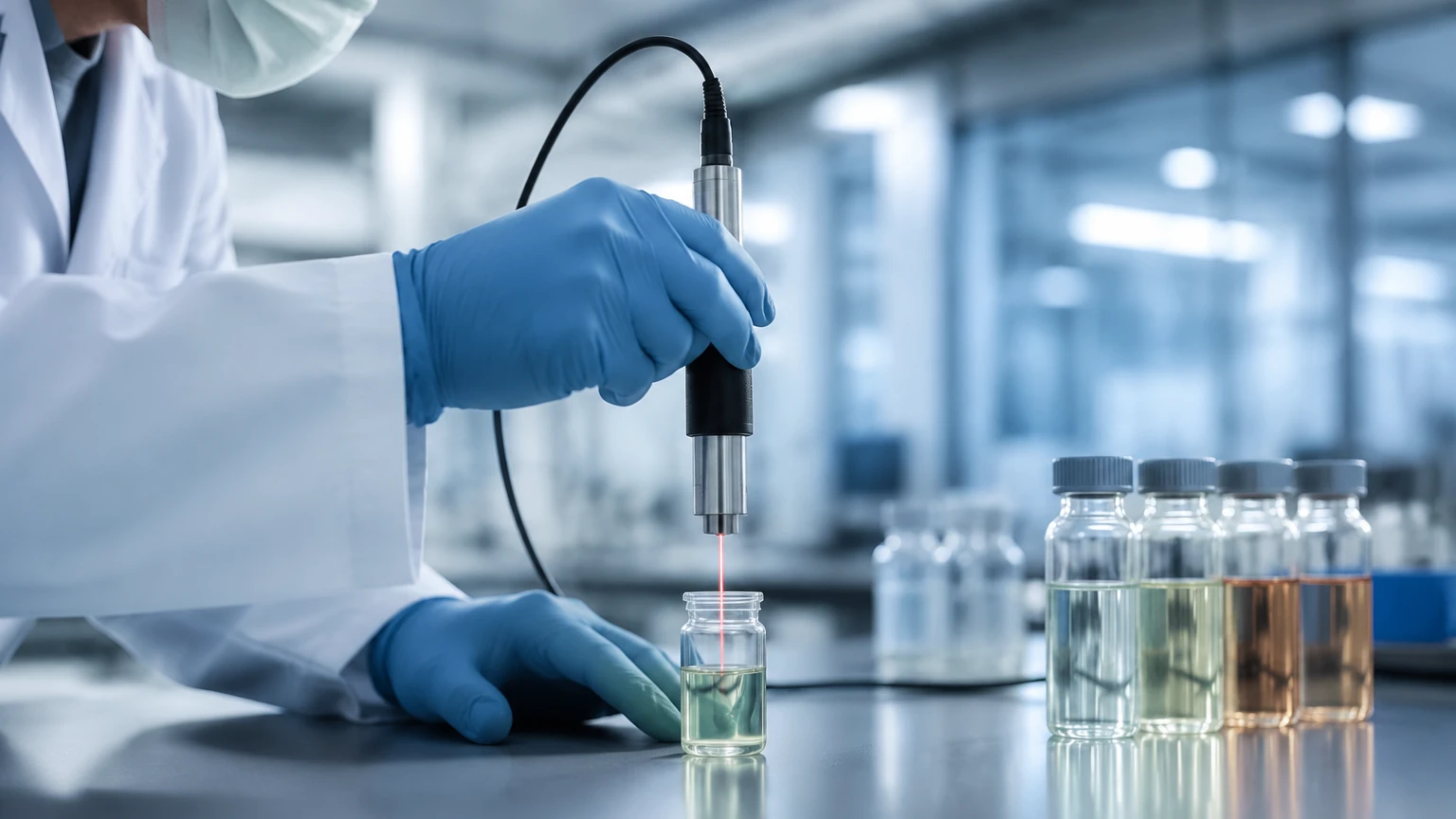
Process Raman systems use Class 3B or Class 4 lasers. When the probe is installed in a closed pipe or vessel, the system is considered Class 1. However, during maintenance or if the probe is removed, strict laser safety protocols must be followed, including the use of interlocks that automatically shut down the laser if the probe is disconnected.
Limitations and Risks
Despite its versatility, process Raman is not a universal solution. Engineers must account for the following limitations:
1. Fluorescence Interference: Some organic compounds and impurities fluoresce strongly when excited by a laser. This fluorescence can be orders of magnitude stronger than the Raman signal, making it impossible to see the Raman peaks. This is often mitigated by using longer wavelength lasers (1064 nm) or advanced baseline subtraction algorithms.
2. Sample Opacity and Color: Dark or highly absorbing samples can absorb the laser energy, leading to localized heating or even sample charring. In these cases, a "large spot" probe or a spinning sample interface may be required to distribute the laser energy.
3. Calibration Complexity: Raman is a secondary measurement technique. It requires a robust chemometric model (typically using Partial Least Squares or PLS) to correlate spectral data with primary lab values. Maintaining these models requires ongoing validation.
4. Cost: The initial capital expenditure for a process Raman system is significantly higher than for simple sensors like pH or conductivity meters. The investment is typically justified by the high value of the data provided in terms of yield optimization and waste reduction.
Integrating Raman with Level and Flow Measurement
In a holistic process control environment, Raman data rarely stands alone. It is most effective when synchronized with physical process data. For example, in a batch reactor, the Raman system monitors the conversion of reactants to products. Simultaneously, a radar level meter or a hydrostatic level transmitter monitors the mass balance and ensures the reactor does not overfill.
Reliable level measurement is foundational to the safety of chemical processes. For those seeking to optimize their vessel monitoring, it is helpful to Review product options and application support for specialized level sensing technologies that can withstand the same harsh environments as Raman probes.
Frequently Asked Questions (FAQ)
Q: How often does a process Raman system need calibration?
A: The spectrometer itself is usually calibrated against a known standard (like neon light or a chemical standard) daily or weekly via automated internal routines. However, the chemometric model used to predict concentrations may need validation every few months or whenever there is a significant change in raw material quality.
Q: Can Raman be used in hazardous (Ex) zones?
A: Yes. Because the spectrometer and laser can be located in a safe area, only the fiber optic cable and the probe enter the hazardous zone. The probes are typically certified as intrinsically safe or explosion-proof, provided the laser power density is kept below ignition thresholds.
Q: What is the typical measurement cycle time?
A: Depending on the signal-to-noise ratio required, a measurement can take anywhere from 1 second to 1 minute. For most industrial processes, a 15-to-30 second update rate is standard.
Q: Does the probe window get dirty?
A: Fouling can be an issue in certain processes. Many industrial probes include integrated cleaning ports for solvent flushing or utilize ultrasonic cleaning attachments to keep the sapphire window clear of deposits.
Conclusion
Process Raman spectroscopy is a transformative technology for industries ranging from petrochemicals to pharmaceuticals. By providing a real-time window into the molecular changes occurring within a process, it enables a level of control that was previously unattainable. When combined with traditional industrial instrumentation—such as the level measurement solutions found on the Welk Main Page—Raman becomes a cornerstone of a truly intelligent and automated production facility. Success depends on selecting the right optical configuration, ensuring robust mechanical installation, and maintaining the integrity of the chemometric models that turn light into actionable data.