Prosonic Flow B 200
Prosonic Flow B 200
In the landscape of industrial automation and renewable energy production, the accurate measurement of gas flow—particularly biogas and digester gas—presents unique challenges. The Prosonic Flow B 200 is a specialized ultrasonic flowmeter designed to address these complexities. Unlike traditional thermal mass or differential pressure meters, this device utilizes ultrasonic transit-time technology to provide reliable data even under fluctuating gas compositions and low-pressure conditions.
For process engineers and plant operators, understanding the technical nuances of the Prosonic Flow B 200 is essential for optimizing gas production and ensuring the efficiency of combined heat and power (CHP) units. This article explores the measurement principles, technical specifications, and practical installation requirements for this instrument within the broader context of industrial process monitoring.
Measurement Principle: Ultrasonic Transit-Time
The Prosonic Flow B 200 operates on the transit-time differential principle. This method relies on the fact that the speed at which an ultrasonic signal travels through a medium is influenced by the velocity of that medium.
The Physics of Sound Velocity
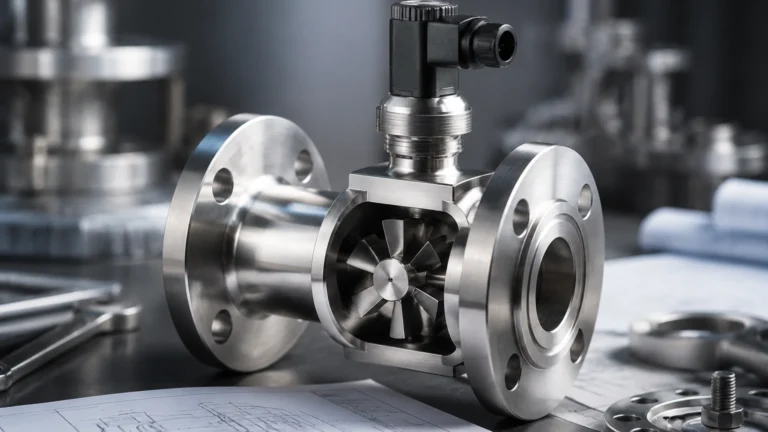
Inside the flowmeter body, two ultrasonic transducers are positioned opposite each other at a specific angle. These transducers act as both transmitters and receivers. The device emits sound pulses alternately in the direction of the flow (downstream) and against the direction of the flow (upstream).
1. Downstream Transit Time: The sound wave traveling with the flow is accelerated by the moving gas, resulting in a shorter transit time.
2. Upstream Transit Time: The sound wave traveling against the flow is slowed down, resulting in a longer transit time.
The difference between these two transit times ($Δt$) is directly proportional to the average flow velocity of the gas. By knowing the cross-sectional area of the pipe, the device calculates the actual volume flow.
Methane Fraction Measurement
A distinguishing feature of the Prosonic Flow B 200 is its ability to measure the methane (CH4) fraction of the gas in real-time. Because the speed of sound in a gas mixture is heavily dependent on the molar mass of the components, the device can correlate the measured sound velocity and the integrated temperature to determine the methane concentration. This is particularly valuable in biogas applications where the CH4/CO2 ratio fluctuates, affecting the energy content of the fuel.
Key Features and Technical Capabilities
The Prosonic Flow B 200 is engineered as a "two-wire" or loop-powered device, which simplifies wiring and integration into existing control systems. It is often preferred in hazardous areas due to its intrinsically safe design options.
Integrated Pressure and Temperature Compensation
Gas volume is highly sensitive to changes in pressure and temperature. The Prosonic Flow B 200 often incorporates or interfaces with temperature and pressure sensors to provide compensated "standard volume flow" readings. This ensures that the data used for billing or process control is normalized to standard conditions (e.g., 0°C and 1.013 bar).
Multi-Variable Output
The device does not merely output a single flow rate. It provides a suite of data points including:
* Volume flow (Actual and Standard)
* Sound velocity
* Methane fraction (%)
* Temperature
* Totalized flow
Selection Criteria and Technical Specifications
Selecting the correct size and configuration for a Prosonic Flow B 200 requires an analysis of the expected flow ranges and pipe diameters. The following table provides a general overview of the technical boundaries for this series.
| Feature | Specification Details |
| :— | :— |
| Nominal Diameters | DN 50 to DN 200 (2" to 8") |
| Measuring Range | 0.5 to 30 m/s (approx. 1.6 to 100 ft/s) |
| Max. Measured Error | ±1.5% o.r. (flow); ±2.0% absolute (methane) |
| Process Temperature | 0 to +80 °C (standard); up to +100 °C (optional) |
| Process Pressure | Up to 10 bar (145 psi) |
| Output Signals | 4-20 mA HART, PROFIBUS PA, FOUNDATION Fieldbus |
| Materials | Stainless steel (1.4404/316L or similar) |
When evaluating these specifications, engineers must ensure that the minimum flow velocity stays above 0.5 m/s to maintain accuracy. At very low flow rates, the transit-time difference becomes so small that the signal-to-noise ratio may degrade.
Installation Considerations and Best Practices
To achieve the specified accuracy of ±1.5%, the Prosonic Flow B 200 must be installed in a location where the flow profile is fully developed and free from turbulence.
Inlet and Outlet Runs
Obstructions such as elbows, valves, or pumps create swirls and non-uniform velocity profiles. The following minimum straight pipe lengths are recommended:
* Upstream (Inlet): Minimum 10x DN (Nominal Diameter).
* Downstream (Outlet): Minimum 5x DN.
If the installation involves two elbows in different planes (3D bends), the upstream requirement may increase to 40x DN unless a flow conditioner is used.
Orientation and Mounting
* Horizontal Pipes: The sensor should be mounted so that the transducer axis is horizontal. This prevents the accumulation of condensate or sediment on the transducer faces, which could attenuate the ultrasonic signal.
* Vertical Pipes: Upward flow is preferred to ensure the pipe remains full and to assist in the natural drainage of any moisture.
* Condensate Management: Biogas is typically saturated with water vapor. The meter should be installed at a high point in the piping system, and the pipe should be sloped to allow condensate to drain away from the sensor head.

Limitations and Process Constraints
While the Prosonic Flow B 200 is highly versatile, it is not a universal solution for every gas application.
1. Gas Composition: The methane measurement assumes a binary or pseudo-binary mixture of CH4 and CO2. If significant amounts of nitrogen (N2) or hydrogen (H2) are present, the methane calculation may require manual correction factors.
2. High Moisture/Droplets: While the device handles saturated gas well, heavy entrained liquid droplets or "slugs" of water can block the ultrasonic signal entirely, leading to a "signal loss" error.
3. Pressure Drop: One major advantage of ultrasonic meters is the negligible pressure drop, as there are no moving parts or flow obstructions. However, the internal diameter of the meter should match the process piping to avoid creating turbulence at the flange connections.
Synergy with Level Measurement Systems
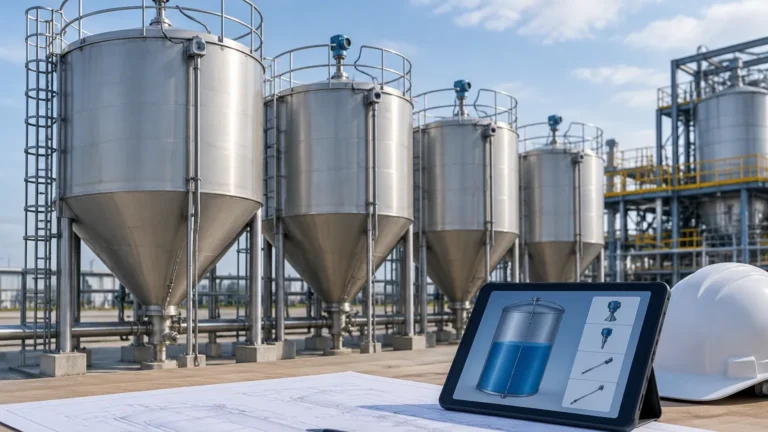
In industrial biogas plants and water treatment facilities, flow measurement is only one part of the operational puzzle. Effective process management requires a holistic approach that includes precise level monitoring of digesters, storage tanks, and chemical feed systems.
While the Prosonic Flow B 200 tracks the output of the system, industrial level instruments—such as radar level meters or ultrasonic level sensors—track the input and storage stages. For instance, monitoring the level of organic waste in a digester using a non-contact radar sensor allows operators to correlate feed rates with the gas production rates measured by the flowmeter.
Manufacturers like Welk provide a range of complementary technologies to ensure comprehensive site monitoring. For those looking to optimize their entire measurement loop, reviewing product options and application support on the Main Page can help in selecting the right combination of level and flow instrumentation. Integrating high-accuracy level data with the flow data from a Prosonic Flow B 200 allows for precise mass balance calculations and improved leak detection.
Frequently Asked Questions (FAQs)
Can the Prosonic Flow B 200 measure dry natural gas?
While technically possible, the device is specifically optimized for low-pressure biogas and methane mixtures. For high-pressure natural gas applications, different ultrasonic or Coriolis flowmeters are typically recommended due to the higher density and pressure ratings required.
How does H2S (Hydrogen Sulfide) affect the meter?
Biogas often contains H2S, which is corrosive. The Prosonic Flow B 200 is constructed from high-grade stainless steel to resist corrosion. However, extremely high concentrations of H2S may eventually affect the seals or transducer housings if not monitored. Regular inspection is advised in sour gas applications.
Does the device require frequent recalibration?
Because ultrasonic measurement does not involve mechanical wear, the calibration is inherently stable. Most facilities perform a functional check or "Heartbeat" verification every 1-3 years, but a full wet calibration is usually only required if the process conditions change significantly or if regulatory standards mandate it.
What happens if the methane concentration exceeds 90%?
The device is calibrated for standard biogas ranges (typically 40% to 80% CH4). If the gas is upgraded to biomethane (95%+ CH4), the sound velocity profile changes. The device can still measure flow accurately, but the methane fraction measurement might require a different calibration curve or specialized software settings.
Conclusion
The Prosonic Flow B 200 represents a critical tool for the modern green energy sector. By providing simultaneous measurements of flow, temperature, and gas quality (methane content), it eliminates the need for multiple discrete sensors and complex integration. When installed according to engineering best practices—respecting straight pipe runs and moisture management—it offers a low-maintenance, high-accuracy solution for biogas monitoring. To ensure the highest level of process safety and efficiency, engineers should always consider how these flow measurements integrate with the broader level and pressure monitoring systems across the facility.