Raman Spectroscopy Probe
Raman Spectroscopy Probe
In the landscape of modern industrial process analytical technology (PAT), the raman spectroscopy probe has emerged as a cornerstone for real-time, in-situ molecular analysis. Unlike traditional sampling methods that require extracting a physical specimen and transporting it to a laboratory, these probes allow for direct measurement within reactors, pipelines, and storage tanks. By providing a molecular fingerprint of the substances present, Raman probes enable operators to monitor chemical reactions, identify polymorphic changes, and ensure product quality without interrupting the process flow.
For engineers and plant managers already utilizing advanced level measurement technologies—such as those found on our Main Page—integrating Raman spectroscopy offers a complementary layer of data. While level meters provide critical physical parameters regarding volume and inventory, Raman probes provide the qualitative and quantitative chemical data necessary for comprehensive process control.
Measurement Principles of Raman Spectroscopy
To effectively select and deploy a raman spectroscopy probe, it is essential to understand the underlying physics of the Raman effect. When monochromatic light, typically from a laser source, interacts with a sample, the majority of the photons are scattered elastically. This is known as Rayleigh scattering, where the scattered light has the same frequency as the incident light.
However, a very small fraction of the light—approximately one in every ten million photons—undergoes inelastic scattering. This is the Raman effect. In this process, the incident photon interacts with the vibrational or rotational energy states of the molecules in the sample. This interaction causes the photon to lose or gain energy, resulting in a shift in frequency (and wavelength).
The Raman Shift
The difference between the incident frequency and the scattered frequency is known as the Raman shift. Because each molecular bond has unique vibrational frequencies, the resulting spectrum of shifted light serves as a unique "fingerprint" for specific chemical species.
1. Stokes Scattering: The photon loses energy to the molecule, resulting in a lower frequency (longer wavelength) scattered photon. This is the primary signal used in industrial probes.
2. Anti-Stokes Scattering: The photon gains energy from a molecule already in an excited vibrational state, resulting in a higher frequency (shorter wavelength). This signal is much weaker and rarely used in standard industrial applications.
The Role of the Probe
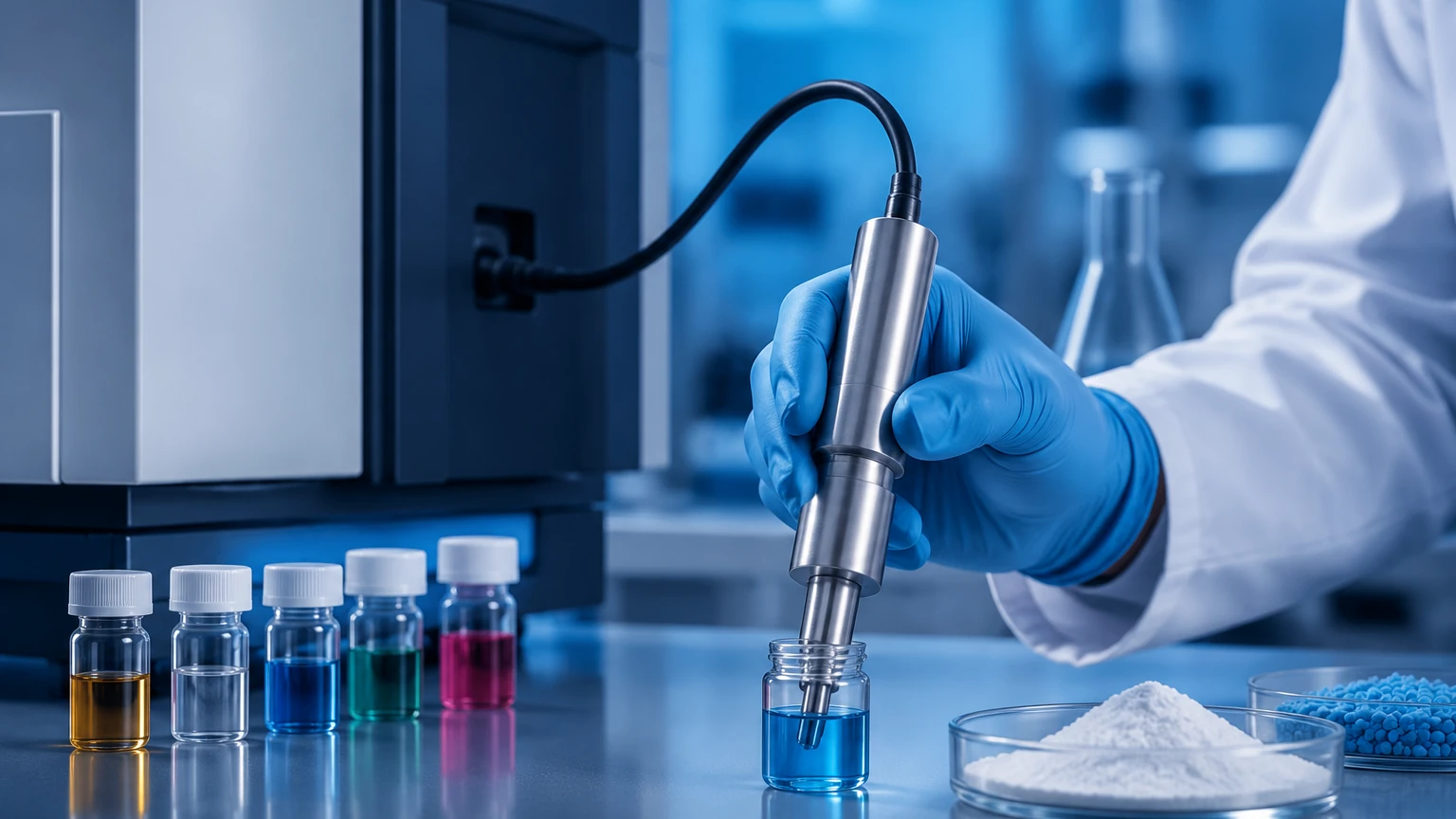
The raman spectroscopy probe acts as the optical interface. It must perform two primary functions simultaneously: delivering the high-intensity laser excitation to the sample and efficiently collecting the weak Raman-shifted light while filtering out the overwhelming Rayleigh background signal.
Key Components of a Raman Spectroscopy Probe
Industrial Raman probes are precision-engineered instruments designed to survive harsh process conditions while maintaining optical alignment. The typical architecture includes several critical sub-systems:
Fiber Optic Cables
Most industrial probes use fiber optics to decouple the spectrometer and laser from the measurement point. This allows the sensitive electronics to be housed in a controlled environment while the probe head is mounted directly in the process. Probes typically use a "filtered" fiber design where the excitation and collection paths are separated to prevent the fiber material itself from generating background Raman interference (silica Raman).
Optical Filters
Inside the probe head, specialized filters are used to manage the light paths. A narrow bandpass filter ensures only the desired laser wavelength reaches the sample. A long-pass or notch filter is then used on the collection side to block the Rayleigh scattered light, allowing only the shifted Raman signals to reach the detector.
Probe Tip and Window
The interface with the process medium is usually a sapphire window. Sapphire is chosen for its exceptional hardness (9 on the Mohs scale), chemical resistance, and wide optical transparency range. For immersion probes, the window is often brazed or sealed with high-performance elastomers into a stainless steel or Hastelloy housing.
Types of Probes for Industrial Environments
Selecting the correct raman spectroscopy probe depends heavily on the physical state of the sample and the environmental conditions. The following table provides a comparison of common probe configurations used in B2B industrial applications.
Selection Table: Raman Probe Configurations
| Probe Type | Application | Optimal Medium | Typical Pressure/Temp Limits | Advantages |
| :— | :— | :— | :— | :— |
| Immersion Probe | Direct reactor mounting | Liquids, clear solutions | Up to 300 bar / 450°C | High signal-to-noise ratio; direct contact. |
| Ball Probe | Slurries and powders | Opaque liquids, solids | Up to 200 bar / 200°C | Resists fouling; fixed focal point for consistency. |
| Non-Contact Optics | Through-window viewing | Hazardous chemicals, gases | Limited by window material | No risk of contamination; easy maintenance. |
| Extractive Flow Cell | Bypass line monitoring | Clean fluids, gases | Variable based on cell design | High precision; controlled environment. |
Selection Criteria for Process Integration
When specifying a raman spectroscopy probe for a project, engineers must evaluate several technical parameters to ensure long-term reliability and data accuracy.
Material Compatibility
The wetted parts of the probe must be compatible with the process chemistry. While 316L stainless steel is standard, highly corrosive environments (such as those involving chlorides or strong acids) may require Hastelloy C-276, Titanium, or Monel. The seal between the sapphire window and the metal body is a common point of failure; gold-brazed seals are preferred for high-vacuum or high-pressure applications where O-rings might degrade.
Focal Length and Spot Size
The focal length determines where the laser energy is concentrated. For clear liquids, a longer focal length may be acceptable. However, for turbid or opaque samples, a short focal length (or a "ball probe" design where the focus is at the surface of the lens) is necessary to ensure the laser penetrates the medium and the scattered light is collected before it is absorbed or scattered away by particles.
Wavelength Compatibility
Probes are optimized for specific laser wavelengths (e.g., 532 nm, 785 nm, or 1064 nm). The optics, coatings, and fiber types must match the laser source. For example, 785 nm is a common balance between signal strength and fluorescence suppression, while 1064 nm is used for samples that exhibit high fluorescence, though it requires more sensitive (and expensive) detectors.
Installation and Operational Best Practices
Successful deployment of a raman spectroscopy probe requires careful consideration of the physical installation site. Many of these principles mirror the installation of high-end level measurement instruments provided by Welk.
Mounting and Orientation
* Turbulence: In reactors with agitation, probes should be installed in areas with consistent flow to prevent the buildup of solids on the window. However, they must be positioned away from the direct path of an impeller to avoid mechanical damage.
* Insertion Length: The probe tip must be sufficiently immersed to represent the bulk process but not so long that it becomes a cantilevered mass subject to vibration fatigue. Standard insertion lengths range from 100 mm to 500 mm.
* Nozzle Design: Use standard flange or NPT connections. Ensure the nozzle diameter allows for easy removal of the probe for cleaning without damaging the sapphire tip.
Safety and Laser Hazards
Since Raman probes utilize Class 3B or Class 4 lasers, safety is paramount.
1. Interlocks: Systems should include fiber-break detection that automatically shuts down the laser if the fiber optic cable is severed.
2. Labeling: All access points where the probe is installed must be clearly labeled with laser safety warnings.
3. Shielding: In non-contact setups, the measurement area must be shielded to prevent stray laser reflections from reaching personnel.
Maintenance and Cleaning
Fouling of the optical window is the most common cause of signal degradation. While many Raman probes are designed with "self-cleaning" geometries that use process flow to scour the window, periodic manual cleaning may be required. Use soft, non-abrasive wipes and solvents compatible with both the process and the probe seals.
Limitations and Mitigation Strategies
While powerful, raman spectroscopy probes face specific challenges in industrial settings:
1. Fluorescence: Some organic compounds and impurities fluoresce when excited by a laser, producing a broad background signal that can drown out the Raman peaks. This is mitigated by using longer wavelength lasers (e.g., 1064 nm) or advanced software-based baseline subtraction algorithms.
2. Sensitivity: Raman scattering is inherently weak. To compensate, high-power lasers and cooled CCD detectors are often required, increasing the system cost compared to simple IR or UV-Vis spectroscopy.
3. Sample Heating: Concentrated laser light can cause localized heating or even combustion in dark or highly absorptive samples. Adjusting the laser power or using a probe with a larger spot size can reduce the power density.
Synergy with Level Measurement
In integrated industrial automation, a raman spectroscopy probe rarely operates in isolation. For instance, in a chemical blending tank, a Welk ultrasonic or radar level meter provides the exact volume of the vessel. By combining this volume data with the concentration data from the Raman probe, the control system can calculate the total mass of a specific component in real-time. This synergy is vital for applications in water treatment, where chemical dosing must be precisely controlled based on both the water level and the contaminant concentration. For more information on the physical measurement side of these applications, visit our Main Page.
Frequently Asked Questions (FAQ)
Q: Can a Raman probe be used in hazardous (Ex) zones?
A: Yes. Because the probe itself is often purely optical (containing no electrical components at the measurement head), it is inherently safe. However, the laser energy delivered through the fiber must be limited to prevent it from acting as an ignition source, and the spectrometer housing must meet local ATEX or IECEx requirements.
Q: How often does a Raman probe need calibration?
A: The probe itself is a passive optical device and does not require calibration in the traditional sense. However, the entire system (laser, probe, and spectrometer) should be verified daily or weekly using a standard reference material like cyclohexane or polystyrene to ensure wavelength accuracy and signal intensity.
Q: What is the maximum distance between the probe and the spectrometer?
A: With high-quality silica fibers, distances of up to 100 meters are possible. However, signal attenuation increases with distance, and longer runs require more robust protective cabling to prevent physical damage.
Q: Can Raman probes measure gases?
A: Yes, but gas-phase Raman signals are much weaker than liquid or solid signals due to lower molecular density. High-pressure cells or specialized multi-pass probes are typically used to enhance the signal for gas applications.
By carefully considering the measurement principles, material requirements, and installation environment, a raman spectroscopy probe can provide unparalleled insight into industrial processes, working alongside reliable level measurement solutions to optimize production and ensure safety.