Remote Water Level Monitoring
Remote Water Level Monitoring
Remote water level monitoring has transitioned from a specialized industrial requirement to a fundamental component of modern infrastructure management. In sectors ranging from municipal water treatment and agricultural irrigation to chemical processing and oil and gas operations, the ability to track liquid levels in real-time from a centralized location is essential for operational efficiency, safety, and regulatory compliance. This guide examines the technical principles, hardware selection, and implementation strategies for establishing a reliable remote monitoring system.
Core Measurement Principles in Remote Monitoring
Before selecting a remote monitoring solution, it is necessary to understand the physics behind the sensors. The choice of technology dictates the system's accuracy, maintenance requirements, and suitability for specific environments. For comprehensive product specifications and technical support, engineers often refer to the Main Page of specialized manufacturers to align sensor capabilities with site requirements.
1. Radar Level Measurement (Non-Contact)
Radar level meters utilize high-frequency electromagnetic waves, typically in the microwave range (e.g., 26 GHz or 80 GHz). The sensor emits a pulse that travels to the liquid surface and reflects back. By measuring the Time-of-Flight (ToF) or using Frequency Modulated Continuous Wave (FMCW) technology, the device calculates the distance to the water surface. Because radar waves are unaffected by air temperature, pressure, or vapor, they are ideal for remote sites where environmental conditions fluctuate significantly.
2. Ultrasonic Level Measurement (Non-Contact)
Ultrasonic sensors emit high-frequency sound waves. The time taken for the echo to return from the liquid surface determines the level. While cost-effective and easy to install, ultrasonic waves are sensitive to air temperature variations and surface foam. In remote water level monitoring, these sensors are frequently used in open-channel flow and wastewater applications where the distance to the liquid is relatively short (typically under 15 meters).
3. Hydrostatic Pressure Measurement (Contact)
Hydrostatic transmitters measure the pressure exerted by the liquid column above the sensor. Based on the principle that $P = \rho gh$ (where $P$ is pressure, $\rho$ is density, $g$ is gravity, and $h$ is height), the sensor converts the weight of the water into a level reading. These are submerged at the bottom of a tank or well. They are highly reliable for deep-well monitoring but require venting to the atmosphere to compensate for barometric pressure changes.
System Architecture for Remote Data Transmission
A remote monitoring system consists of more than just the sensor. It requires a robust communication layer to transmit data from the field to the end-user.
Data Acquisition and Signal Output
Most industrial level sensors provide standard outputs such as 4-20mA analog signals or digital protocols like RS485 Modbus. For remote applications, these signals are connected to a Remote Terminal Unit (RTU) or a cellular gateway.
Wireless Connectivity Options
* Cellular (4G/5G/NB-IoT): Ideal for sites with existing mobile coverage. NB-IoT (Narrowband IoT) is particularly effective for battery-powered remote sensors due to its low power consumption.
* LoRaWAN: A Long Range Wide Area Network is suitable for large industrial complexes or agricultural areas where a private gateway can be established to cover several kilometers without recurring cellular fees.
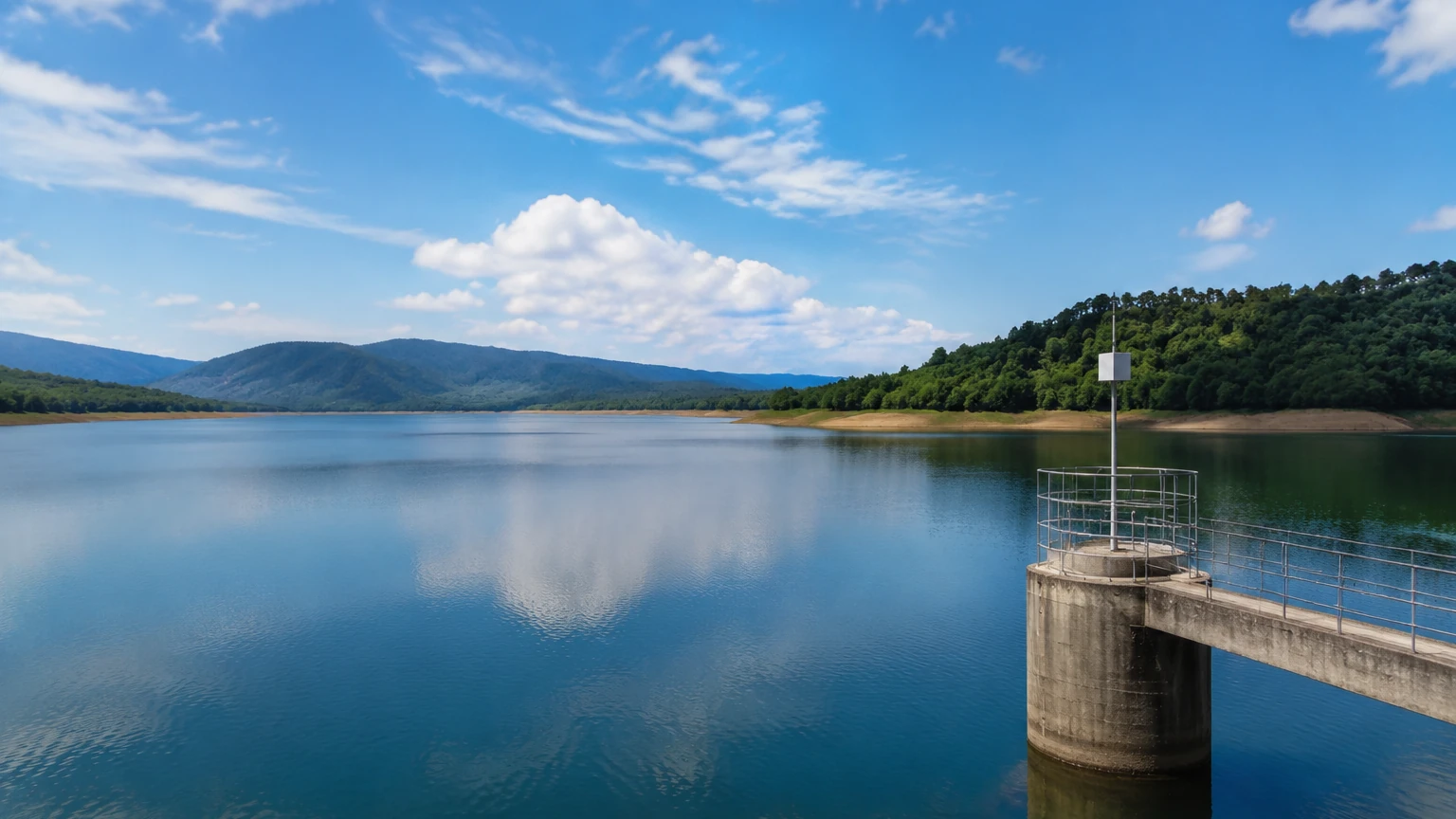
* Satellite: Used in extremely remote locations (e.g., mountain reservoirs or remote pipelines) where no terrestrial network exists.
Selection Criteria for Remote Water Level Sensors
Choosing the correct instrument requires an evaluation of the physical environment and the required data granularity. The following table provides a comparison of the primary technologies used in remote water level monitoring.
| Feature | Radar Level Meter | Ultrasonic Sensor | Hydrostatic Transmitter |
| :— | :— | :— | :— |
| Measurement Type | Non-contact | Non-contact | Contact (Submerged) |
| Accuracy | High (±1mm to ±3mm) | Moderate (±0.25% of range) | High (±0.1% to ±0.5% FS) |
| Max Range | Up to 70m – 100m | Typically up to 15m – 30m | Up to 200m+ (Cable length) |
| Vapor/Steam Impact | Negligible | Significant | None |
| Power Consumption | Moderate | Low | Low |
| Best Application | Chemical tanks, reservoirs | Open channels, sumps | Deep wells, boreholes |
Installation Considerations and Best Practices
The reliability of a remote monitoring system is often determined during the installation phase. Engineering teams must account for both the physical mounting of the sensor and the integrity of the data link.
Mounting and Positioning
For non-contact sensors (Radar and Ultrasonic), the "blocking distance" or dead zone must be considered. This is the area immediately below the sensor where measurements are not possible. The sensor must be mounted high enough to avoid the maximum expected water level entering this zone. Furthermore, the beam path must be clear of obstructions like ladders, pipes, or agitators to prevent false echoes.
Power Management at Remote Sites
Remote locations often lack access to the power grid. Systems typically rely on:
1. Solar Power: A combination of a photovoltaic panel and a lead-acid or lithium-ion battery. This is standard for continuous monitoring.
2. Internal Batteries: High-capacity lithium thionyl chloride (Li-SOCl2) batteries can power low-frequency (e.g., once per hour) reporting for several years.
Atmospheric Venting
When using hydrostatic transmitters, the sensor cable usually contains a small vent tube. This tube allows the internal side of the pressure diaphragm to be exposed to atmospheric pressure, ensuring the sensor only measures the pressure of the water column. If this tube becomes blocked or moisture enters it, the level readings will drift significantly.
Limitations and Risk Mitigation
While remote monitoring reduces the need for manual site visits, it introduces specific risks that must be managed:
* Signal Attenuation: In dense industrial environments or deep valleys, wireless signals may be weak. Using high-gain external antennas or signal repeaters is often necessary.
* Environmental Fouling: In wastewater applications, debris or biological growth can accumulate on submerged sensors. Non-contact radar is generally preferred here to minimize maintenance.
* Lightning and Surges: Remote towers and tanks are prone to lightning strikes. Proper grounding and the use of surge protection devices (SPDs) on the signal lines are mandatory to protect the electronics.
* Data Security: Remote systems are vulnerable to cyber threats. Using encrypted protocols (like HTTPS or MQTTS) and private APNs for cellular data helps secure the transmission of critical infrastructure data.
Practical Applications in Industry
Municipal Wastewater Management
Remote monitoring is used in lift stations and manholes to prevent overflows. Ultrasonic sensors are often deployed here because they are cost-effective for the relatively shallow depths of sewer lines. Data is transmitted via NB-IoT to a central SCADA system, triggering maintenance crews before an environmental incident occurs.
Agricultural Irrigation
In large-scale farming, monitoring the level of irrigation channels and water storage tanks ensures that crops receive adequate water without waste. Hydrostatic sensors are frequently used in boreholes to monitor groundwater depletion, providing data that helps comply with environmental extraction limits.
Chemical and Industrial Storage
For tanks containing corrosive liquids or those operating under pressure, radar level meters are the standard. The non-contact nature ensures the sensor hardware is not degraded by the medium. Remote monitoring allows inventory managers to track chemical usage across multiple sites from a single dashboard.
Frequently Asked Questions (FAQ)
Q: How often should a remote water level sensor be calibrated?
A: For most industrial-grade radar and hydrostatic sensors, a yearly check is recommended. However, if the system is used for custody transfer or high-accuracy billing, semi-annual calibration may be required. Many modern digital sensors feature internal self-diagnostics that can alert the user to potential drift.
Q: Can these sensors work in freezing conditions?
A: Yes, but the installation must be adapted. Hydrostatic sensors must be placed below the frost line to prevent ice damage to the diaphragm. Radar sensors are generally unaffected by cold, though heavy ice buildup on the antenna face should be prevented.
Q: What is the maximum distance for wireless transmission?
A: This depends on the technology. Cellular systems can transmit globally as long as there is a roaming agreement. LoRaWAN typically covers 2–5 km in urban areas and up to 15 km in line-of-sight rural conditions. For distances beyond this without cellular coverage, satellite links are the only option.
Q: How do I handle surface turbulence in the level reading?
A: Turbulence can cause "noise" in the data. Most remote monitoring software and the sensors themselves include damping or filtering algorithms. By increasing the averaging time (e.g., taking a 30-second average of readings), the effect of waves or ripples can be neutralized.
Q: Is it possible to integrate these sensors with existing PLC systems?
A: Absolutely. Most remote monitoring gateways provide Modbus TCP, OPC UA, or MQTT outputs, allowing seamless integration into existing Programmable Logic Controllers (PLCs) or Distributed Control Systems (DCS).
By carefully selecting the measurement principle and ensuring the communication infrastructure is suited to the environment, organizations can implement a remote water level monitoring system that provides years of reliable service with minimal manual intervention.