Sonic Water Level Meter
Sonic Water Level Meter
In the realm of industrial fluid management, the ability to monitor water levels without physical contact is a significant advantage. A sonic water level meter, often referred to within the industry as an ultrasonic level transmitter, provides a non-invasive solution for measuring the distance from a fixed point to the surface of a liquid. These instruments are essential in water treatment, chemical processing, and environmental monitoring, where reliability and ease of maintenance are paramount.
As a professional manufacturer, Welk specializes in providing advanced level measurement instruments that meet the rigorous demands of modern industrial automation. Understanding the technical nuances of sonic measurement is the first step toward selecting the right equipment for a specific application. This guide explores the principles, selection criteria, and practical considerations for deploying sonic water level meters in professional environments.
Understanding the Principle of Sonic Level Measurement
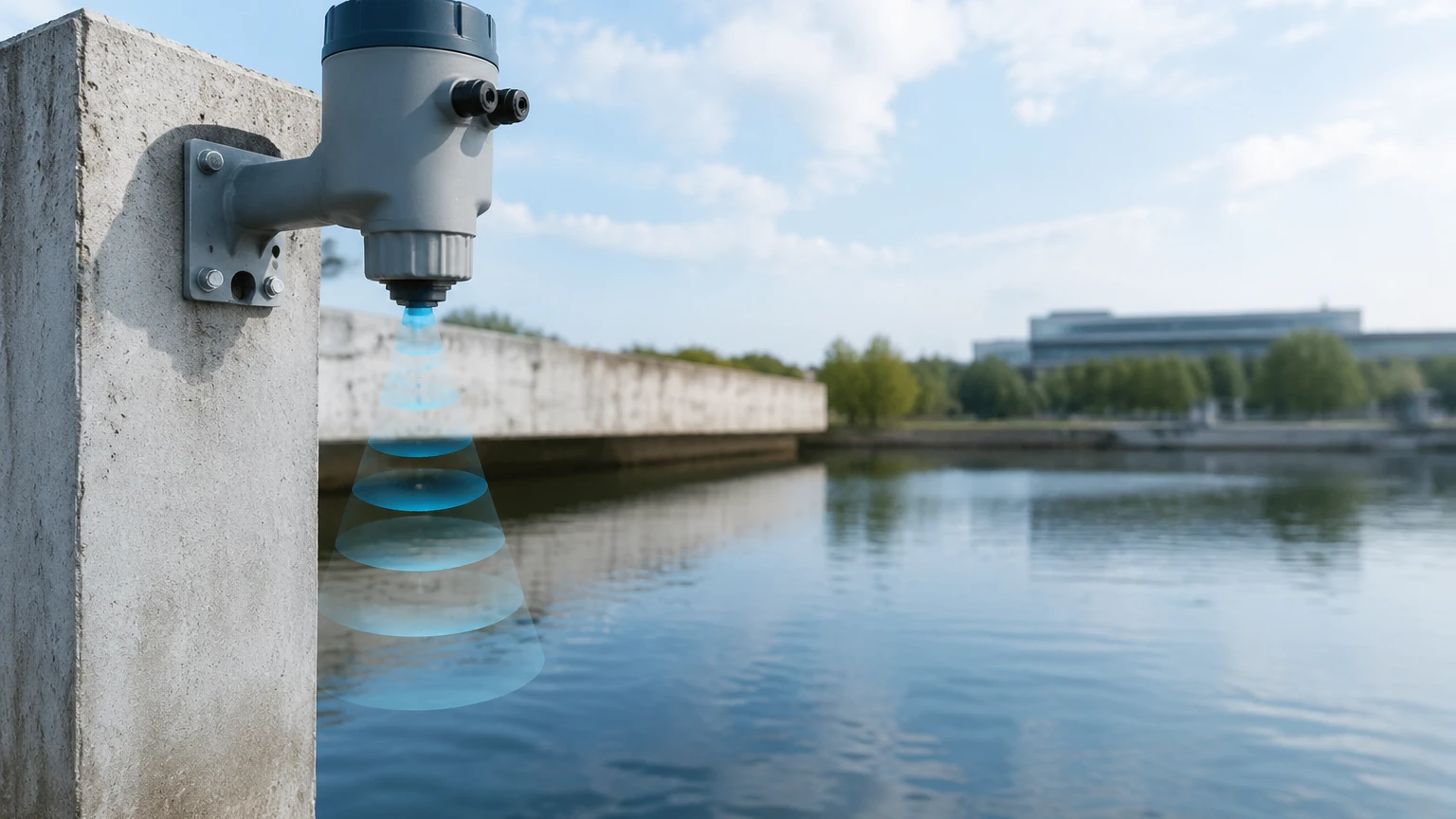
The fundamental operation of a sonic water level meter relies on the "Time of Flight" (ToF) principle. The device consists of a transducer that acts as both a transmitter and a receiver.
1. Pulse Emission: The transducer emits a high-frequency acoustic pulse (usually between 20 kHz and 200 kHz). These sound waves travel through the air toward the surface of the water.
2. Reflection: Upon hitting the water surface, the sound waves are reflected back toward the sensor. This reflection occurs because of the difference in density between the air and the liquid.
3. Signal Reception: The transducer detects the returning echo.
4. Calculation: The internal processor calculates the time elapsed between the emission and the reception. Since the speed of sound in air is known (approximately 340 m/s at 20°C), the distance is determined using the formula:
* Distance = (Speed of Sound × Time Delay) / 2
The meter then subtracts this distance from the total tank height (the zero point) to provide an accurate reading of the current water level. Because the speed of sound is affected by air temperature, modern sonic water level meters include integrated temperature sensors to compensate for these variations automatically, ensuring consistent accuracy across different environmental conditions.
Key Technical Specifications and Evaluation Criteria
When evaluating a sonic water level meter for a B2B project, technical specifications must align with the operational environment. Engineers should focus on the following criteria to ensure long-term performance:
1. Measurement Range and Dead Zone
Every sonic meter has a minimum and maximum range. The "Dead Zone" (or blanking distance) is the area immediately below the transducer where the device cannot receive an echo because the pulse is still being transmitted. Typically, this ranges from 0.2 meters to 0.5 meters. If the water level enters this zone, the reading will be erroneous.
2. Accuracy and Resolution
Standard industrial sonic meters offer an accuracy of ±0.25% to ±0.5% of the full measured range. For a 10-meter tank, this equates to a precision of roughly 25mm to 50mm. Resolution refers to the smallest change in level the device can detect, often as fine as 1mm.
3. Beam Angle
The acoustic pulse is not a laser; it spreads out in a cone shape. The beam angle (usually between 5° and 12°) determines the footprint of the signal at the water surface. A narrower beam angle is preferable for narrow tanks or sumps with internal obstructions like ladders or pipes, as it reduces the risk of false echoes.
4. Output Signals and Communication
For integration into a SCADA or PLC system, the meter must provide standard industrial outputs. Common options include:
* Analog: 4-20mA (current loop).
* Digital: RS485 (Modbus-RTU).
* Smart Protocols: HART or Profibus.
* Switching: Relay outputs for high/low-level alarms.
Comparative Selection: Integrated vs. Split-Type Systems
Choosing between an integrated (compact) design and a split-type system depends on the accessibility of the installation site and the hazardous nature of the environment.
| Feature | Integrated Sonic Meter | Split-Type Sonic Meter |
| :— | :— | :— |
| Design | Sensor and display in one housing | Remote sensor connected to a controller |
| Installation | Simplified wiring; single mounting point | More complex; requires cabling between units |
| Accessibility | User must reach the sensor to read display | Display can be mounted at eye level (up to 50m away) |
| Environmental Resistance | Best for standard outdoor/indoor tanks | Ideal for deep wells or corrosive pits |
| Max Range | Typically up to 15–20 meters | Can reach up to 30–40 meters |
| Cost | Generally more cost-effective | Higher cost due to separate components |
For detailed technical datasheets and model comparisons, engineers are encouraged to visit the Main Page to review product options and application support.
Critical Installation Guidelines for Accurate Readings
Correct installation is the most influential factor in the performance of a sonic water level meter. Failure to follow geometric and environmental guidelines often leads to signal loss or "hunting" (unstable readings).
Mounting Position
The transducer must be mounted perfectly perpendicular to the water surface. If the sensor is tilted, the sound wave will reflect away from the receiver rather than back to it. Additionally, the sensor should not be mounted in the center of a circular tank, as this can lead to multiple reflections (parabolic effect) that confuse the processor. Ideally, mount the sensor at a distance of 1/3 the radius from the tank wall.
Avoiding Obstructions
The path of the sonic beam must be clear of obstructions. Inlets, agitators, ladders, and internal reinforcement beams can all create "ghost echoes." If an obstruction is unavoidable, many Welk meters feature "false echo suppression" software that allows the user to program the device to ignore specific static reflections.
Entry and Turbulence
Avoid mounting the sensor directly above a water inlet. Falling water creates both physical turbulence and air bubbles, both of which scatter the sonic signal. If the surface is consistently turbulent, a stilling well (a vertical pipe that dampens surface movement) may be necessary to provide a stable target for the sonic pulse.
Operational Limitations and Environmental Interference
While highly versatile, sonic water level meters are not suitable for every application. Engineers must be aware of the following limitations:
* Pressure and Vacuum: Sonic pulses require a medium (air or gas) to travel. They cannot function in a vacuum. High-pressure environments also change the density of the air, significantly affecting the speed of sound and requiring specialized calibration.
* Heavy Foam: Thick, protein-based foam on the water surface acts as an acoustic absorber. Instead of reflecting the sound wave, the foam absorbs it, leading to a "Loss of Echo" error.
* Vapor and Dust: While light moisture is compensated for, extremely dense steam or heavy dust can attenuate the signal. In such cases, radar level meters may be a more robust alternative.
* Temperature Gradients: If there is a significant temperature difference between the sensor and the water surface (e.g., in a hot tank), the speed of sound will vary along the path, leading to inaccuracies unless a multi-point temperature compensation system is used.
Maintenance and Troubleshooting FAQs
Q: How often does a sonic water level meter need calibration?
A: Under stable conditions, these meters do not drift significantly. However, an annual check is recommended to ensure the transducer face is clean and the temperature compensation is functioning correctly.
Q: Can the meter measure through a plastic tank lid?
A: No. The sonic pulse cannot penetrate solid materials. A hole must be cut in the lid, or a flange mount must be used to give the transducer a clear line of sight to the liquid.
Q: What causes the reading to jump to the maximum value suddenly?
A: This is usually a "Loss of Echo." It happens when the reflected signal is too weak to be detected, often due to heavy foam, extreme turbulence, or the water level falling below the sensor's maximum range.
Q: How do I clean the transducer?
A: Use a soft, damp cloth. Avoid abrasive cleaners or sharp tools, as the face of the transducer is a sensitive piezoelectric component. If the environment is prone to condensation, some sensors are designed with a self-cleaning feature that uses high-frequency vibration to shed water droplets.
Industry Applications and Integration
Sonic water level meters are the workhorses of the water and wastewater industry. They are frequently deployed in:
* Open Channel Flow: Combined with a flume or weir, the meter calculates flow rates based on the water head height.
* Sewage Lift Stations: Non-contact measurement prevents the sensor from being fouled by raw sewage or debris.
* Chemical Storage: Measuring acids or bases in plastic tanks where contact-based sensors would corrode.
* Reservoir Monitoring: Providing long-range level data for municipal water supplies.
For organizations looking to upgrade their current level monitoring systems, Welk offers a range of customizable OEM/ODM services. Our instruments are designed to integrate seamlessly with existing industrial automation frameworks, providing the data accuracy required for process optimization and safety compliance.
To explore the full range of ultrasonic and sonic measurement technologies, or to consult with an application engineer regarding specific site requirements, please refer to our Main Page for comprehensive technical resources and product selection tools.