Remote Water Level Sensor
Remote Water Level Sensor
In modern industrial and municipal water management, the ability to monitor liquid levels from a distance is no longer a luxury but a functional necessity. A remote water level sensor is a specialized instrument designed to measure the height of water in tanks, reservoirs, rivers, or boreholes and transmit that data to a centralized control room or cloud-based platform. These systems eliminate the need for manual site visits, reduce operational costs, and provide real-time alerts for flood prevention or process control. This guide explores the underlying measurement principles, communication technologies, and selection criteria essential for engineers and facility managers.
Core Measurement Principles for Remote Monitoring
Before selecting a communication protocol, one must understand the physics of the sensing element. Remote water level sensors generally fall into three categories: hydrostatic, ultrasonic, and radar. Each operates on a distinct physical principle, making them suitable for different environmental conditions.
Hydrostatic Pressure Measurement
Hydrostatic level sensors, often referred to as submersible pressure transmitters, operate on the principle that the pressure at a specific depth is proportional to the height of the liquid column above it. The relationship is defined by the formula:
P = ρ × g × h
Where *P* is pressure, *ρ* is the liquid density, *g* is gravity, and *h* is the height of the liquid.
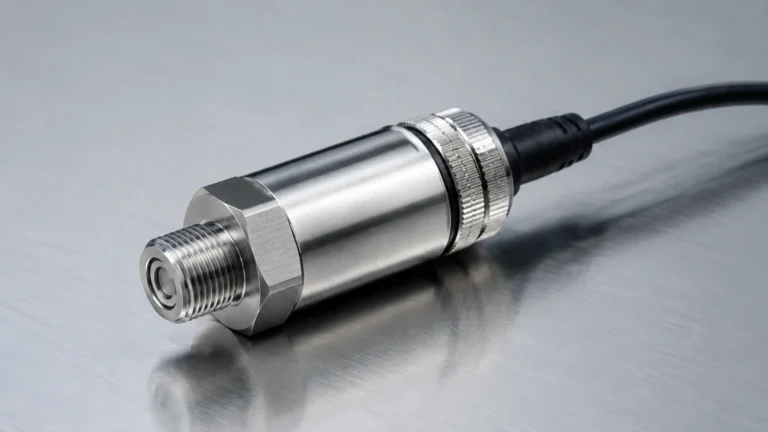
These sensors are submerged at the bottom of the water source. A sensitive diaphragm detects the pressure, which is then converted into an electrical signal (typically 4-20mA). To account for changes in atmospheric pressure, a vent tube is usually integrated into the sensor cable. Hydrostatic sensors are highly effective for deep boreholes and stable tank environments where surface foam or turbulence might interfere with non-contact methods.
Ultrasonic Time-of-Flight
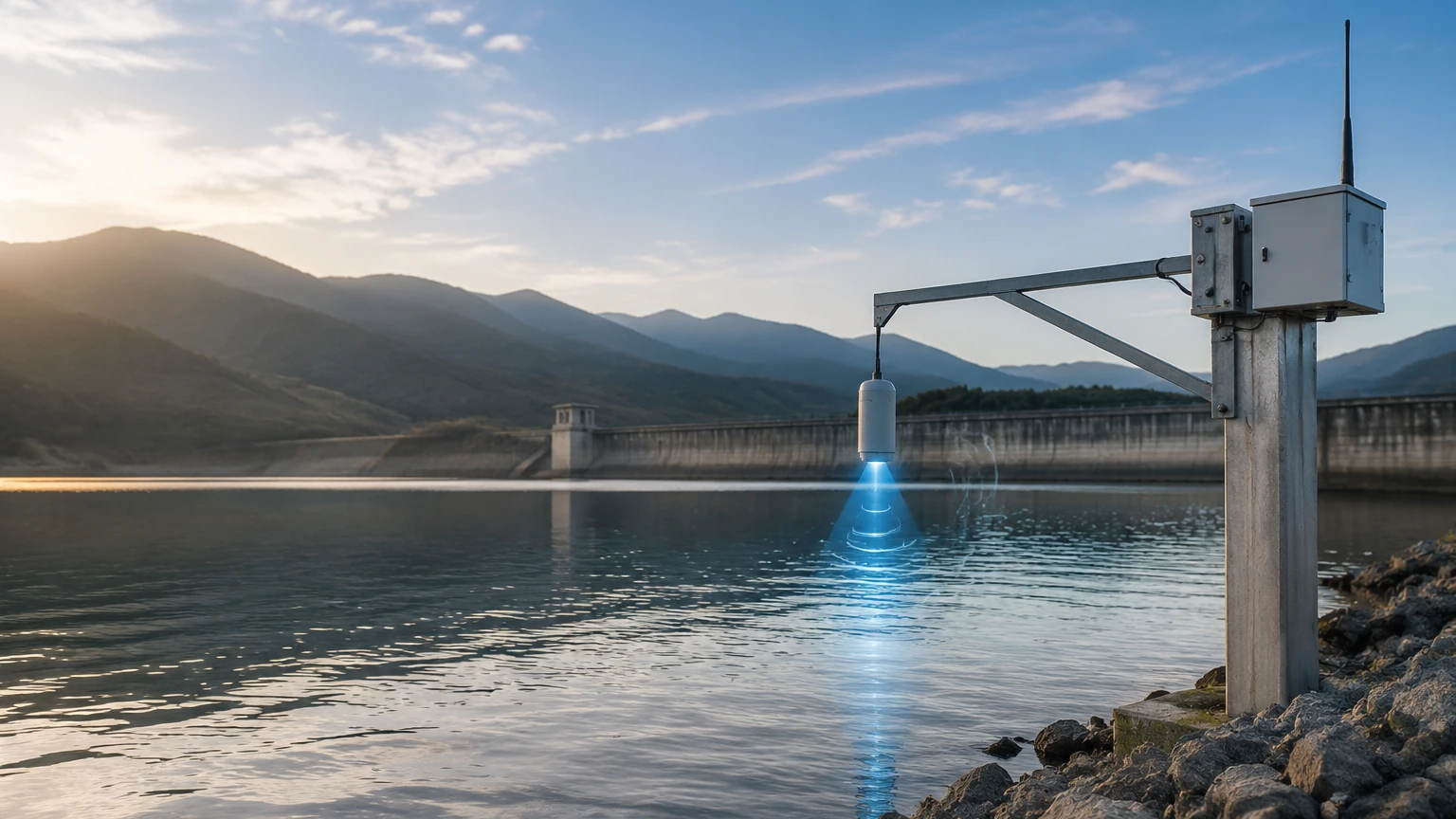
Ultrasonic sensors are non-contact devices that emit high-frequency sound pulses. These pulses travel through the air, reflect off the water surface, and return to the sensor. The distance is calculated based on the time taken for the pulse to return and the speed of sound.
Distance = (Speed of Sound × Time) / 2
Ultrasonic technology is cost-effective and easy to install since it does not touch the liquid. However, it is sensitive to air temperature fluctuations, heavy foam, and vapor, which can attenuate the sound signal. Most industrial ultrasonic units include integrated temperature compensation to maintain accuracy across varying weather conditions.
Radar (FMCW and Pulse)
Radar level sensors use high-frequency electromagnetic waves (microwaves) rather than sound. Frequency Modulated Continuous Wave (FMCW) radar is the current industry standard for high-precision remote monitoring. Unlike ultrasonic waves, radar signals are unaffected by air temperature, pressure, vacuum, or dust.
Modern 80GHz radar sensors offer a very narrow beam angle, allowing them to measure water levels in narrow pipes or tanks with internal obstructions without interference. This makes them the premium choice for critical infrastructure where reliability is paramount. For a detailed look at high-performance radar and other sensing technologies, engineers can consult the Main Page of our technical catalog.
Wireless and Wired Communication Protocols
The "remote" aspect of a remote water level sensor is defined by its ability to transmit data over distances ranging from a few meters to thousands of kilometers. The choice of communication protocol depends on the available power source and the proximity to a data gateway.
Wired Integration (4-20mA and RS485)
In localized industrial settings, such as a water treatment plant, sensors are often hard-wired to a Programmable Logic Controller (PLC).
* 4-20mA Analog: The standard for short-to-medium distances. It is robust against electrical noise but only transmits a single variable (level).
* RS485/Modbus: A digital protocol that allows for multi-drop configurations (multiple sensors on one cable) and transmits diagnostic data alongside the level measurement.
Wireless Long-Range (IoT)
For remote sites like mountain reservoirs or rural irrigation channels, wiring is often impractical.
* LoRaWAN: Low Power, Wide Area Network. Ideal for battery-powered sensors. It can transmit data up to 15 km (approx. 9.3 miles) in open terrain with extremely low power consumption.
* NB-IoT and LTE-M: These use existing cellular infrastructure. They provide excellent penetration through manhole covers and are suitable for urban water monitoring.
* Satellite: Used in extremely isolated regions where no cellular or radio coverage exists. While more expensive, it ensures data continuity for national hydrological monitoring.
Selection Criteria for Remote Water Level Sensors
Choosing the right sensor requires a balance between accuracy, environmental resilience, and budget. The following table provides a comparison of the primary technologies used in remote water level monitoring.
| Feature | Hydrostatic (Submersible) | Ultrasonic (Non-contact) | Radar (Non-contact) |
| :— | :— | :— | :— |
| Best Application | Deep wells, boreholes, clean water | Open channels, sumps, tanks | Harsh environments, high precision |
| Accuracy | ±0.25% to ±0.5% | ±0.25% of range | ±1mm to ±3mm |
| Measurement Range | Up to 500m (1640 ft) | 0.3m to 15m (1-49 ft) | Up to 120m (393 ft) |
| Maintenance | Medium (fouling risk) | Low | Very Low |
| Cost | Low to Medium | Low | Medium to High |
| Interference | Liquid density changes | Foam, vapor, wind | Minimal |
Key Evaluation Questions
1. What is the liquid composition? If the water contains high levels of debris or corrosive chemicals, non-contact sensors (Radar/Ultrasonic) are preferred to avoid hardware degradation.
2. Is power available? Remote sites often rely on solar panels or long-life lithium batteries. In these cases, sensors with low "warm-up" times and low power consumption (like LoRaWAN-integrated radar) are essential.
3. What are the mounting constraints? A narrow borehole requires a slim hydrostatic probe, while a wide river bridge is better suited for a radar sensor mounted overhead.
Installation and Commissioning Guidelines
Correct installation is as critical as the sensor technology itself. Even the most advanced remote water level sensor will provide inaccurate data if poorly positioned.
Positioning and Dead Zones
All non-contact sensors have a "dead zone" or "blind zone" directly beneath the sensor face (typically 0.1m to 0.5m). The sensor must be mounted high enough so that the maximum water level never enters this zone. For hydrostatic sensors, the probe should be positioned above the silt line at the bottom of a well to prevent the pressure port from clogging.
Stilling Wells and Brackets
In applications with high turbulence or surface waves (such as fast-flowing rivers), a stilling well—a vertical pipe with small intake holes—can be used. This creates a calm surface for ultrasonic and radar sensors or protects hydrostatic cables from mechanical stress. Mounting brackets should be rigid to prevent vibration, which can introduce noise into the signal.
Calibration and Zero-Point Setting
Once installed, the sensor must be calibrated to the specific geometry of the site. This involves setting the "Zero" point (empty) and the "Span" (full). For remote IoT sensors, this is often done via a mobile app or a cloud configuration portal. It is vital to verify the digital reading against a physical dip-tape measurement during commissioning.
Operational Limitations and Environmental Challenges
While remote water level sensors are highly reliable, engineers must account for specific environmental factors that can degrade performance over time.
* Temperature Extremes: In very cold climates, ice formation on the surface of the water will cause non-contact sensors to measure the top of the ice rather than the liquid level. Hydrostatic sensors are generally immune to this as long as the water around the probe does not freeze solid.
* Lightning and Surges: Remote sensors, especially those with long cable runs or mounted on high bridges, are susceptible to lightning strikes. Utilizing sensors with integrated surge protection and ensuring proper grounding is a standard B2B requirement for outdoor installations.
* Signal Obstruction: For wireless remote sensors, seasonal vegetation growth can block line-of-sight radio signals (like LoRa). Regular site maintenance or the use of high-gain antennas may be required.
* Biofouling: In raw water or wastewater applications, algae and barnacles can grow on submerged hydrostatic diaphragms. Periodic cleaning schedules must be established to maintain accuracy.
Frequently Asked Questions (FAQs)
Q: How long do the batteries last in a wireless remote water level sensor?
A: Depending on the transmission frequency (e.g., once per hour) and the protocol (LoRaWAN), a high-quality battery pack can last between 3 to 7 years. Solar-powered options can extend this indefinitely.
Q: Can these sensors measure water levels in pressurized tanks?
A: Yes, but standard hydrostatic sensors cannot be used alone as they would measure the tank pressure plus the liquid pressure. In pressurized environments, a differential pressure transmitter or a radar sensor is required.
Q: What is the maximum distance for a remote sensor?
A: If using cellular (NB-IoT) or satellite communication, the distance is virtually unlimited as long as there is network coverage. For point-to-point radio, it is typically limited to 5-15 km.
Q: Is it possible to monitor multiple locations on a single dashboard?
A: Yes. Most modern industrial remote water level sensors are designed to integrate with SCADA systems or specialized cloud IoT platforms that aggregate data from hundreds of different sites into a single interface.
Conclusion
Implementing a remote water level sensor system requires a thorough understanding of both the physical environment and the digital infrastructure. By selecting the appropriate measurement principle—whether it be the ruggedness of hydrostatic pressure or the precision of 80GHz radar—and pairing it with a reliable communication protocol, organizations can achieve significant gains in operational efficiency and safety. For technical specifications and professional-grade hardware, visit our Main Page to explore the full range of level measurement solutions tailored for industrial automation and water management.