Sanitary Flow Meters
Sanitary Flow Meters
In the specialized world of process engineering, the movement of fluids within the food, beverage, dairy, and pharmaceutical industries requires a level of hygiene far beyond standard industrial applications. Sanitary flow meters are the critical components that ensure these processes remain efficient, accurate, and, most importantly, free from contamination. Unlike standard industrial meters, sanitary versions are designed with specific geometries and materials that prevent the growth of bacteria and allow for rigorous cleaning procedures.
For engineers and procurement professionals, selecting the right sanitary flow meters involves balancing precision measurement with strict regulatory compliance. This guide explores the fundamental principles, selection criteria, and installation best practices for these essential instruments.
Measurement Principles for Sanitary Applications
Before selecting a specific instrument, it is vital to understand the physics behind the measurement. In sanitary environments, the absence of moving parts is often preferred to minimize maintenance and contamination risks, though certain mechanical meters remain relevant for specific fluids.
Electromagnetic Flow Meters (Magmeters)
Electromagnetic flow meters operate on Faraday’s Law of Electromagnetic Induction. This principle states that a conductor (the fluid) moving through a magnetic field generates a voltage proportional to its velocity.
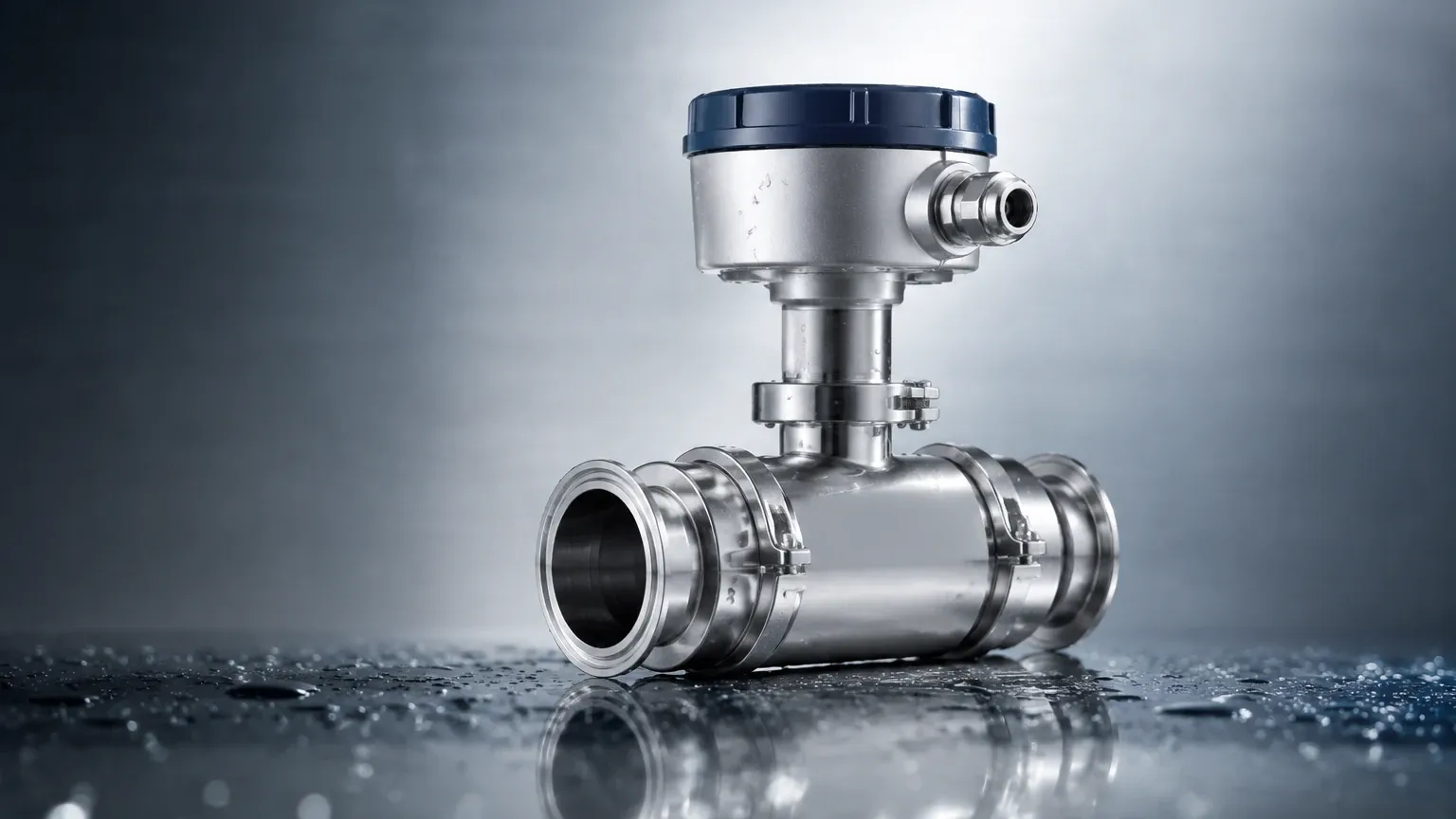
In a sanitary magmeter, the flow tube is lined with a food-grade material (such as PFA) and equipped with stainless steel electrodes. Because the measurement is independent of fluid density, viscosity, and pressure, it is highly reliable for conductive liquids like milk, juices, and pharmaceutical buffers. The primary limitation is that the fluid must have a minimum conductivity, typically $> 5 \mu S/cm$.
Coriolis Mass Flow Meters
Coriolis meters measure mass flow directly rather than volume. They work by inducing vibration in a flow tube; as fluid passes through, the tube twists due to the Coriolis effect. This twist is measured by sensors and converted into a highly accurate mass flow reading.
Coriolis meters are the "gold standard" for accuracy (often $\pm 0.1\%$) and can measure density and temperature simultaneously. Their straight-tube sanitary designs are particularly valued because they are self-draining and can handle non-conductive fluids like oils and syrups.
Ultrasonic Flow Meters (Transit-Time)
Ultrasonic meters use sound waves to determine fluid velocity. In transit-time meters, two transducers send signals back and forth. The difference in the time it takes for the signal to travel upstream versus downstream is proportional to the flow rate. For sanitary applications, "clamp-on" ultrasonic meters are popular because they never touch the process fluid, eliminating any risk of contamination or pressure drop.
Turbine Flow Meters
Turbine meters use a rotor that spins as fluid passes through. The rotational speed is proportional to the flow velocity. While these involve moving parts, sanitary turbine meters are designed with specialized bearings and polished surfaces to meet hygienic standards. They are often used for low-viscosity fluids where high precision is required at a lower price point than Coriolis meters.
Key Evaluation Criteria for Sanitary Instrumentation
When evaluating sanitary flow meters, the technical specifications must align with both the process requirements and international hygiene standards.
Material Composition and Surface Finish
The standard material for wetted parts in sanitary applications is 316L stainless steel. This low-carbon alloy offers superior corrosion resistance against the aggressive chemicals used in Clean-in-Place (CIP) cycles.
Equally important is the surface roughness, often denoted as $Ra$. To prevent microbial attachment, sanitary standards typically require an internal surface finish of $Ra \le 0.8 \mu m$ ($32 \mu in$), often achieved through electropolishing. This ensures that no microscopic pits exist where bacteria can thrive.
Regulatory Certifications
Every sanitary meter should carry certifications that prove its design is suitable for hygienic use. The most common include:
* 3-A Sanitary Standards: A US-based standard focusing on the design of equipment for the dairy and food industries.
* EHEDG (European Hygienic Engineering & Design Group): A European standard emphasizing the cleanability of the equipment.
* FDA Compliance: Ensures that all gaskets, liners, and non-metallic parts are made from materials safe for food and drug contact.
Cleaning Compatibility (CIP and SIP)
Sanitary processes are cleaned using Clean-in-Place (CIP) or Steam-in-Place (SIP) methods. A meter must be able to withstand temperatures up to $140^\circ C$ ($284^\circ F$) during steam sterilization and resist caustic or acidic cleaning agents without degrading the seals or liners.
Practical Selection Table
| Technology | Typical Accuracy | Fluid Conductivity | Cleaning Compatibility | Relative Cost |
| :— | :— | :— | :— | :— |
| Electromagnetic | $\pm 0.5\%$ | Required ($> 5 \mu S/cm$) | Excellent (CIP/SIP) | Moderate |
| Coriolis | $\pm 0.1\%$ | Not Required | Excellent (Self-draining) | High |
| Ultrasonic | $\pm 1.0\%$ | Not Required | Good (External sensors) | Moderate |
| Turbine | $\pm 0.25\%$ | Not Required | Fair (Moving parts) | Low |
Installation Considerations and Best Practices
Even the most accurate flow meter will fail if installed incorrectly. In sanitary environments, installation must prioritize both measurement physics and drainage.
1. Hygienic Connections: Standard NPT threads are forbidden in sanitary lines because the threads create "dead zones" where bacteria can grow. Instead, use Tri-Clamp or DIN 11851 fittings, which provide a smooth, crevice-free transition between the pipe and the meter.
2. Orientation for Drainage: To ensure the system is self-draining after a CIP cycle, meters should ideally be installed in vertical lines with the flow moving upward. If horizontal installation is necessary, the meter must be positioned such that the electrodes (in magmeters) are not at the top or bottom to avoid air bubbles or sediment interference.
3. Straight Pipe Runs: Most flow technologies require a certain amount of straight pipe before and after the meter to eliminate turbulence. A general rule is 5 to 10 pipe diameters upstream and 2 to 3 diameters downstream, though some modern magmeters are designed for "zero-run" installations.
4. Grounding: For electromagnetic meters, proper grounding is essential to eliminate electrical noise. In many sanitary systems using plastic piping or thin-walled stainless steel, grounding rings or specialized grounding electrodes are required.
Common Risks and Limitations
While sanitary flow meters are robust, several factors can compromise their performance:
* Entrained Air: Air bubbles in the line can cause significant errors in both magmeters and ultrasonic meters. In Coriolis meters, "slug flow" (large air pockets) can cause the tubes to stop vibrating correctly.
* Thermal Shock: Rapid temperature changes during SIP cycles can cause liners (like PTFE or PFA) to expand or contract at different rates than the steel housing, potentially leading to leaks or liner collapse if the vacuum is not managed.
* Electrode Coating: In the dairy industry, fats and proteins can build up on magmeter electrodes over time, insulating them and causing signal drift. Regular CIP is required to maintain the conductive path.
Frequently Asked Questions (FAQs)
Q: Can I use a standard industrial flow meter for a food-grade application?
A: No. Standard meters often have internal threads, dead spaces, and surface finishes that allow bacteria to accumulate. They also may use gaskets or lubricants that are not food-safe.
Q: How often should sanitary flow meters be calibrated?
A: This depends on the industry. Pharmaceutical processes may require bi-annual calibration, while food and beverage applications may follow an annual schedule. Always verify the meter’s performance against a master meter or weigh scale.
Q: What is the benefit of a straight-tube Coriolis meter over a bent-tube design?
A: Straight-tube designs are easier to clean and drain, offering lower pressure drops and a smaller footprint, which is often critical in skid-mounted sanitary systems.
Conclusion and Next Steps
Selecting the appropriate sanitary flow meter is a balance of understanding your fluid's properties and the rigorous demands of hygienic processing. By prioritizing materials like 316L stainless steel, ensuring compliance with 3-A or EHEDG standards, and following strict installation guidelines, you can ensure long-term accuracy and process safety.
For engineers looking to integrate these technologies into broader automation systems, it is helpful to consult with manufacturers who understand the nuances of both level and flow measurement. To explore a wider range of industrial instrumentation and technical specifications, you can review product options and application support on the Main Page.
Before finalizing a purchase, ensure you have confirmed the maximum operating temperature, the chemical compatibility of all gaskets, and the required communication protocols (such as 4-20mA HART, Modbus, or Profinet) to ensure seamless integration into your facility's control architecture.