Sensor Liquid Level
Sensor Liquid Level
In modern industrial processes, the ability to accurately monitor and control the volume of fluids in tanks, silos, and open channels is fundamental to operational efficiency and safety. A sensor liquid level system provides the critical data required for inventory management, process automation, and spill prevention. As a professional manufacturer, Welk specializes in a diverse range of instrumentation designed to meet the rigorous demands of the chemical, water treatment, and oil and gas sectors.
Selecting the appropriate sensor liquid level technology requires a deep understanding of the physical principles governing measurement, the characteristics of the media being measured, and the environmental constraints of the installation site. This guide provides a comprehensive technical overview to assist engineers and procurement professionals in identifying the most effective solutions for their specific applications.
Core Measurement Principles
Before selecting a specific instrument, it is essential to categorize sensor liquid level technologies based on their operating principles. These are generally divided into non-contact and contact-based methods.
Non-Contact Principles
1. Radar (Electromagnetic Waves): Radar level meters emit high-frequency electromagnetic pulses (typically in the GHz range). These pulses travel to the liquid surface, reflect, and return to the sensor. The distance is calculated based on the time-of-flight or frequency shift. Because electromagnetic waves do not require a medium for propagation, radar is highly effective in vacuums and high-pressure environments.
2. Ultrasonic (Sound Waves): These sensors emit ultrasonic sound pulses. The time taken for the echo to return from the liquid surface determines the distance. Since the speed of sound is affected by air temperature and density, these sensors are best suited for stable atmospheric conditions, such as water storage.
Contact-Based Principles
1. Hydrostatic (Pressure): This method measures the pressure exerted by a liquid column at a specific depth. Based on the formula $P = \rho gh$ (where $P$ is pressure, $\rho$ is density, $g$ is gravity, and $h$ is height), the sensor converts the measured pressure into a level reading. It is a reliable method for vented tanks and deep wells.
2. Buoyancy (Magnetic and Float): These instruments rely on a float that moves with the liquid level. In magnetic level gauges, the float contains a magnet that actuates external flags or a reed chain transmitter. This provides both local visual indication and electronic output.
3. Capacitance: This principle measures the change in electrical capacitance between two electrodes (or one electrode and the tank wall) as the liquid level rises and falls. It is often used for non-conductive liquids or powders.
Radar Level Meters: Precision and Versatility
Radar technology has become the industry standard for complex industrial applications. Welk offers two primary types of radar sensors: Pulse Radar and Frequency Modulated Continuous Wave (FMCW) Radar.
80GHz FMCW Radar
High-frequency 80GHz radar sensors offer a narrow beam angle (often as low as 3 degrees), which allows for precise measurement even in tall, narrow tanks with internal obstructions like agitators or heating coils. This technology provides a high signal-to-noise ratio, making it ideal for liquids with low dielectric constants (low $\epsilon_r$).
26GHz Pulse Radar
26GHz radar is a versatile solution for general-purpose liquid and solid level measurement. It is robust against dust and steam, making it a preferred choice for chemical storage and cement silos. For more detailed technical specifications on radar configurations, you can visit the Main Page of our product catalog.
Ultrasonic Sensor Liquid Level Applications
Ultrasonic sensors are widely utilized in water and wastewater management due to their cost-effectiveness and ease of installation. However, they have specific limitations:
* Media Constraints: They are not suitable for liquids that produce heavy foam, as the foam absorbs the sound waves, leading to signal loss.
* Environmental Factors: High-pressure environments or vacuums prevent sound propagation. Additionally, significant temperature gradients can distort the accuracy of the reading unless the sensor features integrated temperature compensation.
In typical water treatment applications, an ultrasonic sensor can reliably measure ranges from 0.5 meters (1.6 feet) up to 20 meters (65.6 feet).
Hydrostatic Level Transmitters
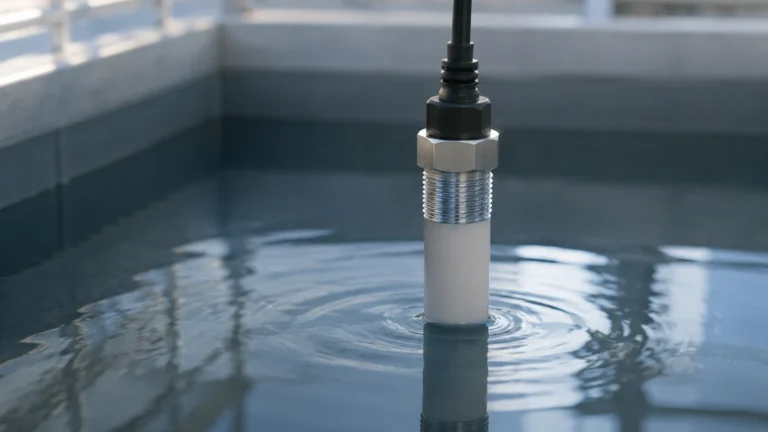
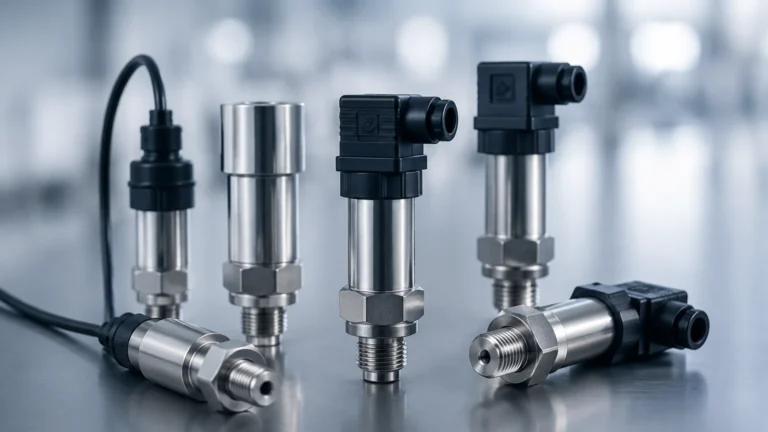
Hydrostatic sensors are highly effective for deep-well monitoring and underground storage tanks. They are typically submerged at the bottom of the vessel. Welk provides hydrostatic transmitters with various diaphragm materials, such as 316L stainless steel, ceramic, or Tantalum, to ensure compatibility with corrosive chemicals.
One critical consideration for hydrostatic measurement is the requirement for atmospheric venting. The sensor cable usually contains a vent tube to compensate for changes in barometric pressure, ensuring that the measurement only reflects the pressure of the liquid column.
Practical Selection Table
Choosing the right sensor liquid level instrument involves balancing performance requirements with budget constraints. The following table summarizes key selection criteria.
| Technology | Typical Accuracy | Max Range | Media Suitability | Temperature Range | Pressure Range |
| :— | :— | :— | :— | :— | :— |
| 80GHz Radar | ±1 mm | 120m (393 ft) | All liquids/solids | -40 to 200°C | Vacuum to 4 MPa |
| 26GHz Radar | ±3 mm | 70m (229 ft) | Most liquids | -40 to 150°C | Vacuum to 2 MPa |
| Ultrasonic | ±0.25% FS | 20m (65.6 ft) | Water, non-foaming | -40 to 70°C | Atmospheric |
| Hydrostatic | ±0.5% FS | 200m (656 ft) | Clean liquids, oils | -20 to 80°C | N/A (Submersible) |
| Magnetic Gauge| ±10 mm | 6m (19.6 ft) | Acids, oils, fuels | -40 to 400°C | Up to 16 MPa |
Installation Considerations
Proper installation is as important as selecting the correct technology. Incorrect placement can lead to "ghost echoes" or inaccurate readings.
1. The 1/3 Rule: For radar and ultrasonic sensors, the instrument should ideally be installed at 1/3 the radius of the tank. Avoid placing the sensor in the center of a domed tank, as this can concentrate multiple reflections, or too close to the wall, where side-lobe interference may occur.
2. Dead Zones (Blocking Distance): Every non-contact sensor liquid level device has a "dead zone" directly beneath the sensor face where measurement is impossible. Ensure the maximum liquid level never enters this zone (typically 0.2m to 0.5m depending on the model).
3. Nozzle Height: If the sensor is mounted on a nozzle, the nozzle's diameter and height must be configured so that the beam does not hit the nozzle edge. For 80GHz radar, shorter nozzles are preferred.
4. Agitators and Obstructions: If the tank contains agitators, the sensor should be positioned so that the signal path is clear of the blades. Software filtering (False Signal Suppression) can be used to "map out" static obstructions.
Limitations and Common Risks
While modern instrumentation is highly advanced, certain conditions pose risks to measurement reliability:
* Dielectric Constant ($ε_r$): Radar sensors rely on the reflectivity of the liquid. Hydrocarbons (like oil) have low dielectric constants ($ε_r < 2$), which result in weaker reflections compared to water ($ε_r ≈ 80$). Special high-sensitivity radar or guided wave radar may be required for low $ε_r$ fluids.
* Vapor and Condensation: While radar is generally immune to vapor, heavy condensation on the sensor face can attenuate the signal. Welk's radar units often feature PTFE lenses to minimize droplet accumulation.
* Turbulence: Rapidly swirling or boiling liquids can scatter the signal of non-contact sensors. In these cases, a stilling well or a bypass pipe is recommended to provide a calm surface for measurement.
Frequently Asked Questions (FAQs)
Q: Can I use an ultrasonic sensor for fuel storage?
A: It is generally not recommended. Fuel vapors can change the speed of sound, leading to errors. Furthermore, fuel tanks often require explosion-proof (Ex-rated) equipment, which is more commonly available in radar or hydrostatic configurations.
Q: How does the density of the liquid affect radar measurement?
A: Radar measurement is independent of liquid density. It is influenced by the dielectric constant. In contrast, hydrostatic measurement is directly dependent on density; if the liquid density changes, the level reading will require recalibration.
Q: What maintenance is required for a sensor liquid level system?
A: Non-contact sensors like radar and ultrasonic require minimal maintenance. Periodic inspection for buildup on the sensor face is recommended. Contact-based sensors, such as magnetic floats, should be checked for mechanical wear or sediment buildup in the chamber.
Q: Is it possible to measure level in a pressurized tank?
A: Yes. Radar and magnetic level gauges are excellent for pressurized vessels. For hydrostatic measurement in pressurized tanks, a differential pressure transmitter must be used to subtract the head pressure from the total pressure.
Conclusion
Identifying the right sensor liquid level solution involves evaluating the chemical compatibility, physical environment, and required precision of the application. Whether utilizing the high-frequency precision of 80GHz radar or the robust simplicity of hydrostatic transmitters, Welk provides the engineering expertise and high-quality instrumentation needed to optimize your process control. To explore our full range of industrial measurement tools, Review product options and application support to find the ideal match for your facility's requirements.