Temperature Control Switch
Temperature Control Switch
In the landscape of industrial automation and process safety, the temperature control switch stands as a fundamental component for maintaining thermal equilibrium and protecting equipment from catastrophic failure. While often overshadowed by complex PLC systems, these discrete devices provide a reliable, hardware-based layer of control that is essential in sectors ranging from chemical processing to wastewater treatment. For engineers and facility managers, understanding the nuances of temperature switch technology is critical for ensuring both operational efficiency and personnel safety.
At its core, a temperature control switch is a device designed to open or close an electrical circuit when a specific temperature threshold is reached. Unlike a continuous temperature transmitter, which provides a constant data stream of thermal values, a switch acts on a binary logic: it triggers an action—such as starting a pump, opening a valve, or sounding an alarm—once the set point is crossed. This article explores the mechanical and electronic principles of these devices, their integration into broader process control systems, and the criteria for selecting the right model for industrial environments.
Measurement Principles of Temperature Control Switches
Before selecting a temperature control switch, it is vital to understand the physics governing its operation. Industrial switches generally fall into two categories: mechanical (electromechanical) and electronic (solid-state).
Bimetallic Switches
The bimetallic temperature control switch operates on the principle of differential thermal expansion. Two different metals, bonded together, expand at different rates when heated. This causes the strip to bend or "snap" at a predetermined temperature, physically moving a contact to open or close the circuit. These are valued for their simplicity, high reliability, and lack of need for an external power source.
Liquid-Filled and Capillary Switches
These switches utilize a bulb filled with a temperature-sensitive fluid (liquid, gas, or vapor). As the temperature at the bulb increases, the fluid expands, creating pressure that travels through a capillary tube to a bellows or diaphragm. This pressure then actuates a microswitch. This design allows the sensing element to be placed inside a tank or pipe while the switch housing is mounted in a more accessible or cooler location.
Electronic and Digital Switches
Modern electronic temperature switches use Resistance Temperature Detectors (RTDs) or thermocouples as the primary sensing element. An internal microprocessor compares the measured resistance or voltage against a programmed set point. These devices offer significantly higher accuracy, adjustable hysteresis, and often include a local digital display. While they require an external power supply, their versatility makes them ideal for precision-critical applications.
The Relationship Between Temperature and Level Measurement
In many industrial applications, temperature control is inextricably linked to level measurement. As a professional manufacturer of industrial instruments, Welk recognizes that thermal fluctuations can significantly impact the accuracy of level data. For instance, in hydrostatic level measurement, the density of a liquid changes with its temperature. A rise in temperature typically decreases density, which could lead to an incorrect level reading if the system is not compensated.
Furthermore, in storage tanks containing viscous fluids like heavy oil or bitumen, a temperature control switch is often used to manage heating coils. If the temperature drops too low, the fluid may solidify, rendering level sensors like ultrasonic or radar meters ineffective due to surface irregularities or signal absorption. By integrating reliable temperature switching with high-quality instrumentation from the Main Page, engineers can create a robust control loop that ensures both the physical state of the media and the accuracy of the level data remain within operational parameters.
Key Evaluation Criteria for Industrial Selection
Selecting a temperature control switch requires more than just knowing the target set point. Engineers must evaluate the device based on the specific rigors of the application environment.
1. Set Point and Reset Point (Hysteresis): The "deadband" or hysteresis is the difference between the temperature at which the switch actuates and the temperature at which it resets. A narrow hysteresis allows for tight control but may cause "chattering" (rapid cycling), while a wide hysteresis protects the equipment from excessive wear but allows for larger temperature swings.
2. Operating Range and Overrange Protection: The switch must operate within the expected process window, but it must also survive "overrange" conditions—occasional temperature spikes that exceed the set point without damaging the sensing element.
3. Wetted Materials: For corrosive chemical applications, the sensing bulb or thermowell must be constructed from compatible materials such as 316 Stainless Steel, Hastelloy, or PTFE-coated alloys.
4. Electrical Rating: The switch contacts must be rated for the load they are controlling. Inductive loads (like motors) require different considerations than resistive loads (like heaters).
5. Environmental Ratings: In hazardous areas, explosion-proof housings (ATEX/IECEx) are mandatory. For outdoor or wash-down environments, NEMA 4X or IP66/67 ratings are required.
Technical Selection Table
| Feature | Bimetallic Switch | Capillary (Liquid-Filled) | Electronic (RTD/TC) |
| :— | :— | :— | :— |
| Accuracy | Moderate (±2-5°C) | Good (±1-2°C) | Excellent (±0.1-0.5°C) |
| Power Required | No | No | Yes (24VDC / 220VAC) |
| Response Time | Slow to Moderate | Moderate | Fast |
| Adjustability | Limited/Fixed | Wide Range | Fully Programmable |
| Vibration Resistance | Low | Moderate | High |
| Typical Use | Overheat protection | Tank/Pipe monitoring | Precision process control |
Installation Considerations and Best Practices
Proper installation is the determining factor in whether a temperature control switch performs to its specifications. Poor placement can lead to thermal lag or false readings.
* Thermowell Usage: In high-pressure or corrosive environments, always install the switch sensing element inside a thermowell. This allows the switch to be removed for calibration or replacement without draining the process vessel. Ensure the use of thermal transfer paste inside the thermowell to minimize response lag.
* Immersion Depth: The sensing portion of the probe must be fully immersed in the moving process fluid. In pipes, the tip should ideally reach the center of the flow. Avoid "dead zones" where fluid stagnates, as these areas do not reflect the true process temperature.
* Orientation: For liquid-filled capillary switches, the orientation of the bulb and the routing of the capillary tube are critical. Avoid sharp bends in the capillary, which can pinch the tube and cause the switch to fail.
* Wiring and Grounding: Ensure that electrical connections are tight and that the housing is properly grounded to prevent EMI (Electromagnetic Interference) from affecting electronic switch logic.
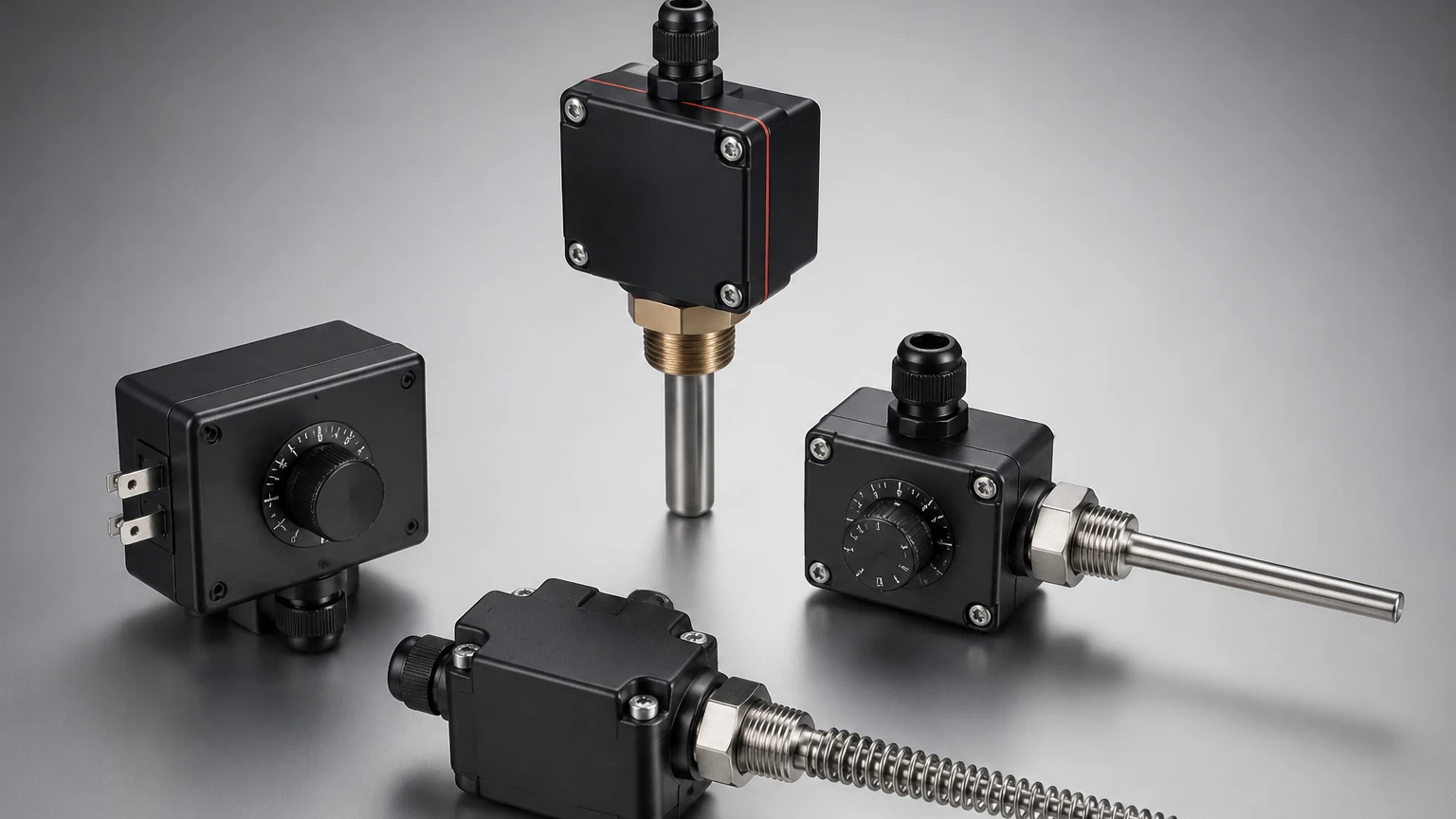
Limitations and Common Risks
While highly effective, temperature control switches have inherent limitations that must be managed through proactive engineering.
* Thermal Lag: No switch reacts instantly. The time it takes for heat to transfer through a thermowell and into the sensing element creates a delay. In fast-moving exothermic reactions, this lag can be dangerous.
* Contact Pitting: In mechanical switches, frequent switching of high-current loads can cause electrical arcing, leading to contact pitting and eventual failure in the "closed" or "open" position. Regular inspection of contacts is necessary.
* Ambient Temperature Influence: Capillary switches can be affected by the temperature of the air surrounding the capillary tube itself. If the tube runs through a very hot or cold area, it may shift the set point (ambient compensation features can mitigate this).
* Mechanical Fatigue: Bimetallic and bellows-operated switches have moving parts that will eventually fatigue. In high-cycle applications, electronic switches are preferred for their lack of moving mechanical components.
Frequently Asked Questions (FAQ)
Q: Can a temperature control switch be used for both heating and cooling applications?
A: Yes. Most switches offer SPDT (Single Pole Double Throw) contacts. This means you can wire the switch to close a circuit on temperature rise (for cooling) or close a circuit on temperature fall (for heating).
Q: How often should an industrial temperature switch be calibrated?
A: For most industrial applications, an annual calibration check is recommended. However, in safety-critical systems or high-vibration environments, semi-annual checks may be necessary to account for set-point drift.
Q: What is the difference between a "limit" switch and a "control" switch?
A: A control switch is used for daily regulation of temperature (e.g., cycling a heater). A limit switch is a safety device, often requiring a manual reset, designed to shut down a system if it reaches a dangerous "high-limit" or "low-limit" threshold.
Q: How do I choose between a thermocouple-based and an RTD-based electronic switch?
A: RTDs (usually Pt100) are more accurate and stable over time for temperatures up to 600°C. Thermocouples are preferred for much higher temperatures or applications where extremely fast response times and ruggedness are prioritized over absolute accuracy.
Conclusion
The temperature control switch remains a cornerstone of industrial process integrity. By providing a dependable mechanism to respond to thermal changes, these devices protect expensive assets and ensure product consistency. Whether used as a standalone safety cutout or integrated with advanced level measurement solutions from the Main Page, selecting the correct switch technology requires a deep understanding of the process media, the physical environment, and the required precision. By following established engineering guidelines for selection and installation, operators can significantly reduce downtime and enhance the safety of their industrial infrastructure.