Single Use Sensor
Single Use Sensor
In the evolving landscape of industrial process control, particularly within the biopharmaceutical, food and beverage, and fine chemical sectors, the shift toward flexible manufacturing has necessitated a new class of instrumentation. The single use sensor represents a critical component of this transition, allowing for accurate measurement without the intensive cleaning and validation requirements associated with traditional stainless steel instrumentation. As a professional manufacturer of industrial level measurement instruments, Welk recognizes that while radar and ultrasonic technologies remain staples of fixed infrastructure, the integration of disposable sensing elements is transforming how engineers approach batch processing and sterility.
This guide explores the fundamental principles, selection criteria, and practical implementation of single-use sensing technology in modern industrial environments.
Measurement Principles of Single Use Sensors
Unlike permanent instruments designed for decades of service, a single use sensor is typically integrated into a disposable process container (such as a 2D or 3D bioprocess bag) and is intended for a single batch or production cycle. Despite their disposable nature, these sensors must adhere to rigorous accuracy standards. The measurement principles generally fall into four categories:
1. Hydrostatic Pressure Sensing
Hydrostatic sensors measure the pressure exerted by a liquid column. In a single-use configuration, a flexible, medical-grade diaphragm is often welded into the bottom of the process bag. This diaphragm transmits the fluid pressure to a reusable transducer located outside the sterile boundary. The principle relies on the equation $P = \rho gh$, where $P$ is pressure, $
ho$ is fluid density, $g$ is gravity, and $h$ is the height of the liquid. This method is highly effective for continuous level measurement in large-scale disposable bioreactors.
2. Capacitive Level Detection
Capacitive sensors detect changes in the dielectric constant within a specific area. In single-use applications, these are often point-level sensors. A sensing electrode is placed against the exterior of a plastic vessel or integrated into a patch. As the liquid level rises and covers the sensor area, the capacitance changes significantly compared to air, triggering a signal. This is a non-invasive method that maintains the integrity of the sterile barrier.
3. Ultrasonic Time-of-Flight
Ultrasonic single-use sensors often utilize a "clamp-on" or "single-use flow cell" design. For level measurement, an ultrasonic transducer sends a sound pulse through the container wall. The time it takes for the echo to return from the liquid surface determines the level. In high-purity applications, the sensor may use a disposable plastic insert that provides a consistent acoustic path, ensuring that the expensive transducer remains isolated from the process fluid.
4. Optical and Fiber Optic Sensing
Optical sensors use light refraction or reflection to detect the presence of liquid. In single-use systems, fiber optic probes can be pre-installed into the bag. When liquid contacts the probe tip, the refractive index changes, altering the amount of light returned to a detector. This is particularly useful for detecting foam or providing high-accuracy point level alerts in small-scale vessels.
Key Evaluation Criteria for Selection
Selecting the appropriate single use sensor requires a balance between technical performance and economic viability. For engineers accustomed to the robust specifications of permanent level meters found on the Main Page, the following criteria are paramount:
Material Compatibility and Regulatory Compliance
Since the sensor (or its housing) directly contacts the product, materials must meet stringent safety standards. This includes USP Class VI compliance, ISO 10993 for biocompatibility, and being Animal Derived Component Free (ADCF). Furthermore, the sensor must withstand Gamma irradiation (typically 25–50 kGy) used for sterilization without losing calibration or structural integrity.
Accuracy and Range
While disposable sensors are often perceived as less accurate than their stainless steel counterparts, modern engineering has closed this gap. For instance, single-use pressure sensors can achieve accuracies within ±1% of the full scale. It is essential to define the required measurement range (e.g., 0–2 meters or 0–10 bar) before selecting a sensor type.
Integration and Connectivity
The sensor must interface seamlessly with existing Distributed Control Systems (DCS) or Programmable Logic Controllers (PLC). Common outputs include 4-20 mA, 0-5 V, or digital protocols like Modbus. The physical connection—often an M12 or similar industrial connector—should be robust enough to handle the rigors of a cleanroom environment.
Comparison Table: Single-Use vs. Traditional Sensors
| Feature | Single Use Sensor | Traditional Permanent Sensor |
| :— | :— | :— |
| Initial Capital Cost | Low | High |
| Cleaning Requirements | None (Disposable) | Extensive (CIP/SIP) |
| Risk of Cross-Contamination | Negligible | Moderate (Requires Validation) |
| Installation Time | Minutes (Plug-and-Play) | Hours/Days (Welding/Calibration) |
| Calibration | Factory Pre-calibrated | Field Calibrated |
| Environmental Impact | High (Plastic Waste) | Low (Long-term Reuse) |
| Maintenance | None | Periodic (Seal replacement, etc.) |
Practical Selection Table by Application
| Application | Recommended Sensor Type | Reason for Selection |
| :— | :— | :— |
| Bioreactor Level | Hydrostatic Pressure | High accuracy for large volumes; continuous monitoring. |
| Buffer Preparation | Capacitive Point Level | Simple, non-contact detection of high/low limits. |
| Media Filtration | Single-use Pressure | Monitors filter fouling via differential pressure. |
| Small-scale Lab Use | Optical / Fiber Optic | Compact size and high sensitivity for small volumes. |
Installation Considerations and Best Practices
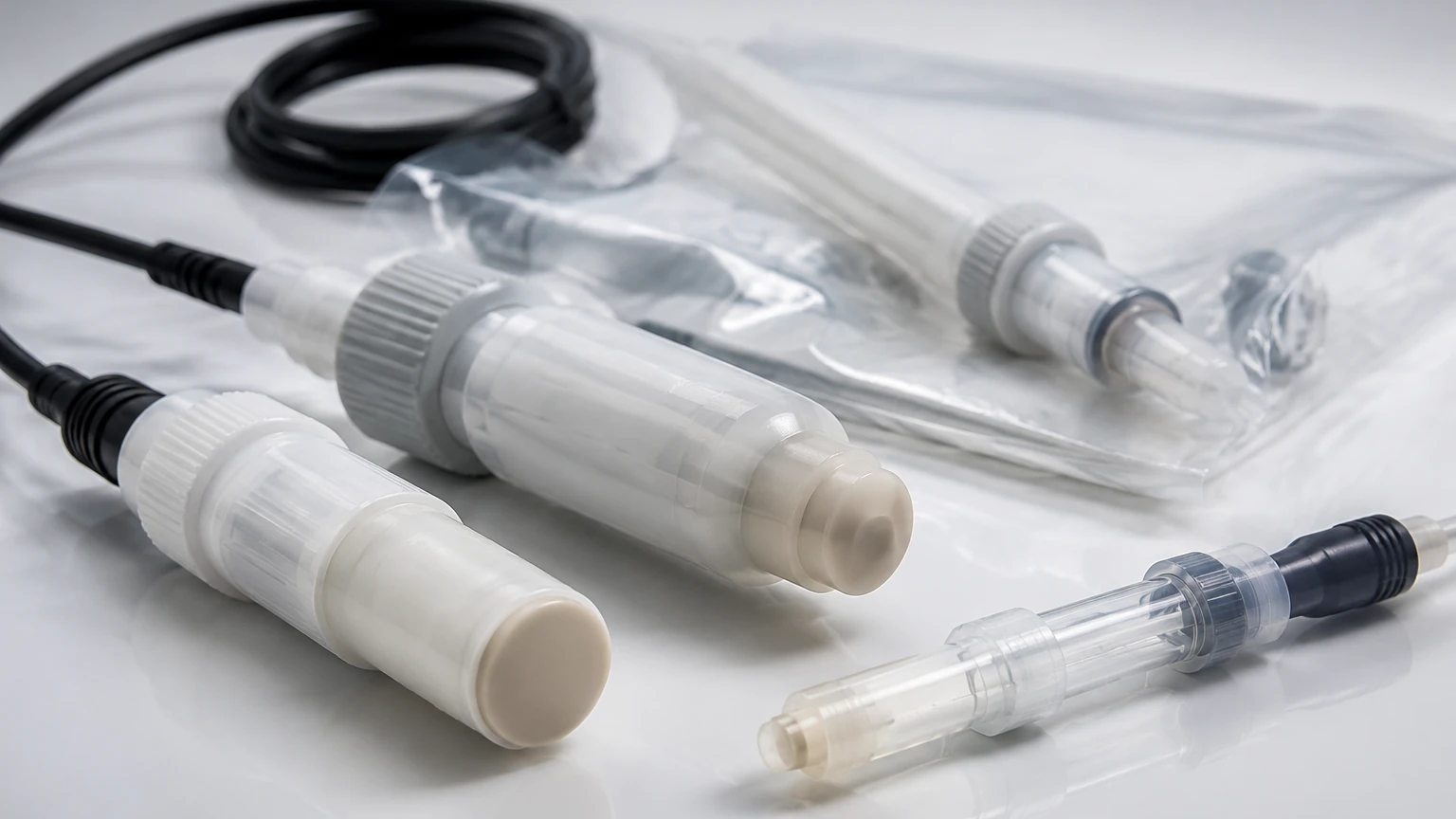
Successful implementation of a single use sensor depends heavily on the installation phase. Because these sensors are often part of a larger "Single-Use Assembly," the following factors must be considered:
1. Mechanical Stress: Ensure that the sensor housing is not subjected to excessive tension or torque when the bag is filled. Liquid weight can cause the bag to stretch, which may shift the sensor position or damage the electrical leads.
2. Orientation: For hydrostatic sensors, the diaphragm must be located at the lowest possible point of the vessel to ensure a full range of measurement. For ultrasonic sensors, the transducer must have a clear, vertical path to the liquid surface, free from internal obstructions like dip tubes or impellers.
3. Zeroing and Taring: Even with factory calibration, it is standard practice to "zero" the sensor after the empty bag is installed in its support housing but before filling begins. This accounts for the atmospheric pressure and the weight of the empty bag assembly.
4. Cable Management: In multi-bag suites, cable clutter can lead to accidental disconnections. Using color-coded cables or RFID-tagged connectors can simplify the setup of complex single-use manifolds.
Limitations and Risks
While the benefits of single-use technology are significant, engineers must remain aware of specific limitations:
* Extractables and Leachables (E&L): There is always a risk that chemicals from the plastic sensor housing could migrate into the product. Manufacturers must provide comprehensive E&L data packages to satisfy regulatory bodies like the FDA or EMA.
* Shelf Life: Unlike stainless steel probes, a single use sensor has a finite shelf life, often ranging from 1 to 3 years, depending on the materials and sterilization method used.
* Signal Drift: Some disposable sensors may experience slight signal drift during long-term fermentation cycles (e.g., 21 days). This must be accounted for in the process control logic.
* Fragility: Disposable components are generally more susceptible to physical damage during shipping and handling compared to heavy-duty industrial level meters.
Frequently Asked Questions (FAQs)
Q: Can a single use sensor be reused if it is cleaned?
A: No. These sensors are specifically designed and validated for one-time use. Attempting to clean or re-sterilize them can compromise material integrity, sensor accuracy, and process sterility.
Q: How are single-use sensors calibrated?
A: Most are factory-calibrated using precision equipment. The calibration data is often provided via a barcode or an integrated chip that the transmitter reads upon connection, ensuring "plug-and-play" functionality.
Q: Are single-use sensors compatible with high temperatures?
A: Most single-use sensors are rated for standard operating temperatures in bioprocessing (typically 4°C to 50°C). They are not designed for the extreme temperatures found in steam-in-place (SIP) cycles, as the single-use philosophy eliminates the need for such processes.
Q: What happens if the sensor fails during a batch?
A: This is a critical risk. Many engineers design redundancy into their systems, such as using two point-level sensors or combining a hydrostatic sensor with a secondary non-invasive ultrasonic sensor to verify readings.
Conclusion
The integration of the single use sensor into industrial workflows offers a pathway to increased agility and reduced operational overhead. By eliminating the need for Clean-in-Place (CIP) and Steam-in-Place (SIP) infrastructure, facilities can pivot between different products with minimal downtime. However, the transition requires a deep understanding of measurement principles and a rigorous approach to sensor selection. For those seeking a broader range of robust, permanent level measurement solutions for infrastructure-heavy applications, exploring the various technologies available on the Main Page remains an essential part of a comprehensive instrumentation strategy. Whether utilizing disposable or permanent technology, the goal remains the same: achieving precise, reliable, and safe process control.