Sludge Flow Meter
Sludge Flow Meter
In industrial wastewater treatment and process engineering, the accurate measurement of sludge flow is a critical yet challenging task. Sludge is characterized by its high solids content, varying viscosity, and often abrasive or corrosive nature. Whether managing primary sludge, activated sludge, or digested sludge, selecting the correct sludge flow meter is essential for optimizing chemical dosing, ensuring process efficiency, and maintaining regulatory compliance. This guide explores the technical principles, selection criteria, and installation requirements for sludge flow measurement systems.
Understanding Sludge Flow Measurement Principles
Before selecting a meter, it is vital to understand the physical principles that allow these instruments to function in high-solids environments. Unlike clean water applications, sludge requires technologies that can handle non-Newtonian fluids and potential obstructions.
Electromagnetic Measurement (Magmeters)
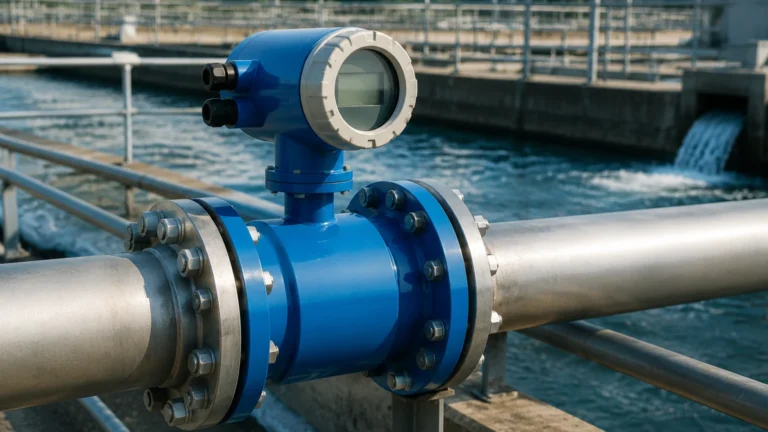
Electromagnetic flow meters are the industry standard for sludge. They operate based on Faraday’s Law of Electromagnetic Induction, which states that a conductor (the sludge) moving through a magnetic field generates a voltage proportional to its velocity.
Because the measurement is independent of viscosity, density, and pressure, magmeters are highly effective for sludge, provided the medium has a minimum conductivity (typically >5 μS/cm). Since there are no moving parts or obstructions in the flow path, the risk of clogging or pressure drop is virtually eliminated. For comprehensive instrumentation needs, engineers often consult the Main Page of specialized manufacturers to integrate flow data with level monitoring systems.
Ultrasonic Doppler Measurement
Ultrasonic Doppler flow meters utilize the frequency shift of sound waves reflected off moving particles or gas bubbles within the sludge. A transducer emits an ultrasonic signal into the pipe; when this signal hits a solid particle in the sludge, it reflects back to a receiver at a different frequency. The difference in frequency (the Doppler shift) is directly proportional to the flow rate. This technology is ideal for "dirty" liquids where electromagnetic meters might not be feasible, though it requires a minimum concentration of suspended solids to provide a reliable reflection.
Coriolis Mass Flow Measurement
Coriolis meters measure mass flow by vibrating a tube (or tubes) through which the sludge passes. The mass of the moving fluid causes a twisting of the tube due to the Coriolis effect. This twist is measured as a phase shift between sensors. While highly accurate and capable of measuring density simultaneously, Coriolis meters are often limited by high capital costs and potential wear in highly abrasive sludge applications.
Key Selection Criteria for Sludge Flow Meters
Choosing the right sludge flow meter requires a detailed analysis of the fluid properties and the specific process environment. Engineers must evaluate the following factors to ensure long-term reliability.
Solids Content and Type
The concentration of solids (measured in mg/L or percentage) dictates the technology. For thin sludge (less than 2% solids), standard electromagnetic meters are sufficient. For thickened sludge (5% to 10% solids), high-consistency magmeters with specialized signal processing are required to filter out "slurry noise" caused by particles hitting the electrodes.
Liner and Electrode Materials
Sludge can be abrasive (containing grit or sand) or corrosive (due to chemical additives or biological activity).
- Liners: Hard rubber or Polyurethane liners are typically used for abrasive sludge due to their wear resistance. For chemical sludge, PTFE (Teflon) or PFA is preferred for its chemical inertness.
- Electrodes: Stainless steel 316L is standard, but for aggressive sludge, materials like Hastelloy C, Tantalum, or Titanium may be necessary to prevent pitting and corrosion.
Pipe Size and Flow Velocity
To prevent solids from settling and clogging the pipe, sludge flow should ideally maintain a velocity between 1.5 m/s and 3.0 m/s. If the velocity is too low, solids drop out of suspension; if too high, abrasive wear on the meter liner increases exponentially. The meter size should be selected based on these velocity constraints rather than the existing pipe size.
Technical Comparison Table
| Feature | Electromagnetic (Magmeter) | Ultrasonic Doppler | Coriolis Mass Flow |
| :— | :— | :— | :— |
| Primary Advantage | No obstructions; high reliability | Non-intrusive (clamp-on) | Measures mass and density |
| Solids Handling | Excellent (up to 10%+) | Required for operation | Moderate (abrasion risk) |
| Accuracy | ±0.5% of rate | ±2.0% to 5.0% of rate | ±0.1% to 0.2% of rate |
| Conductivity | Required (>5 μS/cm) | Not required | Not required |
| Maintenance | Low (electrode cleaning) | Low (transducer check) | Medium (tube wear) |
| Relative Cost | Moderate | Low to Moderate | High |
Installation Guidelines and Best Practices
Proper installation is as important as meter selection. Failure to follow hydraulic requirements often leads to measurement errors or premature equipment failure.
Straight Pipe Runs
Flow meters require a stable flow profile to measure accurately. For a sludge flow meter, the standard requirement is a straight run of 5 diameters (5D) upstream and 2 diameters (2D) downstream from the meter. If valves or pumps are located nearby, these distances may need to be increased to 10D or more to eliminate turbulence.
Ensuring a Full Pipe
A flow meter cannot accurately measure a partially full pipe. In sludge applications, the meter should be installed in a vertical section of pipe with the flow moving upward. This ensures the pipe remains full and prevents air bubbles from collecting at the top of the sensor, which would cause signal loss.
Grounding and Interference
Electromagnetic meters are sensitive to electrical noise. Proper grounding is mandatory, especially in plastic or lined pipes. Grounding rings or grounding electrodes must be used to ensure the sludge and the meter are at the same electrical potential. This prevents stray currents from interfering with the small millivolt signals generated by the flow.
Access for Maintenance
Even with "maintenance-free" designs, sludge meters may require periodic inspection. Installing a bypass loop allows the meter to be isolated and cleaned without shutting down the entire process. This is particularly important for sludge lines prone to grease buildup or mineral scaling.
Limitations and Common Risks
While modern sludge flow meters are robust, certain conditions can compromise their performance:
1. Electrode Coating: In biological sludge or oily waste, a film can build up on the electrodes, insulating them from the fluid. Some meters feature electrolytic cleaning or "bullet-head" electrodes to shed debris.
2. Entrained Air: Air bubbles introduced by pumps or chemical reactions can cause electromagnetic meters to over-read or ultrasonic meters to lose signal. Air release valves should be installed upstream if air entrainment is suspected.
3. Liner Vacuum: In some piping configurations, a vacuum can occur (e.g., during pump shutdown). If the meter liner is not vacuum-rated (like some PTFE liners), it can collapse or pull away from the sensor body.
4. Abrasive Wear: High-velocity grit in primary sludge can erode the liner over time. Regular ultrasonic thickness testing of the pipe and meter body is recommended in high-grit environments.
Frequently Asked Questions (FAQs)
Q: Can I use an ultrasonic transit-time meter for sludge?
A: Generally, no. Transit-time meters require clean liquids to allow the signal to pass through. The high solids content in sludge absorbs or scatters the signal. Doppler meters are the correct ultrasonic choice for sludge.
Q: How do I handle sludge that is non-conductive?
A: If the sludge is non-conductive (e.g., oil-based sludge), an electromagnetic meter will not work. In these cases, a Coriolis mass flow meter or a Doppler ultrasonic meter should be used.
Q: What is the minimum velocity required for a sludge flow meter?
A: To keep solids in suspension, a minimum velocity of 1.0 m/s is recommended. However, for the best accuracy and to prevent electrode coating, 1.5 m/s to 2.5 m/s is the ideal operating range.
Q: How often should a sludge flow meter be calibrated?
A: In most municipal applications, an annual verification is sufficient. However, in industrial processes with abrasive sludge, a semi-annual check of the liner integrity and zero-point stability is advised.
Conclusion
Selecting a sludge flow meter requires a balance between technology, material compatibility, and hydraulic design. Electromagnetic meters remain the most versatile and cost-effective solution for conductive sludge, while Doppler and Coriolis meters provide alternatives for specific chemical or accuracy requirements. By adhering to strict installation standards—such as ensuring a full pipe and providing adequate straight runs—operators can ensure reliable data for years of service. For those integrating flow measurement with advanced tank monitoring, reviewing the latest sensor technologies on the Main Page can provide a holistic view of process automation and control.