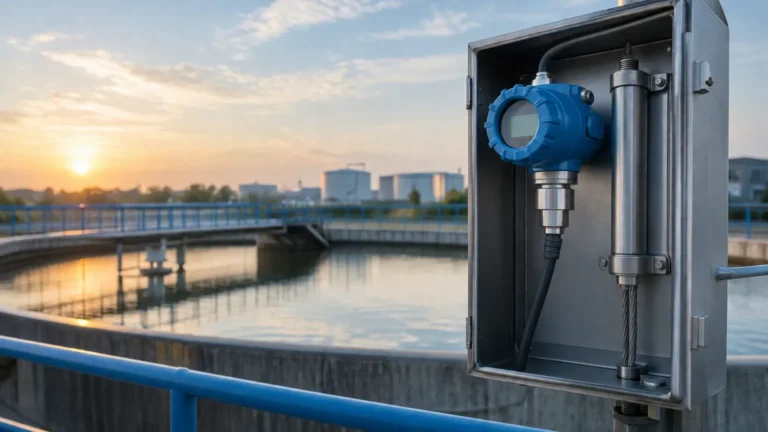
Submersible Water Level Sensor
Submersible Water Level Sensor
In industrial process control and environmental monitoring, the submersible water level sensor—often referred to as a hydrostatic level transmitter—serves as a cornerstone technology for measuring liquid depth in open and closed containers, deep wells, and wastewater systems. Unlike non-contact methods such as radar or ultrasonic sensors, the submersible water level sensor operates in direct contact with the medium, utilizing the physics of liquid weight to provide high-accuracy data.
For engineers and procurement professionals, choosing the correct instrument requires a deep understanding of hydrostatic principles, material compatibility, and the specific environmental challenges of the installation site. This guide provides a factual technical overview of submersible level technology to assist in the selection and deployment of these critical instruments.
1. Measurement Principles and Physics
The operation of a submersible water level sensor is based on the principle of hydrostatic pressure. According to Pascal's Law, the pressure at a specific point within a static liquid is directly proportional to the height of the liquid column above that point, the density of the liquid, and the force of gravity.
The Hydrostatic Equation
The fundamental formula used by these sensors is:
P = ρ × g × h
Where:
* P is the hydrostatic pressure (measured by the sensor diaphragm).
* ρ (rho) is the density of the liquid (e.g., approximately 1,000 kg/m³ for fresh water).
* g is the local acceleration due to gravity (standardized at 9.80665 m/s²).
* h is the height of the liquid column above the sensor.
By rearranging the formula to h = P / (ρ × g), the sensor’s internal electronics can convert the measured pressure into a precise level or depth reading.
Atmospheric Pressure Compensation
A critical challenge in hydrostatic measurement is the influence of atmospheric pressure. Changes in weather or altitude can alter the pressure exerted on the surface of the liquid. To ensure that the sensor only measures the pressure generated by the liquid itself, most submersible water level sensors utilize a vented cable. This cable contains a small capillary tube that allows the back of the sensor’s sensing diaphragm to be exposed to the ambient atmospheric pressure. This "vents" the sensor, effectively canceling out the atmospheric pressure on both sides of the diaphragm and leaving only the pressure of the liquid column to be measured.
2. Core Components and Construction
A professional-grade submersible water level sensor, such as those produced by Welk, is engineered to withstand long-term immersion in potentially corrosive or turbulent environments. The device typically consists of three primary modules:
The Sensor Head (Probe)
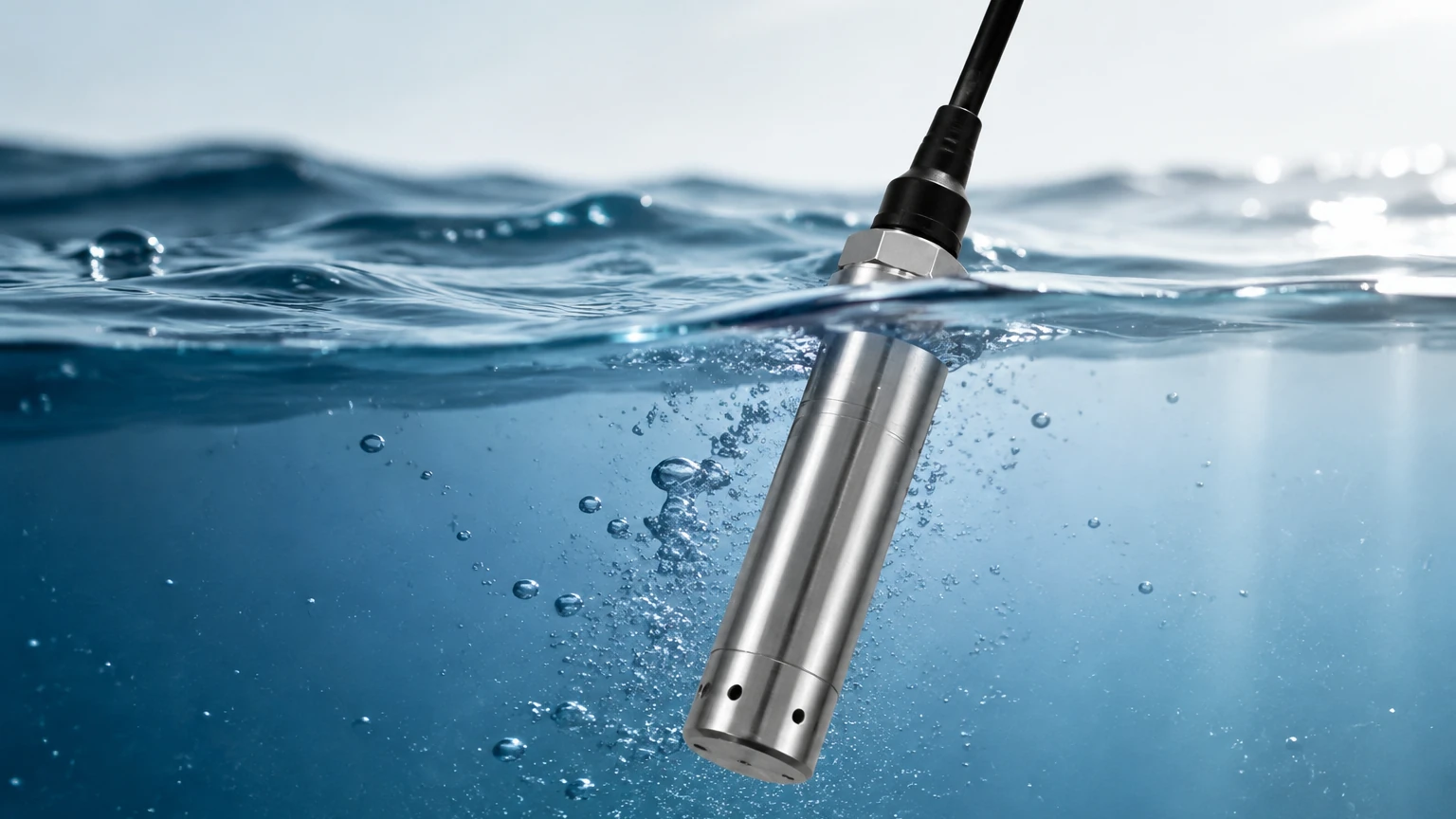
This is the submerged portion of the device. It contains the sensing element—usually a piezoresistive silicon chip or a ceramic capacitive sensor—housed behind a flexible stainless steel or ceramic diaphragm. The housing is typically made of 316L stainless steel, though specialized materials like Titanium or PVC are used for seawater or acidic applications.
The Vented Cable
The cable is the lifeline of the sensor, providing electrical power, signal transmission, and atmospheric venting. It is typically jacketed in Polyurethane (PUR) for general use, Polyethylene (PE) for drinking water, or FEP/Teflon for high-temperature and chemical-resistant applications. A high-strength Kevlar or steel strain-relief member is often integrated to prevent the cable from stretching under its own weight in deep-well applications.
The Signal Transmitter
Located either within the probe head or in a separate surface-mounted junction box, the transmitter converts the raw millivolt signal from the sensing element into a standardized industrial output, such as 4-20mA, 0-10V, or digital RS485 (Modbus RTU).
3. Technical Selection Criteria
Selecting the right submersible water level sensor requires matching the instrument's specifications to the physical and chemical properties of the application. The following table outlines the primary evaluation criteria:
| Feature | Standard Specification | Industrial/Heavy Duty | Specialized/Chemical |
| :— | :— | :— | :— |
| Measurement Range | 0–1m to 0–50m H2O | 0–200m+ H2O | Custom micro-ranges |
| Accuracy (FS) | ±0.5% | ±0.25% or ±0.1% | ±0.05% (Scientific) |
| Housing Material | 304 Stainless Steel | 316L Stainless Steel | Titanium, Hastelloy, PVC |
| Diaphragm Material | 316L SS | Ceramic (Al2O3) | Tantalum |
| Cable Jacket | PVC / PUR | Polyethylene (PE) | FEP / PTFE |
| Output Signal | 4–20mA | RS485 (Modbus) | HART, 0.5–4.5V Ratiometric |
| Operating Temp | -10°C to +70°C | -20°C to +85°C | Up to +125°C (Specialized) |
Material Compatibility
* Fresh Water: 316L stainless steel with a PUR cable is the industry standard.
* Seawater/Brine: Titanium housings are required to prevent pitting and galvanic corrosion.
* Wastewater: Sensors with a flush, non-clogging diaphragm and a protective cage are preferred to prevent solids from damaging the sensing element.
4. Installation Best Practices
Proper installation is the most significant factor in the longevity and accuracy of a submersible water level sensor. Failure to follow engineering guidelines often leads to premature sensor failure or erratic readings.
Placement and Stability
The sensor should be placed in a location where the liquid is relatively calm. In tanks with agitators or high-flow inlets, the sensor must be protected from turbulence.
* Stilling Wells: In high-flow environments, install the sensor inside a perforated pipe (stilling well). This protects the probe from mechanical stress and ensures a stable pressure reading.
* Anchor Weights: For deep wells or open water, an anchor weight should be attached to the probe to keep it vertical and prevent it from drifting.
Cable Management
* Bending Radius: Never exceed the manufacturer’s minimum bending radius for the cable, as this can kink the internal vent tube.
* Vent Protection: The end of the cable (at the surface) must be kept in a dry, ventilated enclosure. If moisture enters the vent tube, it will migrate to the sensor head and cause permanent damage. Using a desiccant filter at the vent terminus is highly recommended.
* Lightning Protection: In outdoor installations, surge protection devices should be installed both at the sensor and at the control panel to protect against transient voltages.
5. Limitations and Common Risks
While submersible water level sensors are versatile, they are not suitable for every application. Engineers must account for the following limitations:
1. Density Sensitivity: Since the sensor measures weight, any change in the liquid's density (due to temperature changes or chemical concentration) will result in an error. If the density changes by 2%, the level reading will also be off by 2% unless compensated for in the control system.
2. Solids Accumulation: In wastewater or sludge, heavy solids can settle on the diaphragm. This adds "false weight," leading to over-reporting of the level. Regular cleaning or the use of flush-diaphragm models is necessary.
3. Mechanical Damage: The sensing diaphragm is extremely thin (often less than 0.1mm). Dropping the probe or poking the diaphragm with a tool will destroy the sensor.
4. Media Compatibility: Hydrostatic sensors are not ideal for highly viscous liquids or media that can solidify or coat the sensor, as this prevents the diaphragm from moving freely.
For complex industrial environments where hydrostatic measurement may not be the optimal fit, engineers should evaluate alternative technologies. Detailed technical comparisons of various measurement methods can be found on our Main Page.
6. Frequently Asked Questions (FAQ)
Q: Can I cut the cable of a submersible water level sensor to shorten it?
A: It is generally not recommended to cut the cable in the field unless you have specialized tools to re-terminate the vent tube and ensure a moisture-proof seal. Cutting the cable often voids the warranty and risks blocking the atmospheric compensation path.
Q: How often does a submersible level sensor need calibration?
A: For most industrial applications, an annual calibration check is sufficient. However, in critical applications or environments with high sediment, semi-annual inspections are recommended to check for diaphragm coating and zero-point drift.
Q: What is the difference between a "vented" and a "sealed" sensor?
A: A vented sensor uses a capillary tube to compensate for atmospheric pressure changes, making it accurate for shallow water and open tanks. A sealed (absolute) sensor is sealed at the factory and is typically used in deep-sea applications where atmospheric pressure is negligible compared to the total pressure, or where an external barometer is used to mathematically compensate for the level.
Q: Can these sensors be used in hazardous areas?
A: Yes, but they must be specifically rated as Intrinsically Safe (Ex ia) or Flameproof (Ex d) and used with an appropriate safety barrier in the control cabinet.
7. Conclusion and Next Steps
The submersible water level sensor remains one of the most reliable and cost-effective methods for liquid level monitoring across the water treatment, chemical, and oil and gas industries. By understanding the hydrostatic principle and ensuring proper installation—specifically regarding cable venting and material selection—operators can achieve long-term, maintenance-free performance.
When planning a project, always confirm the specific gravity of the liquid, the maximum depth required, and the chemical composition of the medium. For more information on selecting the right instrument for your specific application, visit our Main Page to review product options and application support.