Tss Analyzer
Tss Analyzer
In industrial water treatment and process engineering, monitoring the concentration of solids is a fundamental requirement for maintaining operational efficiency and regulatory compliance. A Total Suspended Solids (TSS) analyzer is the primary instrument used to provide real-time, continuous measurement of the dry weight of particles trapped by a filter. Unlike laboratory gravimetric methods, which are time-consuming and retrospective, an automated TSS analyzer allows for immediate process adjustments, protecting downstream equipment and ensuring effluent quality.
While often categorized alongside turbidity meters, a TSS analyzer is specifically calibrated to report mass concentration (typically in mg/L or g/L) rather than just light-scattering properties. This guide explores the measurement principles, selection criteria, and practical installation strategies for integrating TSS analysis into modern industrial workflows.
Measurement Principles of TSS Analyzers
To select the correct instrument, it is essential to understand how a TSS analyzer translates physical interactions into a concentration value. Most industrial analyzers utilize optical methods, though the specific configuration of the light source and detector varies based on the expected solids concentration.
Optical Transmission and Absorption
In low-to-medium concentration applications, the analyzer measures the attenuation of a light beam as it passes through the process medium. As the number of suspended particles increases, more light is absorbed or blocked. The sensor measures the intensity of the light reaching the detector and calculates the concentration based on the Beer-Lambert law. This method is effective for relatively clear fluids but can become inaccurate if the light path is completely obscured by high solids loading.
Scattered Light (Nephelometry and Backscatter)
For more diverse concentrations, scattering methods are preferred.
- 90-Degree Scattering: Used primarily for low concentrations (turbidity-like measurements), where detectors are placed at a right angle to the light source.
- Backscattering: In high-concentration environments, such as sludge monitoring, the analyzer measures light reflected back at an angle (often 135 to 170 degrees). Because the light does not need to travel through the entire sample to reach a detector on the opposite side, backscatter sensors can measure extremely high TSS levels, often up to 100 g/L or more.
Multi-Beam Ratiometric Technology
Advanced TSS analyzers often use multiple light sources and detectors to compensate for sensor fouling and component aging. By comparing the ratios of signals from different paths, the instrument can cancel out errors caused by a dirty lens or a fluctuating light source, significantly extending the time between manual cleanings.
The Relationship Between TSS and Level Measurement
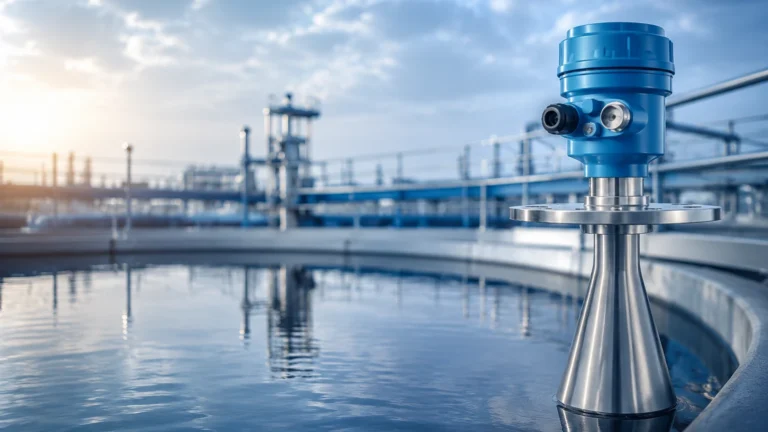
In many industrial applications, analytical measurements like TSS are used in conjunction with level instrumentation to provide a complete picture of tank or vessel status. For example, in a secondary clarifier at a wastewater treatment plant, a Main Page for level measurement might feature ultrasonic or radar sensors to track the water surface, while a TSS analyzer monitors the clarity of the effluent.
Furthermore, sludge blanket level detection is a specialized application where level and TSS intersect. In this scenario, a sensor tracks the interface where the solids concentration reaches a specific threshold. Understanding the TSS profile throughout the water column allows operators to optimize pumping cycles and prevent "washout," where solids are accidentally discharged into the environment.
Key Evaluation Criteria for Selection
Choosing a TSS analyzer requires a thorough assessment of the process environment. A sensor that works perfectly in a drinking water plant will likely fail in a chemical processing facility or a mining slurry line.
Concentration Range
Analyzers are typically optimized for specific ranges. Low-range sensors (0–1,000 mg/L) are suitable for treated effluent or raw water intake. High-range sensors (up to 100,000 mg/L or 10%) are required for thickened sludge, pulp and paper stock, or industrial slurries. Selecting a sensor with the appropriate dynamic range ensures linearity and accuracy.
Particle Characteristics
The size, shape, and color of the suspended solids affect light scattering. For instance, dark particles absorb more light, while crystalline particles scatter light differently than organic flocs. If the process involves significant changes in particle color or size, a dual-wavelength or multi-angle analyzer may be necessary to maintain calibration stability.
Cleaning and Maintenance Requirements
Fouling is the most common cause of failure for optical TSS analyzers. In biological processes, biofilm can grow on the sensor lens within hours. Many industrial TSS analyzers include integrated cleaning systems, such as:
- Mechanical Wipers: A rubber or silicone blade that physically wipes the lens at set intervals.
- Air Blast/Water Jet: High-pressure pulses used to dislodge debris without mechanical contact.
- Ultrasonic Cleaning: High-frequency vibrations that prevent particles from adhering to the sensor surface.
Technical Selection Table
| Feature | Low-Range Immersion | High-Range Backscatter | Flow-Through Cell |
| :— | :— | :— | :— |
| Typical Range | 0–2,000 mg/L | 0–100,000 mg/L | 0–500 mg/L |
| Primary Use | Effluent monitoring | Sludge/Slurry control | Ultra-pure water/Condensate |
| Installation | Tank/Channel (Immersion) | Pipe (Flange) or Tank | Bypass Line |
| Fouling Risk | Moderate | High | Low (if filtered) |
| Common Industry | Municipal Water | Mining / Wastewater | Power / Pharma |

Installation Considerations and Best Practices
Proper installation is as critical as the technology itself. Even the most accurate TSS analyzer will provide misleading data if it is placed in a stagnant zone or an area with excessive air entrainment.
Location and Flow Dynamics
The sensor should be installed in a location where the fluid is well-mixed and representative of the entire process. In open channels, avoid placing the sensor immediately after a bend or a drop where turbulence can create air bubbles. Air bubbles scatter light similarly to solids, leading to false high readings. In pressurized pipes, the sensor should ideally be installed on a vertical upward-flow section to ensure the pipe is always full and to minimize the accumulation of trapped air.
Insertion Depth and Orientation
For immersion probes in tanks, the sensor should be placed at a depth where it is not affected by surface foam or bottom-settled sludge, unless the specific goal is to monitor those layers. The optical face of the sensor should be oriented parallel to the flow direction. This orientation allows the moving fluid to help keep the lens clean and prevents the sensor body from creating a wake that might trap debris.
Calibration Procedures
Unlike temperature or pressure sensors, a TSS analyzer must be calibrated against the specific process fluid it is measuring. This is typically done through a "grab sample" correlation:
1. The analyzer is installed and stabilized.
2. A sample of the process fluid is taken from a point immediately adjacent to the sensor.
3. The sample is analyzed in a laboratory using the standard gravimetric method (filtering, drying at 103–105°C, and weighing).
4. The laboratory value is entered into the analyzer’s transmitter to adjust the slope of the calibration curve.
Limitations and Common Risks
While TSS analyzers are robust, users must be aware of certain physical limitations that can impact data integrity.
1. Color Interference: Significant changes in the color of the liquid (dissolved color) can affect light absorption. If the process liquid changes from clear to dark tea-colored due to dissolved organics, the analyzer may report an increase in TSS even if the particle count remains the same.
2. Particle Size Shifts: Optical sensors are sensitive to the surface area of particles. If a process change causes particles to break down into smaller pieces (increasing total surface area) without changing the total mass, the TSS reading may shift.
3. Scaling and Coating: In chemical processes, calcium carbonate or other minerals can scale onto the optical windows. Mechanical wipers are often ineffective against hard scaling, requiring periodic chemical cleaning with acid.
Frequently Asked Questions (FAQ)
Q: What is the difference between Turbidity and TSS?
A: Turbidity is an optical property—a measure of how much light is scattered by a sample. TSS is a measure of the actual mass of solids per volume of water. While they are related, the correlation changes if the particle size or color changes.
Q: How often does a TSS analyzer need calibration?
A: This depends on the stability of the process. In many municipal applications, a monthly check against a lab sample is sufficient. In volatile industrial processes, weekly verification may be required.
Q: Can a TSS analyzer measure dissolved solids (TDS)?
A: No. TSS analyzers only detect particles that are in suspension. Dissolved solids, such as salts or sugars, do not scatter light in the same way and must be measured using conductivity or refractometry.
Q: What is the maximum temperature for these sensors?
A: Most standard industrial TSS probes are rated for temperatures up to 50°C (122°F). Specialized high-temperature versions with stainless steel bodies and sapphire windows can handle up to 90°C or higher for specific industrial applications.
Conclusion
Implementing a TSS analyzer is a strategic investment for any facility focused on process optimization and environmental stewardship. By providing continuous, actionable data, these instruments allow for the automation of chemical dosing, the protection of filtration membranes, and the assurance that discharge limits are never exceeded. When paired with reliable level measurement systems and a robust maintenance schedule, a TSS analyzer becomes an indispensable tool in the modern industrial toolkit. For those seeking to integrate these technologies into a broader control strategy, consulting a comprehensive resource or Main Page for product specifications is the recommended next step in the engineering process.