Tunable Diode Laser Absorption Spectroscopy
Tunable Diode Laser Absorption Spectroscopy
In the landscape of industrial process monitoring, the ability to measure gas concentrations with high precision, speed, and selectivity is critical for safety, efficiency, and environmental compliance. Tunable Diode Laser Absorption Spectroscopy (TDLAS) has emerged as a premier technology for these requirements. While many industrial facilities focus heavily on liquid and solid storage—utilizing instruments found on the Main Page of instrumentation providers—the gas phase within reactors, stacks, and pipelines requires equally sophisticated analytical tools.
This guide provides a comprehensive technical overview of TDLAS, explaining its underlying physics, practical application criteria, and installation considerations for engineering professionals.
Understanding the Measurement Principle
Tunable Diode Laser Absorption Spectroscopy is based on the principle of infrared absorption. Every gas molecule has a unique set of absorption lines in the electromagnetic spectrum, acting as a "fingerprint." TDLAS leverages this by using a laser as a light source that can be precisely tuned to a specific wavelength corresponding to a single absorption line of the target gas.
The Beer-Lambert Law
The fundamental equation governing TDLAS is the Beer-Lambert Law, which describes the attenuation of light as it passes through a gas medium:
I(ν) = I₀(ν) · exp(-α(ν) · L · C)
Where:
* I(ν): The intensity of the light after passing through the gas.
* I₀(ν): The initial intensity of the laser light.
* α(ν): The absorption coefficient (specific to the gas and wavelength).
* L: The optical path length (the distance the light travels through the gas).
* C: The concentration of the target gas.
By measuring the ratio of the transmitted light to the initial light, and knowing the path length and absorption coefficient, the system can calculate the gas concentration with high accuracy. Because the laser's spectral width is much narrower than the gas absorption line, the measurement is highly selective, virtually eliminating interference from other gases present in the stream.
Direct Absorption vs. Wavelength Modulation Spectroscopy (WMS)
There are two primary methods used in TDLAS:
1. Direct Absorption: The laser wavelength is scanned across the absorption peak, and the resulting dip in intensity is measured directly. This is straightforward but can be sensitive to noise in high-dust environments.
2. Wavelength Modulation Spectroscopy (WMS): A high-frequency modulation is added to the laser scan. By using phase-sensitive detection (lock-in amplification) to extract the second harmonic signal (2f), the system can achieve a much higher signal-to-noise ratio. This allows for the detection of trace gas concentrations at parts-per-billion (ppb) levels.
Key Components of a TDLAS System
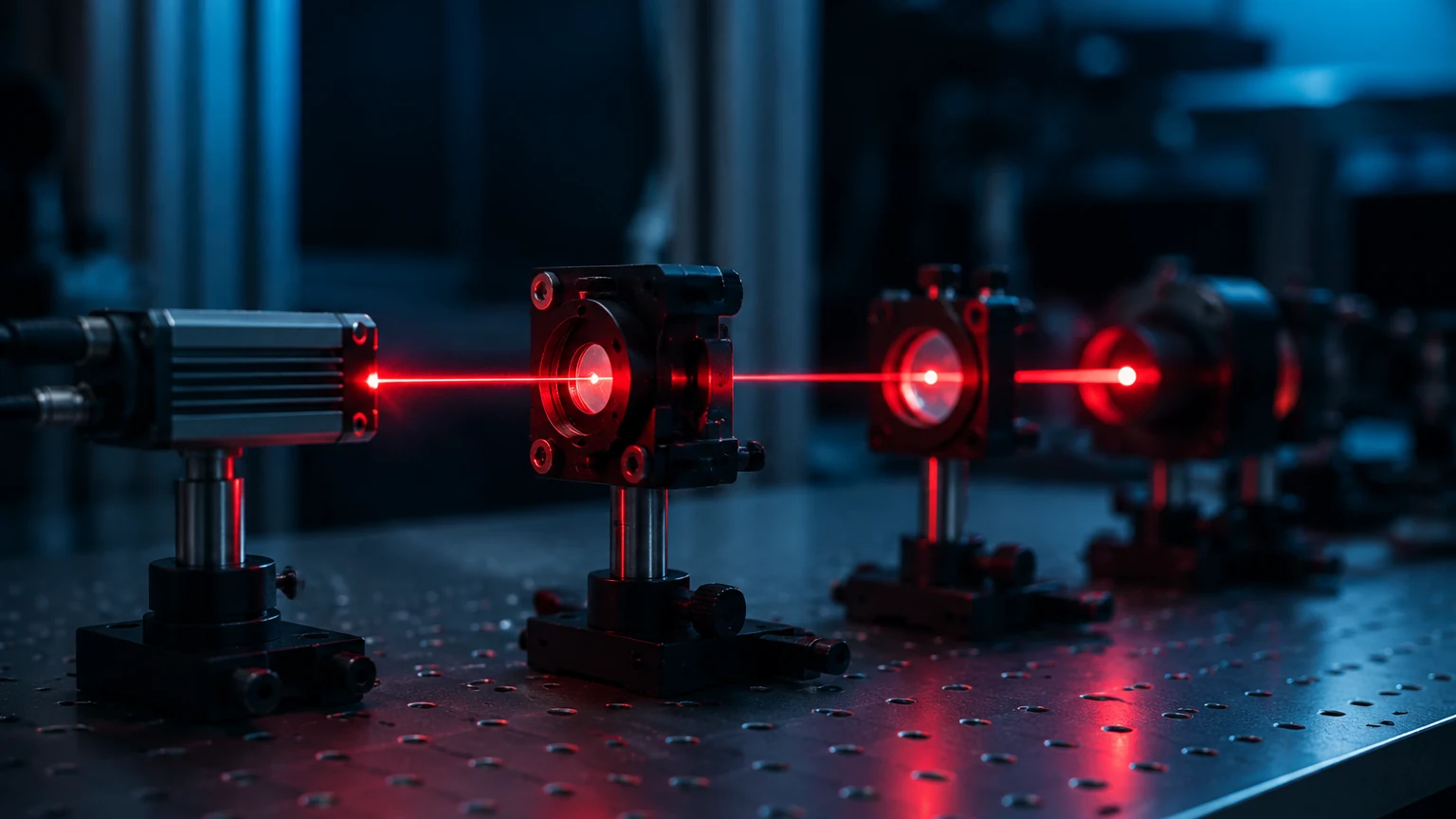
A standard industrial TDLAS analyzer consists of three main modules: the transmitter unit, the receiver unit (in cross-stack configurations), and the electronics/processing unit.
* Tunable Diode Laser: Typically a Distributed Feedback (DFB) or Vertical-Cavity Surface-Emitting Laser (VCSEL). These lasers are chosen for their ability to change wavelength based on the injection current and operating temperature.
* Optical Assembly: Includes lenses to collimate the laser beam and windows to separate the process gas from the sensitive electronics. In many cases, a purge system is used to keep these windows clean.
* Photodetector: Usually an InGaAs or similar semiconductor detector that converts the received light into an electrical signal.
* Signal Processor: An on-board computer that performs the Fast Fourier Transforms (FFT) or curve-fitting algorithms required to extract concentration data from the raw signal.
Industrial Applications and Use Cases
Tunable diode laser absorption spectroscopy is utilized across sectors where rapid response times and non-contact measurement are required.
Combustion Control and Optimization
In large boilers and furnaces, measuring Oxygen (O₂) and Carbon Monoxide (CO) in the flue gas is essential. TDLAS provides real-time data that allows for the adjustment of the air-to-fuel ratio, significantly improving fuel efficiency and reducing emissions. Unlike traditional electrochemical sensors, TDLAS can operate in high-temperature zones (up to 1,500°C) without degradation.
Natural Gas Quality and Safety
In the oil and gas industry, TDLAS is the standard for measuring moisture (H₂O) and Hydrogen Sulfide (H‐S) in natural gas pipelines. These contaminants cause corrosion and must be kept below strict thresholds. The fast response of TDLAS allows operators to shut down valves immediately if a "slug" of contaminated gas is detected.
Chemical Process Monitoring
In reactors where hazardous gases are produced or consumed, TDLAS ensures that concentrations remain within safe limits. Because the measurement is non-contact, the sensors are not poisoned by corrosive chemicals, a common failure mode for catalytic bead or electrochemical sensors.
Comparison with Alternative Technologies
When selecting a gas analysis technology, engineers must weigh the benefits of TDLAS against more traditional methods like Non-Dispersive Infrared (NDIR) or Zirconia sensors.
| Feature | TDLAS | NDIR | Zirconia |
| :— | :— | :— | :— |
| Selectivity | Excellent (No cross-interference) | Moderate (Interference possible) | High (Specific to O₂) |
| Response Time | Fast (< 2 seconds) | Moderate (10–30 seconds) | Fast |
| Maintenance | Low (No moving parts) | Moderate (Filter changes) | High (Cell replacement) |
| Calibration | Stable (Internal reference cells) | Frequent required | Frequent required |
| Installation | In-situ or Extractive | Usually Extractive | In-situ |
| Cost | Higher Initial Investment | Lower Initial Investment | Moderate |
Selection and Specification Criteria
To ensure a successful TDLAS deployment, several technical parameters must be confirmed during the design phase:
1. Target Gas and Range: Define the minimum and maximum concentration expected. TDLAS is excellent for both trace detection (ppm/ppb) and percent-level measurements.
2. Process Temperature and Pressure: Since gas density and absorption line shapes change with temperature and pressure, the analyzer must have integrated compensation sensors or receive these values from the plant's DCS.
3. Optical Path Length: In cross-stack applications, the distance between the transmitter and receiver (typically 0.5m to 10m) determines the sensitivity. Longer paths increase sensitivity but can make alignment more challenging.
4. Dust and Particulate Loading: High levels of dust can attenuate the laser signal. While TDLAS can handle significant transmission loss (often up to 90%), extreme conditions may require a specialized extractive sampling system or high-flow purging.
Installation and Engineering Considerations
Proper installation is the single most important factor in the long-term reliability of a TDLAS system. Engineers should adhere to the following guidelines:
Alignment and Stability
In cross-stack setups, the transmitter and receiver must be perfectly aligned. On large stacks, thermal expansion or mechanical vibration can cause the stack to shift, leading to signal loss. Using heavy-duty mounting flanges and, in some cases, auto-alignment motors can mitigate these risks.
Purging Systems
To prevent process gas from fouling the optical windows, a continuous purge of clean, dry air or Nitrogen (N₂) is required. The purge flow must be sufficient to create a "curtain" of gas that keeps particles away from the glass. It is vital to ensure the purge gas itself does not contain the target analyte (e.g., do not use air purge when measuring O₂).
Temperature and Pressure Compensation
Because the number of molecules in the optical path changes with pressure and temperature (Ideal Gas Law), the analyzer must compensate for these variables to provide a standardized concentration reading. Most modern TDLAS units include inputs for 4-20mA signals from external pressure and temperature transmitters.
Limitations and Potential Risks
While highly advanced, tunable diode laser absorption spectroscopy is not a universal solution for every gas measurement.
* Background Gas Changes: If the composition of the background gas changes drastically (e.g., switching from a Nitrogen-rich to a CO₂-rich environment), the "collisional broadening" effect can change the shape of the absorption peak, requiring recalibration of the broadening coefficients.
* Extreme Opacity: If the process medium is completely opaque to the laser wavelength due to liquid droplets or extremely high dust loads, the signal will be lost. In these scenarios, an extractive system with a heated filter is necessary.
* Cost vs. Complexity: For simple, non-critical applications where high speed is not required, the higher capital cost of TDLAS may not be justified compared to simpler sensors.
Frequently Asked Questions (FAQ)
Q: How often does a TDLAS analyzer need to be calibrated?
A: Unlike electrochemical sensors that drift as the reagent is consumed, TDLAS is inherently stable. Many units feature internal reference cells (containing a known concentration of the target gas) that allow the system to perform automated "line-locking" and health checks. Manual calibration with span gas is typically only required once every 6 to 12 months, depending on local regulations.
Q: Can one TDLAS unit measure multiple gases?
A: A single diode laser can usually only cover a narrow wavelength range, typically sufficient for one gas species. However, multi-channel analyzers are available that house multiple lasers in a single enclosure, allowing for the simultaneous measurement of two or three gases (e.g., CO and H₂O) through the same optical path.
Q: What is the typical lifespan of the laser diode?
A: Industrial-grade DFB lasers used in TDLAS typically have an expected operating life of 10 years or more when operated within their specified temperature ranges.
Conclusion
Tunable Diode Laser Absorption Spectroscopy represents a significant leap forward in gas analysis technology, offering a combination of speed, selectivity, and low maintenance that traditional sensors cannot match. For engineers managing complex industrial processes, integrating TDLAS for gas-phase monitoring—alongside the robust level measurement solutions found on the Main Page—ensures a higher level of process transparency and safety. By carefully considering the optical path, process conditions, and purging requirements, facilities can achieve reliable, long-term performance from their analytical instrumentation.
Download Tunable Diode Laser Absorption Spectroscopy as a PDF