Vega Io
Vega Io
In the modern industrial landscape, the management of bulk solids and liquids has transitioned from manual inspection to sophisticated digital ecosystems. One of the most prominent developments in this field is the integration of level measurement hardware with cloud-based software platforms, often referred to under the umbrella of inventory optimization (IO). Systems such as vega io represent a shift toward the Internet of Things (IoT) in process automation, where the primary goal is not just to measure a level, but to transform that data into actionable logistics and supply chain intelligence.
For process engineers and plant managers, understanding the synergy between field instrumentation and cloud platforms is essential for reducing operational costs and preventing stockouts. This guide explores the engineering principles, selection criteria, and practical implementation of level measurement technologies designed to interface with advanced inventory management systems.
Measurement Principles for Cloud-Integrated Systems
Before a cloud platform like vega io can process data, the physical level must be accurately captured by a sensor. The reliability of the entire digital twin depends on the measurement principle selected for the specific medium and vessel geometry.
Radar Level Measurement (ToF)
Radar sensors, particularly those operating at 80 GHz, are the gold standard for modern IoT integration. They utilize the Time-of-Flight (ToF) principle, emitting high-frequency microwave pulses that reflect off the surface of the medium. The sensor measures the time interval between emission and reception to calculate the distance.
* 80 GHz Technology: The narrow beam angle (often as low as 3 degrees) allows the sensor to avoid internal obstructions like agitators or heating coils. This precision is vital for cloud systems that require clean, noise-free data to generate accurate inventory forecasts.
* 26 GHz Technology: Often used in simpler applications or where larger antennas are required to penetrate heavy foam or steam.
Ultrasonic Level Measurement
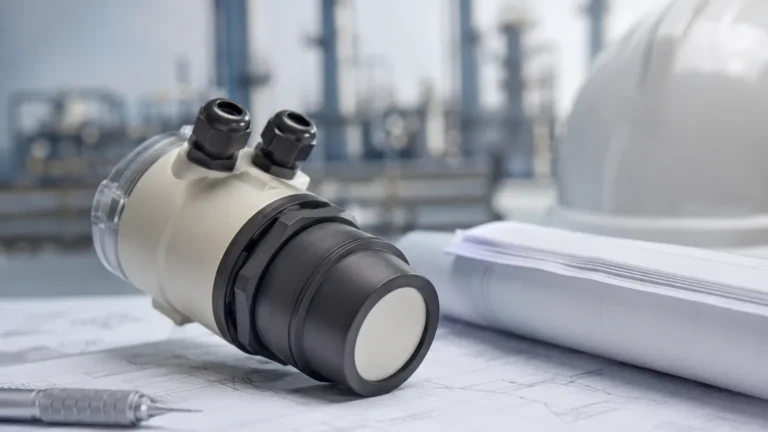
Ultrasonic sensors also use the ToF principle but rely on sound waves rather than microwaves. A transducer emits an ultrasonic pulse that bounces off the surface and returns to the sensor.
While cost-effective, ultrasonic sensors are sensitive to environmental factors. Changes in air temperature, pressure, or the presence of heavy dust and vapors can alter the speed of sound, leading to measurement errors. In an IoT context, these sensors are typically reserved for water treatment or open-air applications where conditions are relatively stable.
Hydrostatic Pressure Measurement
For liquid storage, hydrostatic transmitters measure the pressure exerted by the liquid column. The pressure is directly proportional to the height of the liquid and its density. This method is highly reliable for vented tanks. When integrated into a cloud platform, hydrostatic data is often paired with temperature compensation algorithms to maintain accuracy as fluid density shifts with thermal changes.
The Role of vega io in Inventory Optimization
The term vega io specifically relates to the software and communication infrastructure that bridges the gap between the sensor and the end-user. In a traditional setup, a sensor might output a 4-20mA signal to a local PLC. In an IO-focused setup, the sensor transmits data via cellular (NB-IoT, LTE-M) or satellite links to a centralized server.
Key functions of these systems include:
1. Automated Replenishment: The software monitors levels across multiple sites and automatically generates purchase orders when stock hits a predefined threshold.
2. Geographic Visualization: Users can view a map of all silos and tanks, color-coded by fill level, allowing for optimized delivery routing.
3. Trend Analysis: By analyzing historical consumption rates, the system can predict exactly when a tank will be empty, even if usage fluctuates seasonally.
For organizations looking to implement these capabilities, selecting the right hardware is the first step. You can Review product options and application support to understand which sensors are best suited for digital integration.
Technical Selection Criteria
Choosing a sensor for an IoT-based inventory system requires a different set of priorities than choosing one for a local control loop. Engineers must consider the following factors:
1. Communication Protocol
For remote locations without existing infrastructure, sensors must support wireless protocols. NB-IoT and LTE-M are preferred for their low power consumption and ability to penetrate deep into industrial structures. If the site has a local network, HART or Modbus protocols may be used to feed a gateway that then connects to the cloud.
2. Power Autonomy
Many inventory points are located on remote silos where pulling power cables is cost-prohibitive. Battery-powered sensors or solar-assisted units are common. The frequency of data transmission (e.g., once per hour vs. once per minute) significantly impacts battery life.
3. Media Characteristics
The dielectric constant (dk) of the material is critical for radar. Low-dk materials (like plastic pellets or oils) reflect less energy, requiring high-sensitivity sensors to ensure the cloud platform receives a consistent signal.
Technology Comparison Table
| Feature | 80 GHz Radar | Ultrasonic | Hydrostatic | Level Switch (Point) |
| :— | :— | :— | :— | :— |
| Accuracy | ±1 mm | ±2 mm to 10 mm | ±0.1% of span | N/A (Point only) |
| Range | Up to 120 m | Up to 15 m | Up to 250 m (H2O) | N/A |
| Dust/Vapor Resistance | Excellent | Poor | N/A | Good |
| Power Consumption | Medium | Low | Low | Very Low |
| Best Use Case | Solids silos, chemical tanks | Water/Wastewater | Deep wells, fuel tanks | Overfill protection |
Installation Considerations for IoT Level Sensors
To ensure that a system like vega io functions correctly, the physical installation must adhere to strict engineering guidelines. Even the most advanced cloud software cannot correct for a poorly placed sensor.
* Nozzle Geometry: For radar sensors, the nozzle should be as short as possible. If the nozzle is too long or narrow, it can create "ringing" or false echoes that the sensor might mistake for the material level.
* Dead Zones (Blocking Distance): Every ToF sensor has a dead zone near the antenna where it cannot measure. Ensure the sensor is mounted high enough that the maximum fill level never enters this zone.
* Antenna Alignment: In solids applications, the angle of repose must be considered. Swivel holders are often used to aim the radar beam at the center of the discharge cone to get a representative average of the volume.
* Signal Strength (Wireless): If using cellular-integrated sensors, a signal strength survey should be conducted at the top of the tank. Metal tanks can act as Faraday cages, potentially blocking internal antennas; in such cases, an external antenna must be mounted outside the tank's shadow.

Operational Risks and Limitations
While cloud-based inventory management offers significant advantages, there are inherent risks that must be mitigated during the design phase.
Data Latency and Connectivity
Unlike a hardwired PLC connection, cloud data is not always real-time. If a cellular network goes down, the inventory levels may remain static in the software while the physical level continues to drop. For safety-critical applications, such as preventing a tank overflow, a dedicated high-level switch should always be used as a redundant, hardwired backup.
Cybersecurity
Connecting field devices to the internet introduces vulnerabilities. Encryption (such as TLS) and secure authentication protocols are mandatory. Users should confirm that the platform provider follows industry standards like IEC 62443 for industrial communication security.
Environmental Interference
In outdoor installations, extreme temperatures can affect battery performance and electronic longevity. Sensors should be rated for the ambient temperature range of the location, often requiring sunshades in tropical climates or internal heaters in arctic conditions (though heaters usually require external power).
Frequently Asked Questions (FAQ)
Q: Can I use vega io with sensors from other manufacturers?
A: While most cloud platforms are designed to be ecosystem-specific, many can ingest data from any sensor that outputs standard protocols like HART or 4-20mA via a universal IoT gateway. It is important to verify the compatibility of the data structure and API.
Q: How often should I calibrate a sensor used for inventory management?
A: Radar and ultrasonic sensors are generally maintenance-free as they have no moving parts. However, a yearly verification against a manual tape measure is recommended to ensure no physical shifts in the mounting or buildup on the antenna have occurred.
Q: Is 80 GHz radar always better than 26 GHz?
A: Not necessarily. While 80 GHz offers a narrower beam and better precision, 26 GHz can be more robust in applications with extremely heavy foam or where the antenna needs to be protected by a thick plastic window (process isolation).
Q: What happens if the power fails on a wireless sensor?
A: Most IoT-enabled sensors will send a "low battery" or "heartbeat failure" alert to the cloud platform before they go offline. This allows maintenance teams to replace batteries or check the unit before data is lost.
Conclusion
The integration of level measurement with platforms like vega io is transforming how industries handle bulk materials. By moving from reactive to predictive inventory management, companies can significantly streamline their logistics. However, the success of these digital initiatives relies entirely on the quality of the field instrumentation and the engineering rigor applied during installation. For those starting a new project or upgrading an existing facility, visiting the Main Page is a vital step in selecting the hardware that will serve as the foundation for a reliable inventory optimization system.