Water Flow Meter with Telemetry System
Water Flow Meter with Telemetry System
In modern industrial and municipal water management, the transition from manual meter reading to automated data acquisition has become a standard requirement. A water flow meter with telemetry system integrates physical flow measurement sensors with communication hardware to transmit real-time data to a centralized monitoring platform. This technology allows engineers and plant managers to monitor consumption, detect leaks, and manage distribution networks remotely, significantly reducing operational costs and improving resource efficiency.
For professionals evaluating these systems, understanding the underlying measurement principles and the communication protocols is essential. This guide provides a technical overview of how these systems function, how to select the appropriate technology, and the practical considerations for field installation.
Core Measurement Principles of Water Flow Meters
Before a telemetry system can transmit data, the flow meter must accurately capture the physical volume or velocity of the water. Different applications require different measurement technologies based on water quality, pipe size, and accuracy requirements.
Electromagnetic Flow Measurement
Electromagnetic meters, often referred to as magmeters, operate on Faraday’s Law of Electromagnetic Induction. When a conductive liquid (such as water) flows through a magnetic field generated by the meter, it produces a voltage proportional to the velocity of the fluid.
* Advantages: No moving parts, minimal pressure drop, and high accuracy (typically ±0.5%).
* Requirements: The fluid must have a minimum conductivity, usually >5 μS/cm, and the pipe must be full.
Ultrasonic Flow Measurement
Ultrasonic meters use sound waves to determine flow velocity. There are two primary types: transit-time and Doppler. Transit-time meters send pulses across the pipe; the difference in time between the upstream and downstream pulses is proportional to the flow speed. Doppler meters reflect sound off particles or bubbles in the water.
* Advantages: Non-invasive (clamp-on models available), suitable for large diameters, and capable of measuring non-conductive water (e.g., ultrapure water).
* Requirements: Transit-time requires relatively clean water, while Doppler requires a specific concentration of suspended solids or aeration.
Mechanical (Turbine and Woltman) Measurement
Mechanical meters use a rotating element, such as a turbine or a vertical impeller, that spins at a speed proportional to the flow rate. These are often used in billing applications and simple distribution monitoring.
* Advantages: Low initial cost and no power required for the mechanical register.
* Requirements: Sensitive to debris and wear over time; requires periodic calibration and strainers to protect the internal components.
Telemetry System Components and Communication Protocols
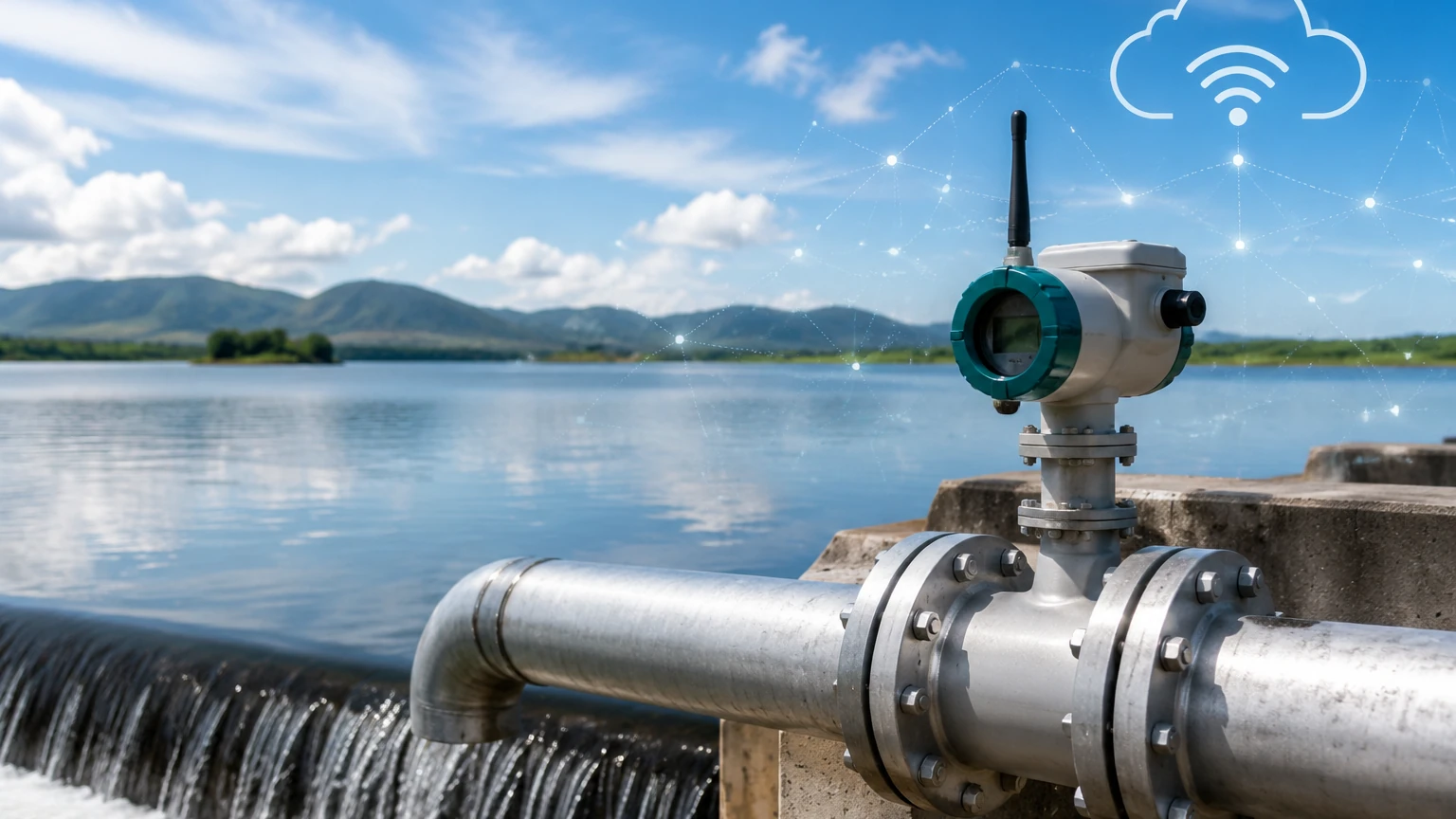
A water flow meter with telemetry system consists of the sensor, a remote terminal unit (RTU) or data logger, and a communication interface. The telemetry layer is responsible for digitizing the pulse or analog signal from the meter and sending it to a server.
Wireless Communication Technologies
1. Cellular (4G/5G/LTE-M): High bandwidth and widespread coverage. Ideal for sites with existing cellular infrastructure. LTE-M and NB-IoT are specifically designed for low-power, long-range industrial IoT applications.
2. LPWAN (LoRaWAN/Sigfox): Low Power Wide Area Networks are excellent for remote areas or deep-underground installations where cellular signals may struggle. They offer extremely low power consumption, allowing batteries to last for several years.
3. Satellite Telemetry: Used in extremely remote locations (e.g., cross-country pipelines or remote irrigation) where no terrestrial network exists. While more expensive, it ensures data continuity in any geographic location.
4. Radio Frequency (RF): Often used for short-range "drive-by" or "walk-by" meter reading or for localized mesh networks within a single facility.
Data Integration and Software
The transmitted data is usually hosted on a cloud platform or an on-premise SCADA system. This software provides visualization tools, trend analysis, and alarm triggers. When selecting a system, it is vital to ensure the hardware is compatible with standard protocols like Modbus RTU/TCP, MQTT, or Profibus to facilitate seamless integration into existing industrial frameworks.
Technical Selection Criteria
Choosing the right water flow meter with telemetry system requires a balance between environmental conditions and data requirements. Use the following table as a preliminary reference for technology selection:
| Feature | Electromagnetic | Ultrasonic (Transit-time) | Turbine/Mechanical |
| :— | :— | :— | :— |
| Best Application | Wastewater, Chemical water | Large diameter, Clean water | Potable water billing |
| Accuracy | ±0.2% to ±0.5% | ±0.5% to ±1.0% | ±1.0% to ±2.0% |
| Moving Parts | None | None | Yes |
| Pipe Size Range | DN10 to DN3000 (0.4" to 120") | DN15 to DN6000 (0.6" to 240") | DN15 to DN500 (0.6" to 20") |
| Power Consumption | Medium to High | Medium | Very Low (Battery) |
| Installation Complexity | Moderate (Requires cutting pipe) | Low (Clamp-on) or Moderate | Moderate |
For a comprehensive range of industrial measurement solutions, including radar and ultrasonic level sensors that complement flow monitoring, users should consult the Main Page of professional manufacturers like Welk to review specific model specifications.
Installation Considerations and Best Practices
The reliability of a telemetry-enabled flow meter depends heavily on the quality of the installation. Even the most advanced telemetry system cannot compensate for poor sensor placement.
Straight Pipe Requirements
Most flow meters require a specific length of straight pipe upstream and downstream of the sensor to ensure a stable, non-turbulent flow profile. A common rule of thumb is "10D Upstream and 5D Downstream," where D is the pipe diameter. For example, a DN100 (4 inch) pipe would require 1000 mm (40 inches) of straight pipe before the meter.
Signal Strength and Antenna Placement
Telemetry units installed in metal pits or underground chambers often face signal attenuation.
* External Antennas: Use high-gain external antennas mounted above ground level or outside of metal enclosures.
* Signal Surveys: Conduct a site survey using a signal strength meter before finalizing the installation point.
Power Management
Remote sites often lack mains power. Options include:
* Internal Lithium Batteries: Suitable for low-frequency reporting (e.g., once or twice per day).
* Solar Power Kits: Necessary for real-time monitoring or high-frequency data transmission (e.g., every 5-15 minutes).
* Loop Power: In some industrial setups, the telemetry unit may be powered by the 4-20mA loop, though this is less common for wireless remote units.
Limitations and Operational Risks
While telemetry systems offer significant advantages, engineers must be aware of their technical limitations:
1. Data Latency: Wireless networks can experience delays. Telemetry is generally not suitable for high-speed closed-loop control but is excellent for monitoring and logging.
2. Environmental Interference: Heavy rain, foliage, or new construction can interfere with wireless signals. Redundant communication paths or local data logging (buffering) are recommended to prevent data loss during outages.
3. Cybersecurity: Any device connected to a network is a potential entry point. It is critical to use encrypted protocols (such as TLS/SSL) and ensure the telemetry hardware supports secure authentication.
4. Maintenance of Sensors: While the telemetry hardware might be robust, the flow sensors themselves may require periodic cleaning, especially in wastewater applications where grease or debris can accumulate on electrodes or impellers.
Frequently Asked Questions (FAQ)
Q: Can a telemetry system be retrofitted to an existing water meter?
A: Yes, many mechanical meters feature a "pulse output" or a magnet on the register. A telemetry data logger can be connected to these outputs to transmit the data without replacing the entire meter.
Q: What is the typical battery life for a remote telemetry unit?
A: Depending on the reporting frequency and the network (e.g., NB-IoT), battery life typically ranges from 3 to 10 years. Reporting data once every 24 hours consumes significantly less power than reporting every 15 minutes.
Q: How does the system handle data if the cellular network goes down?
A: Most industrial-grade telemetry systems include internal memory. They log the data locally with timestamps and "backfill" the data to the server once the connection is restored.
Q: Is a water flow meter with telemetry system suitable for hazardous areas?
A: Yes, but the equipment must be specifically rated (e.g., ATEX or IECEx) for use in explosive atmospheres, which is common in oil and gas or certain chemical processing environments.
Conclusion
Implementing a water flow meter with telemetry system is a strategic investment for any organization looking to digitize their water infrastructure. By selecting the correct measurement principle—whether electromagnetic for high precision or ultrasonic for ease of installation—and pairing it with a robust communication protocol, users can achieve unprecedented visibility into their water systems. Before proceeding with a project, it is recommended to confirm local signal availability, power requirements, and the specific chemical compatibility of the meter materials with the fluid being measured.