What Is a Coriolis Meter
What Is a Coriolis Meter
In the landscape of industrial process control, precision is the primary driver of operational efficiency and safety. Among the various technologies used to quantify fluid movement, the Coriolis meter stands out as one of the most accurate and versatile instruments available. Often referred to as a mass flow meter, it provides direct measurements of mass flow, density, and temperature, making it a cornerstone for complex applications in chemical processing, oil and gas, and water treatment. Understanding what is a coriolis meter requires a deep dive into the physics of the Coriolis effect and its practical application in modern engineering.
While many flow measurement technologies rely on inferential methods—calculating flow based on velocity or pressure drops—the Coriolis meter measures mass directly. This distinction is critical in industries where fluid properties like viscosity and density fluctuate, as mass remains constant regardless of temperature or pressure changes. For engineers managing inventory and process automation, integrating Coriolis technology alongside traditional level measurement systems provides a comprehensive view of material balance.
Measurement Principles of Coriolis Technology
To answer the question of what is a coriolis meter, one must first understand the underlying physics. The device operates on the principle of the Coriolis effect, an inertial force described by Gaspard-Gustave de Coriolis in the 19th century. In an industrial meter, this effect is harnessed within one or more vibrating tubes.
The Coriolis Effect in Motion
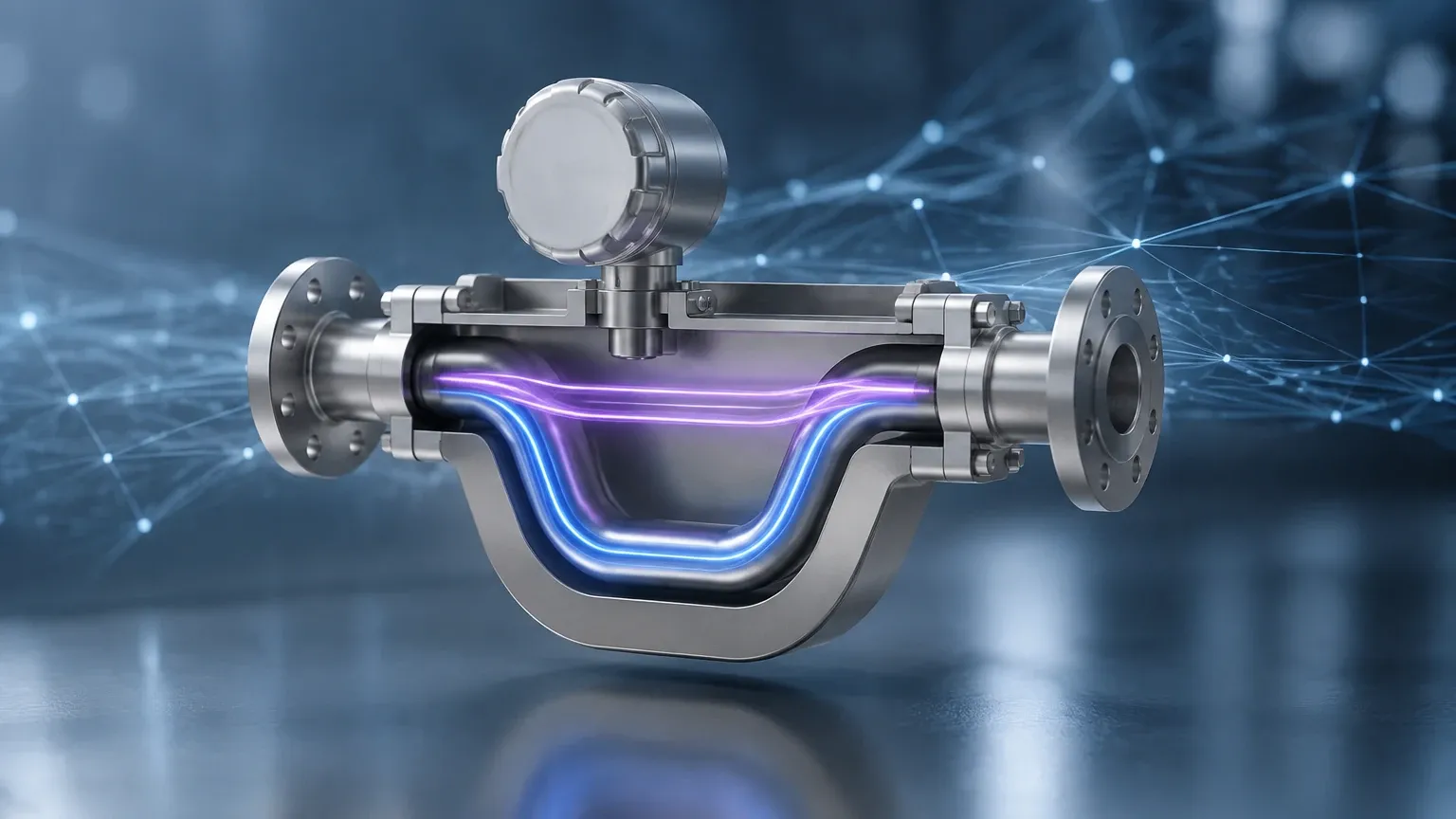
Inside the meter, a drive coil causes the flow tubes to oscillate at their resonant frequency. When there is no flow, the tubes vibrate in a uniform, symmetrical manner. However, when a fluid (liquid or gas) enters the tubes, the mass of the moving fluid introduces an inertial force that resists the vibration.
As the fluid moves toward the point of maximum vibration (the center of the tube loop), it resists being pushed upward or downward, exerting a force against the tube. Conversely, as the fluid moves away from the center, it resists the slowing of its vertical motion. This creates a twisting or "phase shift" in the tube's oscillation.
Quantifying Mass Flow and Density
Sensors located at the inlet and outlet sides of the tubes, known as pick-off coils, detect this phase shift. The time delay between the signals from these two sensors is directly proportional to the mass flow rate. The greater the mass flow, the greater the twist in the tubes, and the larger the phase shift.
Simultaneously, the meter measures fluid density. The resonant frequency at which the tubes vibrate depends on the total mass of the tubes and the fluid inside them. Since the volume of the tubes is fixed, a change in the frequency of oscillation indicates a change in the fluid's density. By combining these measurements with an internal temperature sensor (used to compensate for the thermal expansion of the tubes), a Coriolis meter provides a multi-variable output from a single device.
Key Components and Construction
A Coriolis meter is comprised of two main assemblies: the sensor (the wetted part) and the transmitter (the electronics).
1. Flow Tubes: Usually made of stainless steel (316L), Hastelloy, or titanium to withstand corrosive industrial environments. They can be shaped as U-tubes, triangles, or straight tubes.
2. Drive Coil: An electromagnetic component that maintains the tube oscillation.
3. Pick-off Sensors: Electromagnetic sensors that capture the sine wave generated by the vibrating tubes.
4. Transmitter: The "brain" of the meter that processes the raw signals into digital data, providing outputs via 4-20mA, HART, Modbus, or Profibus.
Practical Selection Criteria
Selecting the right Coriolis meter involves evaluating the specific needs of the process. While they are highly accurate, different tube geometries and sizes are suited to different applications. Engineers must consider the allowable pressure drop, the flow range, and the physical footprint of the device.
Comparison Table: Tube Geometries
| Feature | U-Shaped Tubes | Straight Tubes |
| :— | :— | :— |
| Sensitivity | Extremely high; ideal for low flow rates. | Moderate; requires higher flow for accuracy. |
| Pressure Drop | Higher due to the curved path. | Lower; similar to a standard pipe section. |
| Cleanability | Can be difficult to drain completely. | Excellent; ideal for food/pharma (CIP/SIP). |
| Installation | Requires more space/support. | Compact and easier to fit in tight piping. |
| Vibration Resistance | Generally more robust. | More sensitive to external piping vibration. |
Industrial Applications and Integration
In the context of industrial automation, Coriolis meters are rarely used in isolation. They are frequently integrated into systems where level measurement is also paramount. For example, in a chemical tank farm, a Main Page level transmitter might monitor the total volume of a tank, while a Coriolis meter at the outlet monitors the exact mass of the chemical being dispensed to a reactor.
Oil and Gas
In the oil and gas sector, these meters are used for custody transfer. Because they measure mass directly, they eliminate the need for complex volume-to-mass conversions that are prone to error due to temperature fluctuations in crude oil or natural gas.
Water Treatment and Chemicals
For dosing applications, the high accuracy of the Coriolis meter ensures that expensive chemicals are added in precise amounts. In water treatment, they help in monitoring the density of sludge, providing data that helps optimize the dewatering process.
Installation Considerations
To maintain the high accuracy (often ±0.1% or better) associated with Coriolis technology, proper installation is mandatory. Unlike magnetic or ultrasonic meters, Coriolis meters do not typically require long straight pipe runs upstream or downstream. However, they are sensitive to mechanical stress and external vibration.
* Support and Bracing: The meter must be rigidly supported to ensure that the vibration of the piping does not interfere with the internal oscillation of the tubes. Both the inlet and outlet flanges should be securely anchored.
* Orientation: For liquid applications, the meter is often installed with the tubes pointing downward (the "flag" position or "belly down") to prevent gas bubbles from becoming trapped. For gas applications, the tubes should point upward to prevent condensate buildup.
* Zero Calibration: Upon installation and when the meter is full of the process fluid at operating temperature and pressure, a "zero trim" must be performed. This ensures that the transmitter recognizes a state of zero flow accurately.
Limitations and Common Risks
While discussing what is a coriolis meter, it is important to address its limitations. No instrument is a universal solution, and there are specific scenarios where Coriolis technology may face challenges.
1. Entrained Gas: If a liquid contains significant amounts of undissolved gas (slug flow), the vibration of the tubes can become erratic. This leads to "stalling" or significant measurement errors. Modern transmitters have improved processing to handle minor entrainment, but high gas fractions remain a challenge.
2. Initial Cost: Coriolis meters are generally more expensive than electromagnetic or vortex meters. The ROI must be justified by the need for high accuracy or density data.
3. Pressure Drop: In U-tube designs, the fluid must navigate several bends, which can result in a significant pressure drop across the meter. This must be accounted for in pump sizing.
4. Size Constraints: As pipe diameters increase, Coriolis meters become extremely large, heavy, and expensive. They are most commonly used in line sizes from 2 mm to 250 mm (1/10" to 10").
Coriolis Meters and Level Measurement Synergy
For professional manufacturers like Welk, offering a range of industrial level measurement instruments, the Coriolis meter represents the "flow" side of a complete mass-balance equation. In many industrial automation setups, the data from a radar level sensor and a Coriolis mass flow meter are fed into the same PLC (Programmable Logic Controller).
If a level sensor indicates a drop in tank volume that does not match the mass flow recorded by the Coriolis meter, it can trigger an alarm for a potential leak or a change in fluid density. This synergy is vital for maintaining strict quality control and environmental safety standards in water treatment and chemical plants.
Frequently Asked Questions
Q: Can a Coriolis meter measure the flow of gases?
A: Yes. Coriolis meters are highly effective for gas flow, provided the gas density is high enough to generate a measurable phase shift. They are frequently used in high-pressure gas applications and for compressed natural gas (CNG) dispensing.
Q: Does viscosity affect the accuracy of a Coriolis meter?
A: Generally, no. One of the primary advantages of Coriolis technology is that it is largely independent of viscosity. It can measure everything from water to heavy resins and syrups without requiring recalibration for different fluids.
Q: How long do Coriolis meters typically last?
A: Because there are no moving parts like bearings or gears that can wear out, Coriolis meters have a very long service life. The main factor affecting longevity is the corrosion or erosion of the internal flow tubes by the process fluid.
Q: Is a Coriolis meter better than an ultrasonic flow meter?
A: It depends on the application. Coriolis meters provide higher accuracy and direct mass/density measurement but are more expensive and limited in size. Ultrasonic meters are better for very large pipes and are non-intrusive, but they measure velocity rather than mass.
Conclusion
Defining what is a coriolis meter involves recognizing it as a premier tool for multi-variable fluid analysis. By providing direct mass flow, density, and temperature data, it removes the variables that often plague other measurement technologies. For B2B industrial operations, the investment in Coriolis technology translates to reduced waste, improved product consistency, and enhanced process safety. When paired with reliable level measurement solutions, these instruments form the backbone of modern industrial automation and inventory management. For those looking to optimize their process, it is recommended to Review product options and application support to ensure the selected instrumentation aligns with specific site requirements and fluid characteristics.