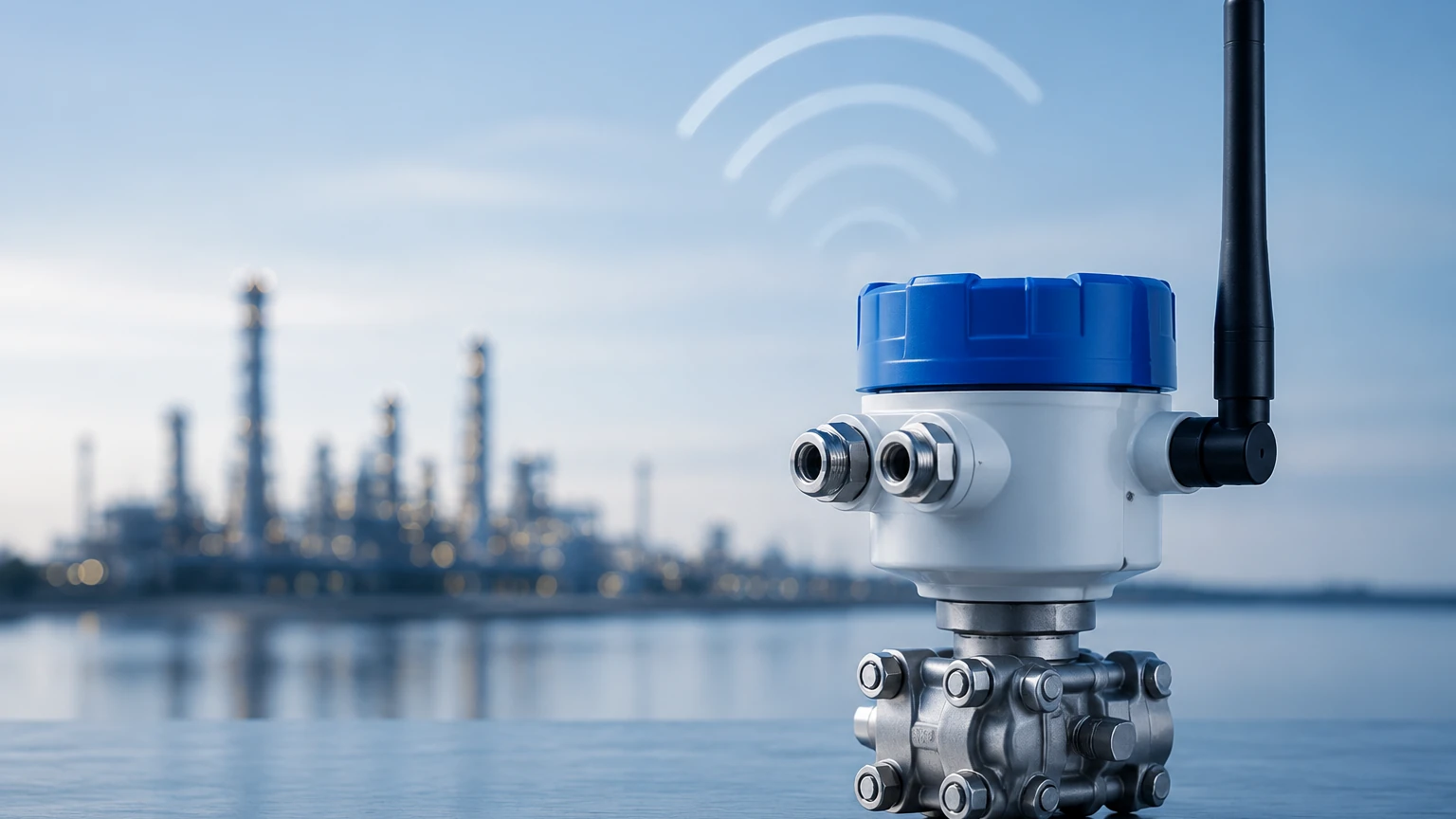
Wireless Differential Pressure Sensor
Wireless Differential Pressure Sensor
In the landscape of industrial automation and process control, the ability to monitor pressure variances across different points in a system is critical for maintaining safety, efficiency, and product quality. A wireless differential pressure sensor serves as a sophisticated instrument designed to measure the difference between two pressure points and transmit that data without the need for extensive physical cabling. This technology has become an essential component for engineers seeking to optimize level measurement, flow rate monitoring, and filter health in complex environments.
Understanding the Principle of Differential Pressure Measurement
Before evaluating the wireless capabilities of these devices, it is necessary to understand the underlying measurement principle. Differential pressure (DP) is defined as the difference in pressure between two distinct points. Unlike gauge pressure, which is measured relative to atmospheric pressure, or absolute pressure, which is measured relative to a vacuum, DP sensors utilize two sensing ports: a high-pressure side (H) and a low-pressure side (L).
Inside the sensor, a sensing element—typically a piezoresistive diaphragm or a capacitive cell—is positioned between these two ports. When there is a difference in pressure, the diaphragm deflects toward the lower pressure side. This mechanical displacement is converted into an electrical signal. In a traditional wired setup, this signal is sent via a 4-20mA loop or digital bus. In a wireless differential pressure sensor, this signal is processed by an onboard microprocessor and transmitted via a radio frequency (RF) module to a gateway or central control system.
For level measurement applications, specifically in pressurized tanks, the DP principle is used to cancel out the head pressure of the gas or vapor space above the liquid. By connecting the high-pressure port to the bottom of the tank and the low-pressure port to the top, the sensor measures only the hydrostatic head of the liquid, providing an accurate level reading regardless of the internal tank pressure.
The Role of Wireless Technology in Process Monitoring
The integration of wireless connectivity into differential pressure sensors addresses several significant challenges in industrial infrastructure. The primary driver for adopting a wireless differential pressure sensor is the reduction in installation costs. In many brownfield sites, the cost of running conduit, trays, and signal wiring can exceed the cost of the instrument itself by a factor of ten, especially if the installation requires crossing roads, railways, or hazardous zones.
Wireless sensors offer:
* Rapid Deployment: Sensors can be installed and commissioned in a fraction of the time required for wired alternatives.
* Scalability: Adding new measurement points to a network does not require additional I/O cards or wiring infrastructure.
* Accessibility: They allow for monitoring in remote or rotating equipment where physical wires would be prone to failure or impossible to install.
These sensors typically operate on standardized industrial protocols such as WirelessHART, ISA100.11a, or LoRaWAN, ensuring data integrity and security in noisy electromagnetic environments.
Key Technical Specifications for Selection
When selecting a wireless differential pressure sensor, engineers must look beyond the wireless protocol and focus on the metrological performance of the device. The following table outlines the primary evaluation criteria for industrial-grade units.
| Specification | Description | Typical Industrial Range |
| :— | :— | :— |
| Measurement Range | The span between the minimum and maximum DP the sensor can detect. | 0-100 Pa to 0-2 MPa |
| Static Pressure Rating | The maximum total pressure the sensor body can withstand without damage. | Up to 40 MPa (400 bar) |
| Accuracy | The degree of conformity to the actual pressure value, including linearity and hysteresis. | ±0.075% to ±0.25% of span |
| Battery Life | The expected duration of the internal power source based on update rates. | 2 to 10 years |
| Update Rate | How frequently the sensor transmits data to the gateway. | 1 second to 60 minutes |
| Ingress Protection | The level of sealing against dust and moisture. | IP66 / IP67 / IP68 |
Selecting the correct range is vital. A sensor with a range that is too wide will lose resolution at lower pressures, while a range that is too narrow may lead to over-pressure damage or frequent "out of range" errors. Many modern units from manufacturers like Welk offer adjustable turndown ratios, allowing a single sensor to be calibrated for various process conditions.
Comparative Analysis of Wireless Protocols
The choice of wireless protocol significantly impacts the performance and reliability of the measurement system. Engineers must balance the need for data frequency against battery longevity and transmission distance.
1. WirelessHART / ISA100.11a: These are mesh-networking protocols specifically designed for process automation. They offer high reliability through path redundancy and are ideal for dense industrial environments where metal structures might block line-of-sight signals.
2. LoRaWAN (Long Range Wide Area Network): This protocol excels in long-distance transmission, often reaching several kilometers. It is highly energy-efficient but is generally limited to lower update rates, making it suitable for environmental monitoring or non-critical tank level tracking.
3. NB-IoT / LTE-M: These cellular-based technologies leverage existing mobile infrastructure. They are useful for widely distributed assets, such as water distribution networks or remote oil wells, where installing a local gateway is not feasible.
Installation Guidelines and Best Practices
Correct installation is paramount to ensuring the accuracy and longevity of a wireless differential pressure sensor. Because these devices are often located in exposed or remote areas, several engineering considerations must be addressed during the design phase.
Impulse Line Configuration
Impulse lines are the small-bore pipes that connect the process to the sensor. For gas applications, the sensor should be mounted above the process tapping points to allow condensate to drain back into the process. Conversely, for liquid or steam applications, the sensor should be mounted below the tapping points to ensure the impulse lines remain filled with fluid and free of trapped air bubbles.
Manifold Valves
A 3-way or 5-way valve manifold should always be used. This allows the sensor to be isolated from the process for maintenance or zero-point calibration without shutting down the entire system. The manifold also protects the sensor from one-sided over-pressure during commissioning.
Signal Optimization
While wireless sensors eliminate signal wires, they still require a clear path for RF transmission. Avoid placing the sensor's antenna directly against large metal surfaces. If the sensor must be installed inside a metal enclosure or a shielded area, an external antenna with a low-loss coaxial cable may be required to reach the gateway.
Industrial Applications: Beyond Simple Pressure
The versatility of the wireless differential pressure sensor allows it to be used as a proxy for other critical process variables.
1. Hydrostatic Level Measurement:
In pressurized vessels, a DP sensor is the standard for level measurement. By compensating for the internal tank pressure, the sensor provides a precise reading of the liquid column height. This is common in chemical reactors and liquefied gas storage. For more information on comprehensive level measurement solutions, you can explore the Main Page of specialized instrument providers.
2. Flow Measurement (Orifice Plate/Venturi):
According to Bernoulli's principle, the square root of the differential pressure across a restriction in a pipe (like an orifice plate) is proportional to the flow rate. Wireless DP sensors are frequently used to monitor flow in steam lines or water distribution systems where power is unavailable.
3. Filter Health Monitoring:
By measuring the pressure drop across a filter or heat exchanger, operators can determine the level of fouling. A sudden increase in differential pressure indicates a clogged filter, allowing for predictive maintenance and preventing system downtime.
Common Risks and Maintenance Requirements
Despite their robustness, wireless differential pressure sensors are subject to specific risks that must be managed.
* Battery Depletion: The most common maintenance task is battery replacement. Factors such as extreme cold, high transmission frequency, and poor signal strength (which causes the radio to work harder) will shorten battery life. Most industrial sensors provide a "low battery" alert via the control system.
* Signal Interference: In environments with heavy electrical machinery or competing wireless networks, signal latency or packet loss can occur. Utilizing mesh networks or frequency-hopping spread spectrum (FHSS) technology helps mitigate these risks.
* Calibration Drift: Like all precision instruments, DP sensors can drift over time due to temperature cycling or mechanical stress. Periodic zero-checks and annual span calibrations are recommended to maintain system integrity.
Information to Confirm Before Implementation
Before finalizing the procurement of a wireless differential pressure sensor, project teams should confirm the following details:
1. Process Compatibility: Ensure the wetted materials (e.g., 316L Stainless Steel, Hastelloy, or Tantalum) are compatible with the process fluid to prevent corrosion.
2. Hazardous Area Certification: If the sensor is to be installed in a potentially explosive atmosphere, it must carry the appropriate ATEX, IECEx, or CSA intrinsic safety ratings.
3. Gateway Capacity: Verify that the existing wireless gateway can support the additional data load and that the sensor is within the effective communication range.
4. Environmental Limits: Check that the operating temperature range of the electronics and the battery matches the installation site's climate, particularly in extreme outdoor environments.
By carefully considering these factors, industrial operators can leverage wireless differential pressure sensors to gain deeper insights into their processes, reduce infrastructure costs, and enhance overall operational safety.