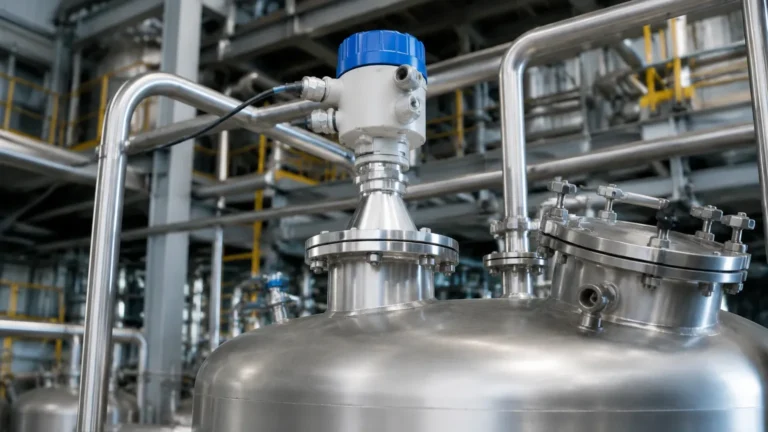
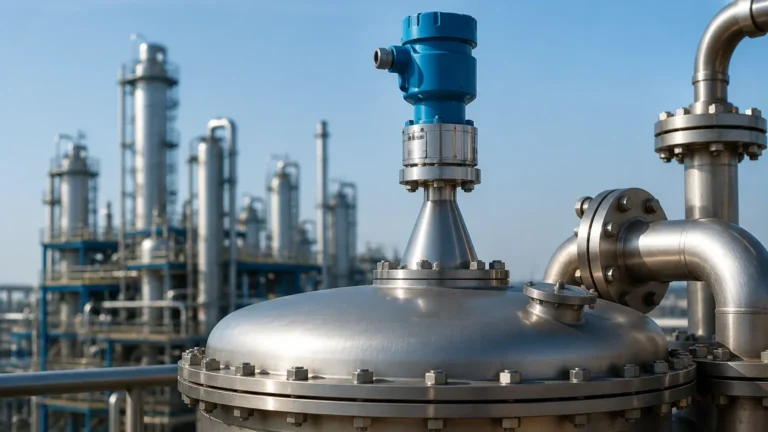
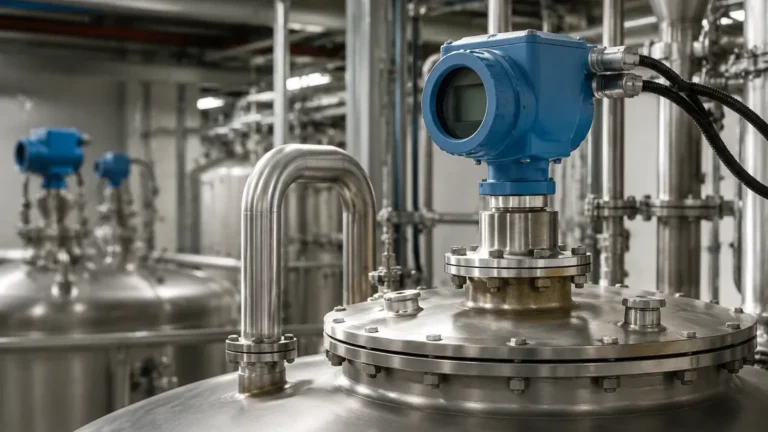
Emerson 3408 Radar Level Transmitter
Emerson 3408 Radar Level Transmitter: Engineering Principles and Application Guide
In the landscape of industrial process automation, precise level measurement is a fundamental requirement for inventory management, process control, and safety. Among the various technologies available, non-contacting radar has emerged as a preferred solution due to its reliability in challenging environments. The Emerson 3408 radar level transmitter represents a significant evolution in this category, utilizing high-frequency Frequency Modulated Continuous Wave (FMCW) technology to provide accurate readings in a variety of liquid and slurry applications.
This guide explores the underlying measurement principles of the Emerson 3408, provides technical selection criteria, outlines installation best practices, and addresses the practical limitations that engineers must consider when deploying Radar Level Meters in industrial settings.
1. Measurement Principles: 80 GHz FMCW Technology
To understand the performance of the Emerson 3408 radar level transmitter, one must first understand the Frequency Modulated Continuous Wave (FMCW) principle. Unlike traditional pulse radar, which measures the time-of-flight of a single microwave pulse, FMCW transmitters emit a continuous signal with a constantly changing frequency.
The FMCW Process
As the signal travels from the antenna to the product surface and back, the frequency of the emitted signal continues to change. By the time the reflection is received, there is a frequency difference between the transmitted and received signals. This difference, known as the "beat frequency," is directly proportional to the distance to the material surface.
The Advantage of 80 GHz
The Emerson 3408 operates at a 78-82 GHz frequency range. This high frequency offers several distinct advantages over legacy 6 GHz or 26 GHz systems:
* Narrow Beam Width: Higher frequencies allow for a much narrower microwave beam using a smaller antenna. This is critical in vessels with internal obstructions like agitators, heating coils, or narrow nozzles, as the beam is less likely to hit these objects and create false echoes.
* Improved Accuracy: The wide bandwidth associated with 80 GHz technology allows for better signal resolution, enabling the transmitter to distinguish between the actual product level and nearby obstacles or the vessel bottom.
* Smaller Process Connections: Because the antenna can be smaller while maintaining a narrow beam, the Emerson 3408 can be installed on smaller nozzles, reducing installation costs and complexity.
2. Technical Specifications and Features
The Emerson 3408 is designed as a versatile, user-friendly transmitter suitable for the chemical, water treatment, and food and beverage industries. Key technical features include:
* Measuring Range: Capable of measuring distances up to 30 meters (98 feet).
* Accuracy: Standard accuracy is typically within ±2 mm (0.08 inches).
* Process Temperature: Designed to handle temperatures ranging from -40°C to +150°C (-40°F to +302°F), depending on the seal and antenna type.
* Pressure Ratings: Suitable for vacuum up to 25 bar (362 psi).
* Connectivity: Supports HART® 7, Bluetooth® wireless technology for remote configuration, and traditional 4-20 mA analog outputs.
Smart Meter Verification
A standout feature of the Emerson 3408 is its integrated diagnostic suite, specifically Smart Meter Verification. This allows operators to verify the health and integrity of the transmitter without interrupting the process or removing the device from the tank. This is a critical factor for industries requiring strict regulatory compliance or those operating in hazardous areas where physical inspections are risky.
3. Engineering Selection Criteria
Selecting the correct configuration for an Emerson 3408 radar level transmitter requires a thorough analysis of the process media and the vessel environment. Engineers should consult the following table for initial selection parameters:
| Parameter | Requirement/Value | Engineering Consideration |
| :— | :— | :— |
| Dielectric Constant (Dk) | Dk > 1.2 | Low Dk fluids (like oils) reflect less energy; higher Dk (water) provides stronger signals. |
| Vessel Height | Up to 30m (98 ft) | Ensure the chosen range covers the full tank depth plus a safety margin. |
| Nozzle Height | < 200 mm (7.8 in) | Long nozzles can cause signal interference; 80 GHz minimizes this but limits still apply. |
| Agitation Level | Moderate to High | Narrow beam 80 GHz radar handles surface turbulence better than lower frequencies. |
| Chemical Compatibility | PFA, PTFE, or Stainless Steel | Match the wetted parts to the corrosivity of the process fluid. |
Material Properties
The Dielectric Constant (Dk) of the medium is the most critical factor in radar selection. If the Dk is very low, the microwave signal may pass through the liquid and reflect off the tank bottom. In such cases, the Emerson 3408’s advanced signal processing algorithms (such as the "bottom projection" feature) are required to maintain a stable reading.
4. Installation and Commissioning Best Practices
Proper installation is paramount to the long-term reliability of any radar level meter. While the 80 GHz technology of the Emerson 3408 is more forgiving than older models, the following constraints must be observed:
Mechanical Positioning
1. Avoid the Center: Never install the transmitter in the exact center of a domed or cylindrical tank. This can cause multiple reflections to converge at the antenna, leading to signal errors.
2. Nozzle Clearance: The antenna should ideally extend slightly beyond the nozzle end to prevent internal nozzle reflections. If the nozzle is long, a nozzle extension or a specific antenna type may be necessary.
3. Obstruction Mapping: Ensure the beam path is clear of ladders, pipes, or inflow streams. If obstructions are unavoidable, use the transmitter’s software to perform a "False Echo Suppression" or "Static Echo Map" to ignore these signals.
Electrical and Communication
The Emerson 3408 features a Bluetooth interface, which allows for commissioning via a smartphone or tablet using the AMS Device Configurator app. This is particularly useful for transmitters mounted on top of tall silos or in areas where access is restricted. However, for permanent integration into a Distributed Control System (DCS), shielded twisted-pair cabling is required to ensure HART signal integrity.

5. Application Limitations and Risk Mitigation
Despite its advanced capabilities, no single technology is a universal solution. Engineers must recognize the following risks when deploying the Emerson 3408:
* Heavy Foam: Dense, thick foam can absorb microwave signals entirely, leading to a "loss of echo." If the foam is light and airy, the radar may see through it to the liquid, but heavy chemical foam remains a challenge. In these instances, a guided wave radar or hydrostatic transmitter might be a better alternative.
* Extreme Vapor and Condensation: While 80 GHz radar is less affected by vapor than ultrasonic sensors, extremely high-pressure steam or heavy condensation on the antenna lens can attenuate the signal. The Emerson 3408 often utilizes a "drip-off" lens design to mitigate condensation buildup.
* Solid Build-up: If the process media is prone to crystallization or heavy coating, the antenna lens must be cleaned regularly. While the 3408 has diagnostics to detect signal degradation due to coating, it cannot physically clear the obstruction.
6. Comparison with Other Radar Level Meters
When evaluating the Emerson 3408, it is helpful to compare it against the broader category of Radar Level Meters. While the 3408 is an excellent general-purpose 80 GHz transmitter, other applications might require different specialized tools:
1. Guided Wave Radar (GWR): For tanks with extremely low dielectric fluids or very heavy foam, GWR uses a physical probe to guide the signal, providing a more robust reflection in difficult conditions.
2. 6 GHz / 26 GHz Radar: In applications involving heavy dust or very large-scale turbulence, lower-frequency radars may sometimes perform better as the longer wavelengths are less affected by small particles or surface ripples.
3. High-Temperature/High-Pressure Specials: For applications exceeding 150°C or 25 bar, specialized heavy-duty radar models with ceramic seals and cooling fins are required.
7. Frequently Asked Questions (FAQ)
Q: Can the Emerson 3408 be used for solids measurement?
A: While primarily designed for liquids and slurries, the 3408 can be used on some fine powders and granules in small silos. However, for large grain silos or heavy dust environments, a dedicated solids radar with a larger antenna and higher power is usually recommended.
Q: How does Bluetooth connectivity affect security?
A: The Bluetooth interface on the Emerson 3408 is designed with industrial security in mind. It requires physical proximity for the initial handshake and uses encrypted communication and password protection to prevent unauthorized access.
Q: What is the "Blocking Distance" for this transmitter?
A: The blocking distance (or Dead Zone) for the Emerson 3408 is minimal, typically around 0 to 100 mm (0 to 4 inches) from the bottom of the antenna. However, for the highest accuracy, it is best to keep the maximum level at least 200 mm (8 inches) away from the antenna.
Q: Does it require a stilling well?
A: In most cases, no. The narrow 80 GHz beam allows the 3408 to operate effectively in open tanks even with some turbulence. Stilling wells are only necessary in cases of extreme foam or when the liquid surface is excessively agitated.
Conclusion
The Emerson 3408 radar level transmitter is a robust, high-precision instrument that leverages 80 GHz FMCW technology to simplify level measurement in complex industrial environments. By providing a narrow beam, high resolution, and advanced diagnostics like Smart Meter Verification, it reduces the engineering effort required for installation and maintenance. However, successful implementation depends on a clear understanding of the process media's dielectric properties, vessel geometry, and potential environmental interferences. When correctly specified and installed, it serves as a reliable cornerstone for modern process control systems.