Radar Level Transmitter Floating Roof Tank
Radar Level Transmitter Floating Roof Tank: Engineering Selection and Application Guide
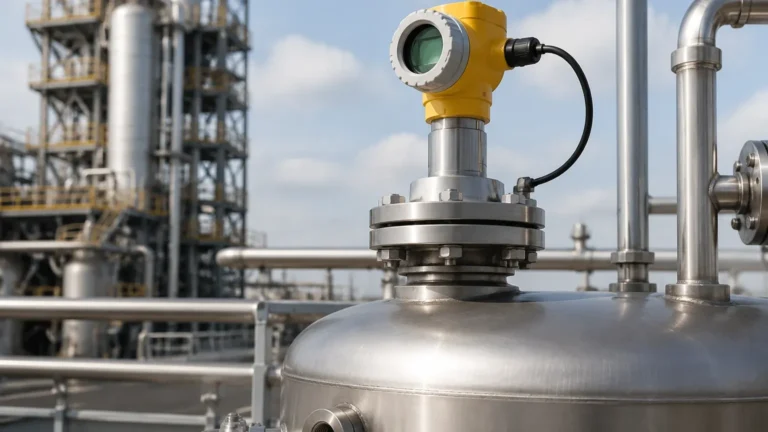
In the large-scale storage of volatile organic compounds (VOCs), crude oil, and refined petroleum products, floating roof tanks (FRTs) are the industry standard for minimizing evaporative losses and enhancing fire safety. However, the presence of a mobile internal or external roof introduces significant complexity to level measurement. Selecting the correct radar level transmitter floating roof tank configuration is essential for accurate inventory management and overfill prevention.
This guide examines the measurement principles, selection criteria, and installation requirements for Radar Level Meters in floating roof applications, providing a technical framework for process engineers and procurement specialists.
Understanding Radar Measurement Principles
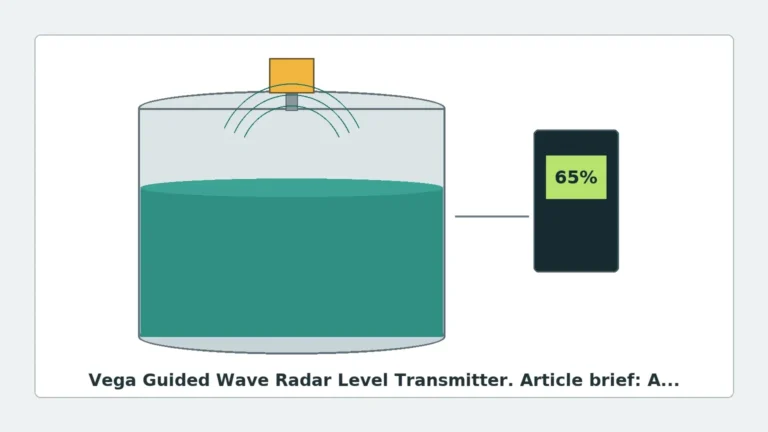
Before selecting a specific instrument, it is critical to understand how radar technology interacts with the unique environment of a floating roof tank. Radar level transmitters operate on the principle of Time of Flight (ToF), where electromagnetic pulses or continuous waves are emitted from an antenna, reflected off a surface, and received back at the sensor.
Frequency Modulated Continuous Wave (FMCW)
Modern industrial radar transmitters, such as those manufactured by Welk, primarily utilize FMCW technology. In this method, the transmitter emits a continuous signal with a constantly changing frequency. The difference in frequency between the emitted and received signal is directly proportional to the distance. FMCW is preferred for floating roof tanks because it offers superior signal processing and higher accuracy (up to ±1 mm) compared to older pulse-based systems.
Pulse Radar
Pulse radar sends short microwave bursts and measures the time interval until the echo returns. While robust, it generally offers lower resolution than FMCW. In the context of a radar level transmitter floating roof tank setup, pulse radar is increasingly being replaced by high-frequency FMCW units due to the latter's ability to filter out noise from tank internals.
Measurement Strategies for Floating Roof Tanks
There are two primary methods for measuring the level in a floating roof tank: measuring the roof itself or measuring the liquid level through a stilling well.
1. Direct Measurement of the Floating Roof
In this configuration, the radar is mounted on the fixed roof (for internal floating roof tanks) or a gantry. The radar signal reflects off the top surface of the floating roof.
* Advantage: Simple installation; no contact with the product.
* Limitation: The measurement reflects the position of the roof, not necessarily the liquid level. If the roof tilts or if there is product accumulation on top of the roof (buoyancy changes), the reading may be inaccurate.
2. Measurement via Stilling Well (Guide Pole)
This is the most common method for both internal and external floating roof tanks. The radar is mounted atop a vertical pipe (stilling well) that penetrates the floating roof. The radar signal travels down the pipe and reflects off the liquid surface inside the well.
* Advantage: Provides a direct liquid level measurement. The pipe acts as a waveguide, concentrating the signal and shielding it from foam, turbulence, and the movement of the roof.
* Limitation: Requires precise vertical alignment and specialized antenna selection to avoid signal interference from the pipe walls.
Selection Criteria for Radar Level Transmitters
When specifying a radar level transmitter floating roof tank system, several technical factors must be evaluated to ensure long-term reliability.
Frequency Selection: 26 GHz vs. 80 GHz
* 26 GHz Radar: Traditionally used for stilling well applications. The longer wavelength is less sensitive to small deposits on the pipe wall but has a wider beam angle, which can lead to interference if the stilling well is not perfectly smooth.
* 80 GHz Radar: The current state-of-the-art. 80 GHz units offer a very narrow beam angle (often as low as 3°). This allows the signal to pass through narrow nozzles and stay clear of the stilling well's internal welds or slots, significantly reducing "false echoes."
Material Compatibility and Hazardous Areas
Floating roof tanks usually store flammable liquids. Transmitters must carry ATEX, IECEx, or equivalent explosion-proof certifications. For corrosive environments, such as sour crude or chemical storage, antenna faces should be constructed from PTFE or PEEK, with housing materials typically being 316L stainless steel.
Accuracy and Repeatability
For custody transfer applications, high-precision radar with an accuracy of ±1 mm to ±2 mm is required. For standard process monitoring, ±3 mm to ±5 mm is often sufficient.
Technical Comparison: Radar Options for FRTs
| Feature | 26 GHz FMCW Radar | 80 GHz FMCW Radar | Guided Wave Radar (GWR) |
| :— | :— | :— | :— |
| Beam Angle | 8° – 12° | 3° – 6° | N/A (Contacting) |
| Stilling Well Suitability | Good (standard pipes) | Excellent (narrow/slotted) | Limited (probe length) |
| Accuracy | ±2 mm to ±5 mm | ±1 mm | ±2 mm |
| Mounting Nozzle | ≥ 50 mm (2") | ≥ 20 mm (¾") | ≥ 50 mm (2") |
| Maintenance | Low | Very Low | Moderate (cleaning probe) |

Installation Considerations and Constraints
Proper installation is the single most important factor in the performance of a radar level transmitter floating roof tank application.
Stilling Well Requirements
If measuring through a stilling well, the pipe must be:
1. Vertical: A deviation of more than 1° can cause the signal to hit the pipe wall repeatedly, degrading the echo.
2. Smooth: Internal welds must be ground flush. Any burrs or sharp edges will create parasitic reflections.
3. Vented: Stilling wells in floating roof tanks often have slots or holes to allow the liquid level inside the pipe to equalize with the tank level. The radar signal can interact with these slots; using a high-frequency (80 GHz) radar helps minimize this interaction.
Nozzle Positioning
The transmitter should be mounted away from the tank wall to avoid interference. Ideally, the nozzle height should be kept to a minimum to prevent the "ringing" effect where the signal bounces within the nozzle before entering the tank or pipe.
Environmental Protection
For external floating roof tanks, the transmitter is exposed to the elements. A sunshade or weather shield is recommended to prevent temperature-induced electronics drift and to protect the unit from direct impact during heavy rain or hail.
Application Risks and Limitations
While Radar Level Meters are highly reliable, certain conditions can impact their performance in floating roof environments:
* Heavy Wax or Paraffin Buildup: In crude oil tanks, wax can accumulate on the inside of stilling wells or on the antenna. While 80 GHz radar can often "see through" thin films, heavy buildup will eventually attenuate the signal.
* Roof Tilting: If the floating roof does not move perfectly horizontally, it can jam against the stilling well or the tank shell. Radar can detect the level, but it cannot always diagnose a mechanical roof failure unless multiple units are used to compare levels at different points.
* Vapor Space Dielectric: High-pressure tanks with heavy gas blankets can change the speed of the radar signal. While rare in standard atmospheric FRTs, this requires compensation in high-pressure storage.
FAQ for International Buyers
Q: Can a radar transmitter measure the level if the roof is submerged?
A: If the radar is aimed at the roof and the roof sinks, the radar will measure the top of the liquid (or the sunken roof). If measuring via a stilling well, the radar will continue to measure the liquid level regardless of the roof's status, which is a primary safety advantage.
Q: Is it necessary to take the tank out of service for installation?
A: For stilling well installations, if a nozzle and well already exist, the radar can often be installed while the tank is in service (hot work permits notwithstanding). Direct measurement radars can also be installed on existing manways.
Q: How does the dielectric constant (DC) of the liquid affect the measurement?
A: Radar requires a reflection. Liquids with a low DC (like LPG or certain refined oils) reflect less energy. However, in a stilling well, the signal is concentrated, allowing radar to accurately measure liquids with a DC as low as 1.4.
Q: What information should I provide to Welk for a customized quote?
A: You should provide the tank height, product type (and its dielectric constant), operating temperature/pressure, stilling well diameter (if applicable), and the required hazardous area certifications.
Conclusion
Implementing a radar level transmitter floating roof tank solution requires a balance between precision engineering and practical site constraints. For most modern applications, an 80 GHz FMCW radar mounted on a stilling well provides the highest level of accuracy and the lowest maintenance requirements. By understanding the interaction between the electromagnetic signal and the tank's mechanical structure, operators can ensure reliable inventory data and enhanced safety for their bulk storage assets.
For technical specifications and model selection, engineers should consult with experienced manufacturers like Welk to match the instrument's capabilities to the specific chemical and physical properties of the stored medium.
Download Radar Level Transmitter Floating Roof Tank as a PDF