Radar Level Transmitter vs Ultrasonic
Radar Level Transmitter vs Ultrasonic: A Practical Engineering Guide
In the field of industrial process control, selecting the correct non-contact level measurement technology is critical for operational safety, inventory accuracy, and maintenance efficiency. The debate between radar level transmitter vs ultrasonic sensors is a frequent challenge for instrumentation engineers. While both technologies utilize "time-of-flight" principles to determine the distance to a material surface, their underlying physics—electromagnetic waves versus mechanical sound waves—dictate their performance in specific environments.
This guide examines the measurement principles, selection criteria, and installation requirements for both technologies, providing the technical framework necessary to specify the right instrument for your application.
Understanding the Measurement Principles
Before comparing the two technologies, it is essential to understand how each interacts with the process environment.
Ultrasonic Level Measurement
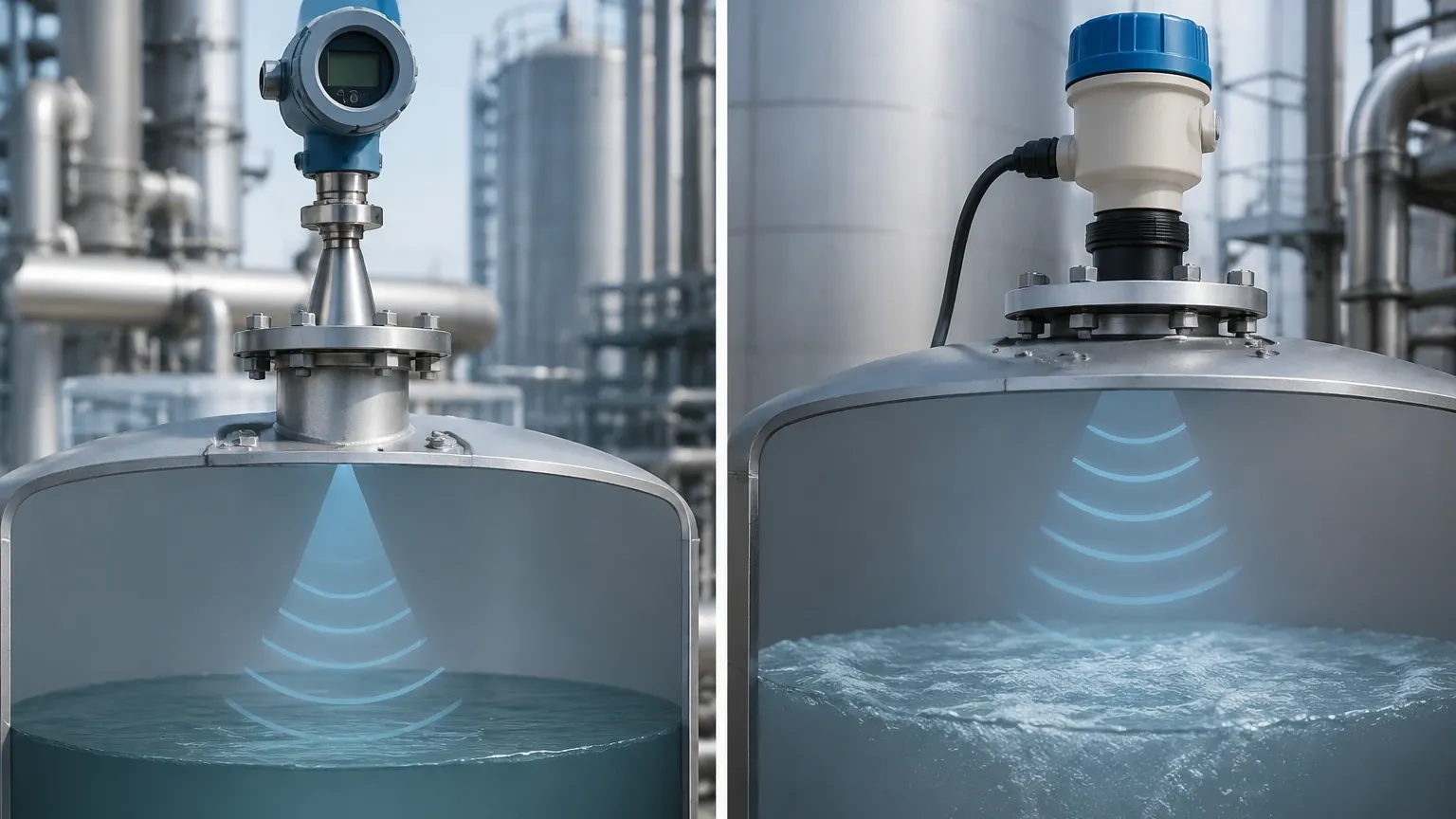
Ultrasonic sensors operate using high-frequency sound waves (mechanical energy). A piezoelectric transducer within the sensor head emits a pulse of sound that travels through the air space in a tank, reflects off the surface of the liquid or solid, and returns to the transducer. The instrument measures the time elapsed between the emission and the reception of the echo.
Because sound requires a medium (typically air) to travel, the speed of the pulse is directly influenced by the density, temperature, and composition of that medium. To maintain accuracy, ultrasonic sensors usually include an integrated temperature sensor to compensate for changes in the speed of sound.
Radar Level Measurement
Radar Level Meters utilize electromagnetic waves, typically in the microwave spectrum (ranging from 6 GHz to 80 GHz). Unlike sound, electromagnetic waves do not require a physical medium and travel at the speed of light.
There are two primary types of radar technology used in level measurement:
1. Pulse Radar: Similar to ultrasonic, it sends a burst of energy and measures the time-of-flight.
2. FMCW (Frequency Modulated Continuous Wave): The transmitter emits a continuous signal with a varying frequency. The difference in frequency between the emitted signal and the reflected signal is proportional to the distance.
Because radar waves are unaffected by air temperature, pressure, or vacuum, they provide a highly stable measurement in complex process conditions.
Radar Level Transmitter vs Ultrasonic: Key Differences
When evaluating a radar level transmitter vs ultrasonic, engineers must consider how the physical properties of the application will affect signal integrity.
| Feature | Ultrasonic Sensors | Radar Level Meters |
| :— | :— | :— |
| Medium of Travel | Sound waves (requires air/gas) | Electromagnetic waves (vacuum-capable) |
| Effect of Temperature | High (requires compensation) | Negligible |
| Effect of Pressure | Limited to ~0.3 MPa (3 bar) | High (up to 4 MPa or higher) |
| Vapor/Steam Impact | Significant (attenuates signal) | Minimal impact |
| Dust/Powder Impact | High (blocks sound waves) | Low (penetrates dust) |
| Surface Foam | Often absorbs signal | Absorbs or reflects depending on foam type |
| Cost | Lower initial investment | Higher, but decreasing |
| Measurement Range | Typically up to 15m (49 ft) | Up to 30m, 70m, or 120m (393 ft) |
Technical Selection Criteria
1. Process Atmosphere
Ultrasonic sensors are highly sensitive to the atmosphere between the sensor and the product. If the tank contains heavy steam, chemical vapors, or dust, the sound waves will be scattered or absorbed, leading to signal loss. Radar waves, however, pass through these vapors with almost no attenuation, making them the preferred choice for chemical reactors and volatile storage.
2. Dielectric Constant (εr)
For radar measurement, the reflectivity of the material depends on its dielectric constant. Materials with high dielectric constants (like water, εr ≈ 80) reflect radar signals very well. Hydrocarbons and oils (εr < 2.5) are more difficult to measure and require sensitive radar electronics or guided wave radar. Ultrasonic sensors do not depend on dielectric properties; they depend on the mechanical density of the surface to reflect the sound wave.
3. Vacuum and Pressure
Sound cannot travel in a vacuum. Therefore, ultrasonic sensors cannot be used in vacuum tanks. Furthermore, high pressure changes the density of the air, significantly altering the speed of sound and causing measurement errors. Radar is the standard for high-pressure or vacuum vessels because electromagnetic waves are independent of these variables.
4. Accuracy and Beam Angle
Modern 80 GHz Radar Level Meters offer very narrow beam angles (as tight as 3 degrees). This allows the signal to avoid internal tank obstructions like agitators, ladders, or heating coils. Ultrasonic sensors typically have wider beam angles (10 to 15 degrees), which increases the risk of interference from tank walls and internal structures.
Installation Considerations and Constraints
Regardless of the technology chosen, proper installation is the most significant factor in long-term reliability.
The Blocking Distance (Dead Zone)
Every non-contact sensor has a "blocking distance" or "dead zone" immediately below the transducer. For ultrasonic sensors, this is usually 0.25m to 0.8m (10" to 31"), depending on the frequency. For radar, the dead zone is often much smaller, sometimes as little as 0.05m (2"). The material level must never enter this zone, or the sensor will provide an erratic or "frozen" reading.
Nozzle Geometry
The mounting nozzle should be as short as possible. If the nozzle is too long or too narrow, the signal (either sound or microwave) will reflect off the nozzle walls before reaching the process, creating a "false echo." For radar, the antenna should ideally extend slightly past the bottom of the nozzle.
Obstruction Management
* Agitators: If a tank has an agitator, the sensor should be mounted where the beam does not hit the blades directly. Radar transmitters often include "False Echo Suppression" software to learn and ignore static reflections from internal structures.
* Inflow: Never mount the sensor directly above the fill pipe. The turbulence and the falling stream will disrupt the signal.
Application-Specific Recommendations
When to choose Ultrasonic:
* Open Channels: Monitoring flow in flumes and weirs.
* Water Treatment: Sump pits, clear water storage, and chemical tanks with no vapor.
* Cost-Sensitive Projects: Where the environment is stable and the budget is limited.
When to choose Radar:
* Chemical Storage: Acids or solvents that produce vapor.
* Solids and Powders: Cement silos, grain elevators, or plastic pellets where dust is prevalent.
* High-Temperature Processes: Bitumen, molten metals, or pressurized steam vessels.
* Long-Range Requirements: Any tank taller than 15 meters (49 feet).
Limitations and Risks
While radar is often seen as the "superior" technology, it is not without limitations. The primary risk in radar applications is the "low dielectric" limit. If a material has an extremely low εr, the radar signal may pass right through it and reflect off the bottom of the tank instead. In these cases, Guided Wave Radar (GWR) or specialized high-sensitivity pulse radar is required.
For ultrasonic sensors, the biggest risk is temperature stratification. If the air temperature at the top of the tank is significantly different from the air temperature near the liquid surface, the calculated distance will be incorrect despite temperature compensation at the sensor head.
Buyer’s Checklist: Information to Confirm Before Purchase
When sourcing equipment from a manufacturer like Welk, international buyers should provide the following technical data to ensure the correct instrument is supplied:
1. Medium Name: Is it liquid, slurry, or solid? Is it corrosive?
2. Dielectric Constant: (For radar) If unknown, describe the material (e.g., "diesel fuel" or "dry sand").
3. Process Temperature and Pressure: Provide both normal operating and maximum design limits.
4. Measurement Range: The total height of the tank and the required "zero" point.
5. Connection Type: Flange size (DN/ANSI) or thread type (G/NPT).
6. Output Requirements: 4-20mA, HART, RS485 Modbus, or Profibus.
7. Tank Geometry: Provide a drawing showing the location of agitators, ladders, and the fill pipe.
Frequently Asked Questions (FAQ)
Q: Can I use an ultrasonic sensor for diesel fuel?
A: While it is possible, it is not recommended if the tank is enclosed. Diesel produces vapors that can change the speed of sound, and it is a flammable environment. An intrinsically safe radar level transmitter is a much more reliable and safer choice.
Q: Does radar work on foam?
A: It depends on the foam. Dry, airy foam may be transparent to radar, allowing it to measure the liquid level underneath. Thick, dense, or wet foam may reflect the radar signal, measuring the top of the foam. If foam is a major factor, testing or Guided Wave Radar is often necessary.
Q: Is 80 GHz radar always better than 26 GHz?
A: Not necessarily. 80 GHz radar offers a narrower beam and is better for small tanks or avoiding obstructions. However, 26 GHz radar is often more robust in applications with heavy condensation or antenna buildup.
Q: Why is my ultrasonic sensor reading 'Full' when the tank is empty?
A: This is often caused by "ringing" or a reflection within the mounting nozzle. Ensure the sensor is not mounted too close to the tank wall and that the nozzle is not excessively long.
Conclusion
The choice between radar level transmitter vs ultrasonic is no longer just about cost. As radar technology has become more affordable, its superior accuracy and immunity to environmental factors have made it the industry standard for most process applications. However, ultrasonic sensors remain a highly effective and economical solution for simple water and wastewater applications. By understanding the physics of the measurement and the constraints of the installation environment, engineers can select the most reliable level measurement solution for their specific industrial needs.