Siemens Radar Level Transmitter Lr100
Siemens Radar Level Transmitter LR100: A Technical Engineering Guide to High-Frequency Level Measurement
In the landscape of industrial automation, the demand for precise, non-contact level measurement has led to the rapid evolution of radar technology. Among the various solutions available, the siemens radar level transmitter lr100 represents a significant shift toward high-frequency, compact instrumentation. This article provides a comprehensive technical analysis of the SITRANS LR100, its operating principles, application engineering considerations, and how it fits into the broader category of Radar Level Meters used in modern process industries.
Understanding the Measurement Principle: 80 GHz FMCW Technology
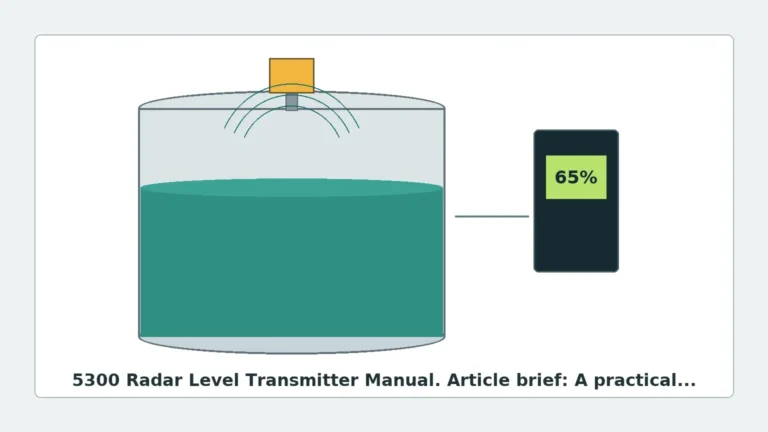
Before selecting a specific instrument, it is essential to understand the underlying physics of the measurement. The Siemens LR100 utilizes Frequency Modulated Continuous Wave (FMCW) technology operating at the 80 GHz frequency band.
FMCW vs. Pulse Radar
Traditional radar level meters often used pulse-based time-of-flight (ToF) measurement, where a short microwave pulse is emitted and the time taken for the reflection to return is measured. While effective, pulse radar often struggles with signal noise and requires larger antennas to maintain a focused beam.
FMCW radar, conversely, emits a continuous signal with a constantly changing frequency. The difference between the frequency of the emitted signal and the reflected signal (the "beat frequency") is directly proportional to the distance to the material surface.
The Advantage of 80 GHz
The shift from lower frequencies (e.g., 6 GHz or 26 GHz) to 80 GHz offers several engineering advantages:
1. Narrow Beam Angle: The LR100 features a very narrow beam angle (typically around 8 degrees). This allows the signal to avoid internal tank obstructions such as ladders, agitators, or heating coils, which would otherwise cause false echoes.
2. Smaller Antenna Size: Higher frequencies allow for much smaller antenna structures. The LR100 is designed with a compact PVDF encapsulated antenna, making it suitable for small vessels and tight mounting spaces.
3. Higher Resolution: The wider bandwidth available at 80 GHz improves the resolution and accuracy of the level measurement, even when measuring materials with low dielectric constants.
Technical Specifications and Selection Criteria
When evaluating the siemens radar level transmitter lr100 for an industrial project, engineers must match the device specifications to the process conditions. The LR100 is primarily designed for liquid level measurement in open or closed vessels.
Key Performance Parameters
| Feature | Specification |
| :— | :— |
| Measurement Range | Up to 8 meters (26.25 ft) |
| Frequency | 80 GHz FMCW |
| Beam Angle | 8° |
| Accuracy | ±5 mm (0.2 inches) |
| Process Temperature | -40°C to +60°C (-40°F to +140°F) |
| Process Pressure | -1 to 3 bar (-14.5 to 43.5 psi) |
| Output Signal | 4-20 mA loop powered |
| Enclosure Material | PVDF (Polyvinylidene Fluoride) |
| Ingress Protection | IP66 / IP68 |
Selection Considerations for International Buyers
For B2B procurement, the LR100 is often compared against other Radar Level Meters in the market. Buyers should confirm the following before finalizing a purchase:
* Chemical Compatibility: The wetted parts are made of PVDF. Ensure this material is compatible with the stored liquid (e.g., water, mild acids, or oils).
* Communication Requirements: The LR100 is a basic 2-wire 4-20 mA device. If HART, Modbus, or Profibus communication is required, higher-tier models in the Siemens LR series or equivalent industrial transmitters may be necessary.
* Configuration Tools: The LR100 is often configured via Bluetooth using the SITRANS mobile IQ app. Engineers must ensure that mobile devices are permitted in the installation area, especially in hazardous zones.
Installation Guidelines and Constraints
Correct installation is the most critical factor in ensuring the reliability of a radar level transmitter. Even advanced 80 GHz systems can fail if basic geometric principles are ignored.
1. Mounting Location
The transmitter should be mounted at least 200 mm (approx. 8 inches) away from the vessel wall. Mounting too close to the wall can cause the radar beam to reflect off the side of the tank, leading to signal interference.
2. Nozzle Design
If the LR100 is mounted on a nozzle, the nozzle should be as short as possible. The end of the transmitter's sensor should ideally extend slightly past the nozzle opening into the tank to prevent "ringing" or internal reflections within the pipe. For the LR100, which has an integrated antenna, the nozzle height should not exceed the diameter significantly.
3. Avoiding Obstructions
Despite the narrow 8-degree beam, the signal path must remain clear of obstructions. If an agitator is present, the transmitter should be positioned where the beam does not hit the blades. If this is unavoidable, the software's "Auto False Echo Suppression" feature must be mapped while the tank is empty to ignore these static reflections.
4. Dead Zone (Blocking Distance)
Every radar meter has a minimum distance from the sensor face where measurement is not possible. For the LR100, this is typically around 250 mm (10 inches). The maximum fill level of the tank must be calibrated to stay below this dead zone to avoid erratic readings when the tank is full.
Application Risks and Limitations
While the siemens radar level transmitter lr100 is a robust tool, certain industrial environments pose challenges that may require additional engineering controls or alternative technologies.
Condensation and Buildup
In applications involving hot liquids, steam can condense on the sensor face. While the 80 GHz signal can penetrate thin films of condensation, heavy droplets or crystalline buildup can attenuate the signal. The PVDF face of the LR100 is designed to be non-stick, but regular inspection is recommended in high-vapor applications.
Surface Turbulence and Foam
Heavy foam acts as an absorber for radar signals. If the foam is dense and thick, the radar signal may reflect off the top of the foam rather than the liquid surface, or it may be lost entirely. In cases of extreme turbulence (e.g., near an inflow pipe), the signal may scatter. Using a stilling well can mitigate these issues, though it adds complexity to the installation.
Low Dielectric Constants
Radar relies on the dielectric constant (εr) of the material to reflect the signal. Water has a high εr (~80), making it an excellent target. Hydrocarbons and oils have much lower εr values (1.9 to 4.0). While 80 GHz technology is highly sensitive, measuring materials with εr < 2.0 at the maximum range of 8 meters may require careful calibration and a stable surface.

Comparison: LR100 vs. Industrial Alternatives
In many B2B scenarios, the LR100 is selected for its cost-effectiveness in basic water and wastewater applications. However, for complex chemical processing or high-pressure oil and gas applications, other Radar Level Meters may be more appropriate.
| Application Requirement | LR100 Suitability | Alternative Recommendation |
| :— | :— | :— |
| Basic Water Storage | Excellent | N/A |
| High Pressure (>3 bar) | Not Suitable | Guided Wave Radar or High-Pressure Radar |
| Extreme Temp (>60°C) | Not Suitable | Transmitters with cooling fins/remote electronics |
| Solids/Powders | Limited (Short range) | Dedicated Solids Radar (e.g., LR500 series) |
| Hazardous Areas (Ex) | Available (Check Certs) | Intrinsically Safe (IS) rated models |
Practical Maintenance and Troubleshooting
Industrial instrumentation requires a lifecycle management plan. For the LR100, maintenance is minimal due to the lack of moving parts, but troubleshooting usually follows these steps:
1. Check the Loop Current: Ensure the 4-20 mA loop has adequate voltage (typically 12-35V DC). A low voltage can cause the device to reboot or provide intermittent signals.
2. Verify Echo Profile: Using the Bluetooth interface, view the echo profile. A healthy signal shows a sharp peak at the material surface. A flat line or multiple small peaks suggest signal loss or interference from obstructions.
3. Clean the Sensor Face: If the signal strength (amplitude) has gradually decreased over months, wipe the PVDF face with a soft cloth and mild detergent to remove any film or scale.
Frequently Asked Questions (FAQ)
Q1: Can the LR100 be used for solids measurement?
A: While primarily designed for liquids, it can measure plastic pellets or grains over very short distances (usually less than 4 meters) where the surface is relatively flat. However, dedicated solids radar is recommended for dusty or sloped environments.
Q2: Is a specialized handheld programmer required for the LR100?
A: No. The LR100 is designed for the modern era, utilizing Bluetooth for configuration via a smartphone or tablet. It can also be configured via traditional EDD/FDT tools if connected to a control system.
Q3: How does the LR100 handle vacuum conditions?
A: The LR100 is rated down to -1 bar (full vacuum). However, the mechanical seal and PVDF housing must be checked against the specific vacuum and temperature profile of the process to ensure long-term integrity.
Q4: What is the difference between the LR100, LR110, and LR120?
A: The series scales in capability. The LR100 is the entry-level model with an 8m range and 4-20 mA output. The LR110 and LR120 offer longer ranges (up to 15m or 30m), higher pressure ratings, and additional communication protocols like Modbus RTU.
Conclusion
The siemens radar level transmitter lr100 is a highly capable entry-point into 80 GHz radar technology. Its narrow beam, compact design, and ease of integration make it an ideal choice for water treatment, environmental monitoring, and simple industrial liquid storage. By understanding the constraints of the 80 GHz frequency and following strict installation protocols, process engineers can achieve high-reliability level measurement with minimal maintenance overhead. For applications exceeding the 8-meter range or 3-bar pressure limit, exploring the wider range of Radar Level Meters is recommended to ensure the safety and efficiency of the industrial process.